Sara Carmen

He’s warm, consistent, and still won’t say what this is. Here’s how to read commitment in behavior instead of breadcrumbs.
Key Takeaways
- The most reliable signs he sees a future with you show up in his calendar and his conflict habits, long before any romantic speech.
- Sign #3, repair that changes behavior, outweighs every grand gesture because it costs him something real.
- Four quiet tests can replace months of late-night decoding, and none of them requires an ultimatum.
Quick answer: The strongest signs he sees a future with you are dated plans months ahead, consulting you before big decisions, repairing conflict with changed behavior, a standing role in his inner circle, and steady answers when you ask where things stand. Consistency across months matters more than intensity.
Contents
Table of Contents
He books the weekend trip, texts good morning every day, and calls you his favorite person. Then one honest question, “Where is this going?”, gets a shrug and a joke. Now you’re awake at 1 a.m. typing “does he see me in his future” into a search bar, hoping a stranger can decode him.
Affection and intention are separate signals, and they’re easy to confuse. Warmth costs almost nothing. Building a life around someone costs time, ego, and options, and that gap is where mixed signals breed.
This guide ranks seven signs by what they actually cost him, flags the counterfeit version of each, and hands you four low-drama tests you can run this month.
Signs 1 to 3: his calendar, his decisions, and his fights tell the truth first

Words are free. These three behaviors spend real resources, which is why they carry the most weight.
1. He puts dates on the future
“We should travel sometime” is a wish. “Let’s book the March trip before prices jump” commits finite future time, and that commitment is the evidence. Watch his future plans for specifics: tickets bought, a wedding RSVP sent, a month named out loud, ideally six or more weeks ahead.
A man who pictures you in his life reserves space in it. The counterfeit version, future faking, sounds identical on date night and never survives contact with a calendar. If the same promise resets every month, you’re dating a screenplay.
2. You’re in the decision loop before things are final
There’s a difference between being informed and being consulted. “I took the job” versus “How would you feel about me taking the job in Denver?” The second treats your preferences as inputs, which psychologists call interdependence: his choices start carrying your weight.
Look at lease renewals, holiday travel, big purchases, career moves. You don’t need veto power at month three. You do need evidence that he treats the two of you as one planning unit before decisions lock.
3. He comes back after friction, and something actually changes
This is the sign to bet on, and the research backs the bet. In John Gottman’s newlywed study, couples still married six years later had turned toward each other’s everyday bids for connection 86% of the time, while couples who divorced averaged 33% (Brittle, 2015). Everyday attention, the least glamorous currency in romance, did the predicting.
Why does repair outrank everything else? Booking a trip is fun, so it proves little about staying power. Coming back after a fight costs ego: he has to remember what you said while he was upset, reopen a conversation he’d rather avoid, and change one concrete behavior for weeks afterward. That’s emotional investment made visible.
An apology is a sentence. Repair is a sentence plus a changed pattern: he texts when plans shift, he retires the joke that stung, he returns to the hard topic within a day or two instead of letting it rot. Gottman’s team calls these de-escalating moves repair attempts. Slow processors exist, so judge the return, not the speed.
Signs 4 to 7: integration, routines, transparency, and a timeline that holds
These four are the quieter signs he wants a long-term relationship, and they’re easy to miss because none of them photographs well.
4. You have a standing role with his people
One introduction is a performance. A standing role is infrastructure: his friends text you directly, his sister assumes you’re at Thanksgiving, and he shows up in your world too. Integration that runs one direction is hospitality. Reciprocal integration is a merged life taking shape.
5. He builds you into boring logistics
Keys, errands, a standing Tuesday dinner, soup when you’re sick. Mundane interdependence is the least sexy evidence and some of the strongest, because routines are where people park what they intend to keep.
Notice the difference between a standing Tuesday dinner and a standing Saturday night. One is a life. The other is a slot.
6. He gets specific about money and limits
Stage-appropriate transparency beats grand disclosure. At month four, that might mean budgeting the trip together or naming a savings goal. Nobody needs bank statements that early.
The signal is specificity plus honesty about limits: “I can’t afford that until June” tells you he’s planning around a real shared future. Permanent vagueness keeps every exit open.
7. His answer stays steady when you ask directly
Defining the relationship shouldn’t feel like defusing a bomb. When you ask where things stand, a future-minded man engages with specifics even if his voice shakes: nervous is human, evasive is informative.
Then his story holds across months, and his behavior matches it. One good answer is a data point. The same answer, in word and deed, at month two and month eight is a pattern.
Signs he doesn’t see a future with you (and the honest gray zone)
Commitment researchers Scott Stanley, Galena Rhoades, and Howard Markman separate dedication from constraint: choosing a partner versus staying because leaving is expensive. Their “sliding versus deciding” work argues that couples who drift into milestones, like moving in together because it’s convenient, build constraints before they build dedication (Stanley et al., 2006). Convenience can look exactly like commitment from the inside.
Read these mirror-image signs as a cluster, never as one bad week:
- Months in, his friends still don’t know you exist. Dating slang calls this stashing.
- Contact clusters around his convenience: late nights, cancellations, zero daytime presence.
- Every direct question ends in fog, a joke, or a fight you somehow end up apologizing for.
- Apologies arrive fast and change nothing.
- Attention comes in unpredictable bursts, just enough to keep you hoping. Psychologists call that intermittent reinforcement, and it’s the engine behind breadcrumbing.
| What you observe | He’s building | He’s browsing |
|---|---|---|
| Future talk | Dates, bookings, budgets attached | Cinematic promises that reset monthly |
| Conflict | Returns, references your words, one behavior changes | Silence, scorekeeping, instant charm reset |
| His people | You have a recurring role | You’re a guest star, or a secret |
| Direct questions | Specific answers that hold over time | Fog, defensiveness, punishment for asking |
Before you convict him, check the gray zone. An avoidant attachment style can delay warm language while logistics quietly deepen. Post-divorce men often pace introductions slowly on purpose, and distance or family culture can stretch a timeline without emptying it.
Judge the trajectory across eight to twelve weeks. One flat week is noise. A flat quarter is an answer.
Weight digital gestures lightly, too. Feeds and follows are the noisiest evidence channel there is, a lesson we unpacked in our story on why your ex deletes you online: symbolic acts feel enormous and predict almost nothing.
What to do next: four quiet tests instead of one big ultimatum
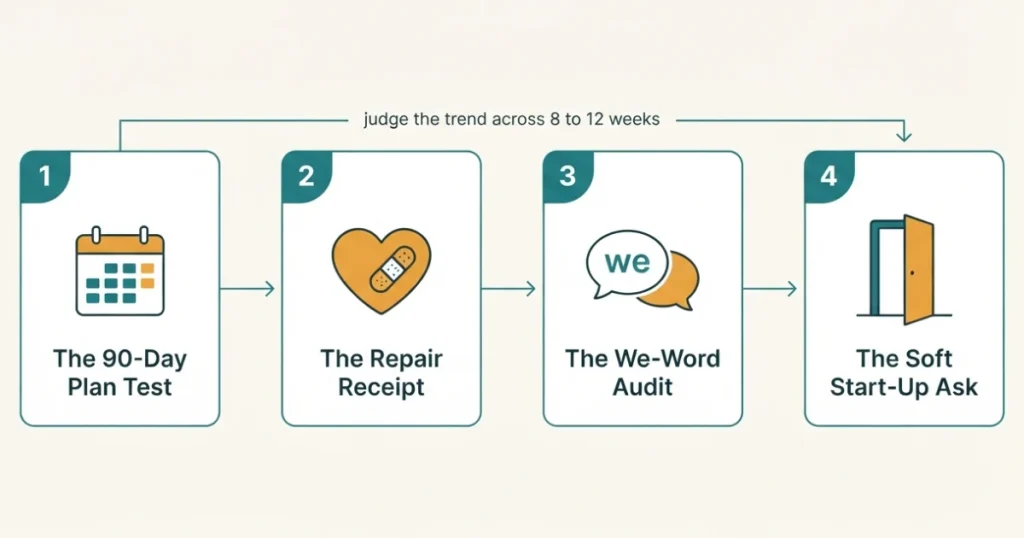
If the question keeping you up is “is he serious about me,” run experiments instead of autopsies. The signs he sees a future with you only count when they survive a mild test, and each of these four applies one.
1. The 90-Day Plan Test. Suggest something eight to twelve weeks out: “There’s a concert in February I’d love to see with you. Want to grab tickets?” A yes, or a no with a counteroffer, is green. Two deflections with no counteroffer are a pattern. Log it and move on.
2. The Repair Receipt. After friction, name one specific change: “When plans shift, a quick text would really help me. Can we do that?” Then watch two weeks. A changed pattern is investment. A repeated apology with no change tells you the apology is the product.
3. The We-Word Audit. For two weeks, note unprompted plural logistics: “when we move,” “our weekend,” “let’s split the drive.” Score spontaneous mentions, and skip date-night performances. If his vocabulary lags but his logistics lead, trust the logistics. Some committed men are simply quiet.
4. The Soft Start-Up Ask. Gottman’s couples research favors gentle openings over harsh ones, so try: “I like where this is going, and I’m looking for something long-term. How do you picture the next year?” Then let the silence sit. If he engages with specifics, however nervously, you have a partner. If asking costs you three days of warmth, you have your answer.
Frequently Asked Questions
Can he love me and still not picture a future together?
Yes. Affection and commitment run on separate tracks, which is why warm men can still avoid a serious relationship. Weight what he builds over what he says he feels.
He says he’s “not ready.” Does he see a future with me anyway?
Maybe. Read what follows the disclaimer: a concrete direction and timeline suggests honesty about pacing, while permanent fog suggests he’s enjoying the benefits of your patience.
How long should I give this before deciding?
Run the four tests across eight to twelve weeks and judge the trend. If every honest question still ends in fog after that, treat the fog itself as the answer.
Back to that 1 a.m. search
The woman typing it wants certainty, and certainty was never on offer. Evidence is. You now know which behaviors cost him something, which ones are theater, and how to test the difference without issuing an ultimatum or losing your dignity.
Run the tests. Keep the log.
Read the evidence, not the adrenaline.
My Closing Remarks
I won’t pretend this is easy. Watching behavior instead of drowning in hope takes practice, and some weeks you’ll reread his texts anyway. Be gentle with yourself while you learn.
Clarity is a skill, and skills grow unevenly. You’re allowed to want a sure thing, and you’re allowed to walk toward one. Your peace was never supposed to hinge on decoding one man.
More Related Stories for You
If the evidence points to no, the next chapter belongs to you: here’s how to feel happy again on your own terms, without waiting on anyone’s timeline.
About The Author