David Wall

Your brain thinks the audience is a lion. Here’s the real reason you blank out, and 5 rules that actually work.
Key Takeaways
- Public speaking anxiety is your amygdala doing its job wrong, not proof that you’re bad at your job.
- A little bit of nervous energy actually makes you sharper on stage, the goal isn’t to feel nothing.
- There’s a specific physical move you can do the second your mind goes blank, and it isn’t “just breathe.”
Quick Answer
Public speaking anxiety happens when your amygdala reads an audience as a physical threat, the same way it would read a bear in the woods. Your body floods with cortisol, your prefrontal cortex goes offline, and your rehearsed words disappear. Around 73% of adults feel it. It responds well to specific protocols, not just breathing tips.
Contents
Table of Contents
You rehearsed the slide deck eleven times. You know the material cold. You could recite it in your sleep.
Then someone says “the floor is yours” and your throat closes up like somebody just grabbed it.
We’ve all had the version of this where we smile and nod through a meeting while quietly planning how to get out of the next one. Maybe you let a junior coworker present the project you actually built. Maybe you called in sick the morning of the big client pitch and told yourself it was a real stomach bug.
Here’s what nobody tells you. This isn’t a confidence problem. Its a wiring problem. Your brain is running an ancient survival program in a conference room, and the program doesn’t know the difference between a hostile tribe and a Tuesday standup meeting.
This article isn’t another “breathe deeply and visualize success” list. That advice assumes you’re calm enough to follow instructions, which defeats the whole point. Instead you’re getting the actual mechanism behind public speaking anxiety, five rules that interrupt the freeze in real time, and an honest line for when it’s time to get real help.
The Numbers Behind Public Speech Anxiety (You Are Not Broken)
Roughly 73% of adults report some level of anxiety over public speaking, a figure that shows up again and again in national fear surveys including Chapman University’s long running research on American fears. That number includes CEOs. It includes people who seem completely fine on a Zoom call five minutes before they present.
Gallup and LinkedIn workplace data both point to presentation anxiety as one of the top reasons capable employees turn down leadership track roles. Not lack of skill. Fear of the room.
Here’s what’s actually happening in your skull. When you face a group of people watching you, your brain processes it as a social-evaluative threat, and that circuitry overlaps heavily with how it would respond to a physical predator. Cortisol floods your system. Your prefrontal cortex, the part responsible for language and logic, gets deprioritized because your body thinks survival matters more than vocabulary right now.
That’s why you can know your material perfectly and still lose it mid sentence. It was never a memory problem.
Knowing the mechanism matters because it means the fix isn’t willpower. It’s protocol.
The 5 Rules That Interrupt Talking in Public Anxiety
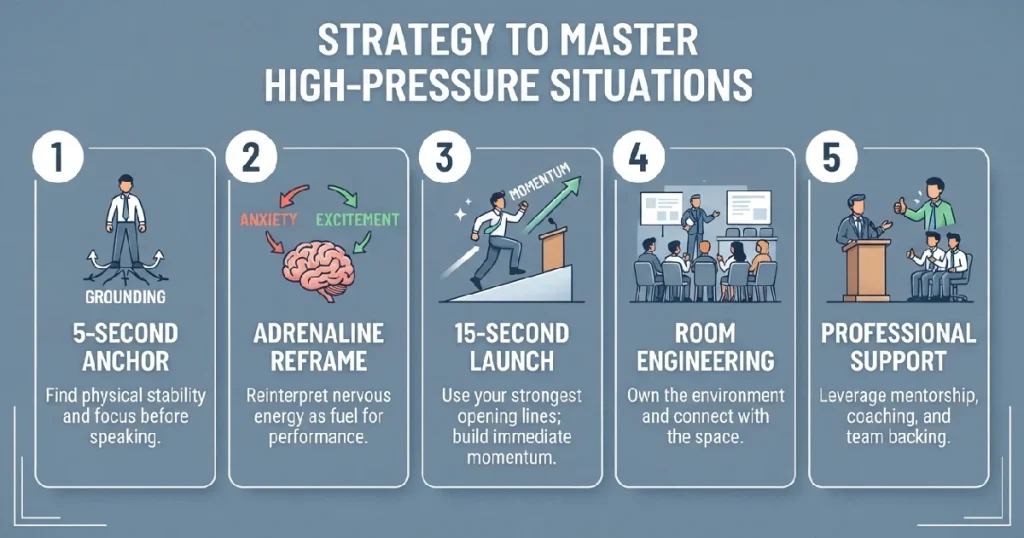
Think of these as rules, not tips. A tip is optional. A rule is something you execute whether you feel ready or not.
Rule 1: The 5-Second Anchor Protocol
When your mind goes blank, do not apologize. Don’t say “sorry, I lost my train of thought.” That sentence tells your nervous system the threat is real and makes it worse.
Instead, plant both feet flat on the floor. Press your thumb into your index finger, hard enough to feel it. Take one slow breath through your nose, four counts in. Then say a bridge phrase you memorized ahead of time.
Try one of these.
- “Let me bring this back to the core point, which is…”
- “The reason I’m pausing here is that this next part is where it gets practical…”
- “So, zooming out for a second, here’s what this means for your team…”
Take Derek, a product manager who used to go silent mid pitch and just stand there sweating. He started practicing the thumb press at his desk before every meeting, not during the panic, before it. By the time he needed it in front of the VP, his hand already knew what to do. The physical anchor interrupts the sympathetic nervous system loop, and the bridge phrase buys your prefrontal cortex the three or four seconds it needs to come back online. Most articles tell you to “pause confidently.” That advice is for someone who isn’t panicking.
Rule 2: Reframe the Adrenaline as Fuel
Don’t try to calm down in the ten minutes before you speak. Research from Alison Wood Brooks at Harvard Business School found that people who reframed their nerves by saying “I am excited” out loud performed better than people who tried to relax. Excitement and anxiety feel almost identical in the body, so the swap is easier than it sounds.
Derek started whispering “I’m excited to walk them through this” in the hallway before client calls, three times, out loud, not just in his head. Saying it engages a different part of the brain than simply thinking it. Moderate arousal, by the Yerkes-Dodson Law, actually sharpens your vocal energy and makes you sound more alive than a speaker who’s working hard to seem calm. If this kind of mental reframe interests you, cognitive reframing exercises for anxiety go deeper into the same idea.
Rule 3: Control the First 15 Seconds
Stop memorizing the whole talk. Memorize the first three sentences, word for word, and nothing else.
Here’s why. Your threat response peaks at the start, not somewhere in the middle. Once you survive the opening, cortisol drops fast.
Derek’s opener for quarterly reviews now sounds like this. “Good morning. In the next eight minutes I’ll walk you through two wins, one bottleneck, and the decision I need from this room. Let’s start with the bottleneck, since that’s where your input matters.” Nothing fancy. Just a launch sequence he can say on autopilot even with shaky hands.
Rule 4: Engineer the Room Before You Enter It
Arrive fifteen minutes early. Stand exactly where you’ll present from. Touch the podium or the table. Look at the three farthest seats in the room.
This turns an unfamiliar space into a familiar one in your hippocampus, which lowers the threat reading before you even open your mouth. For virtual meetings, open the platform ten minutes early, say one sentence out loud to the empty camera, and fix your lighting so there’s no surprise when faces start popping in.
If back to back meetings make early arrival impossible, do a thirty second scan from your seat before standing. Name three objects in the room. It sounds small but it grounds you fast. This pairs well with general workplace stress management before a high stakes meeting, especially for people presenting several times a week.
Rule 5: Know When It’s Time for Therapy for Public Speaking Anxiety
If presentation anxiety has made you decline a role, miss a deadline, or caused chest tightness and vomiting across more than six months of events, self help tools aren’t enough anymore. That’s not a personal failure, that’s just data telling you to escalate.
Cognitive-Behavioral Therapy with graded exposure is the evidence based route. You start by speaking to one trusted person, then small groups, then larger rooms, over roughly 8 to 12 sessions. This kind of structured approach to social anxiety has strong research behind it. A doctor may also discuss a one time dose of propranolol, a beta blocker, for high stakes events. That’s a legitimate medical tool, not cheating.
Getting help for this is the same as hiring a vocal coach. It’s optimization, not confession.
3 Questions People Actually Ask

Why do I talk fine in small groups but freeze at 8 or more people?
Your brain can track individual faces in a group of three, which keeps your logical brain engaged. Past about eight, faces blur into one judging mass and your amygdala treats that as a bigger threat. Pick three anchor faces, left, center, right, and speak only to them.
I’ve rehearsed dozens of times and I still panic, does practice even help?
Practice trains your memory, not your nervous system. Try state dependent rehearsal, do ten jumping jacks then run your talk, so your brain learns to find the words even while your heart rate is up.
Will this anxiety ever fully go away?
For most people the acute freeze fades significantly after 10 to 15 exposures done with intention. A baseline flutter of nerves usually sticks around for life, and that’s fine, that’s what keeps you sharp.
What to Do This Week
You don’t need all five rules perfected before your next meeting. Pick one and drill it on purpose.
The Mirror Drill. Stand in front of a mirror for two minutes a day and practice the thumb press plus one bridge phrase until it feels boring. Boring means it’s becoming automatic.
The Out Loud Rehearsal. Before your next call, say “I am excited” out loud three times in a private spot, even if it feels silly. It’s supposed to feel a little silly at first.
The Early Arrival Walk Through. One place to begin is simply showing up fifteen minutes early to your next presentation and touching the space you’ll stand in. Small, almost nothing, and it works anyway.
You Don’t Owe Anyone a Fearless Performance
You rehearsed eleven times and still froze, remember that from the start of this. Now you know why, and more importantly, you know what to do in that exact four second gap.
The best speakers in any boardroom aren’t the ones who feel nothing. They’re the ones who feel the surge and run the protocol anyway.
You do not need to be fearless. You need to be prepared for the fear. And now you are.
My Closing Remarks
I’ve sat with clients shaking so hard they couldn’t hold their notes, and every single one thought they were the only professional in the building who felt that way. You’re not broken and you’re not behind. You’re running a very old alarm system in a very modern room. Pick one rule from this list and use it this week, that’s enough for now.
More Related Stories for You
If you’re a student dealing with this before class presentations, our guide on public speaking tips for students breaks it down for a younger audience facing the exact same freez
About The Author