David Wall

Your nervousness isn’t broken. It just has five different stages, and nobody ever showed you the map.
Key Takeaways
- Being nervous about speaking in public isn’t one feeling. Its five separate stages, and each one needs a different fix, not the same breathing trick on repeat.
- The shaky voice you hear in your own head is a lot louder than what the room actually hears. Your brain exaggerates it by a wide margin.
- The worst part usually isn’t the talk itself. It’s the two nights before and the hour after, and almost nobody addresses either one.
Quick Answer
Being nervous about speaking in public actually moves through five stages. First comes the dread before the event. Then a sharp adrenaline spike right before you start. Then the shaky first minute. Then a foggy middle stretch. Then the replay afterward. Each stage needs a different fix, not one breathing trick.
Contents
Table of Contents
It’s Tuesday night. Your talk is Thursday morning. You’re lying in bed running the opening line for maybe the tenth time and your chest feels tight for no reason you can name.
We’ve all had that specific kind of awake. Your body acts like something bad is already happening even though nothing has happened yet.
Here’s the thing nobody tells you. Being nervous about speaking in public isn’t one long feeling that starts Tuesday and ends when you sit back down. It’s five separate things stacked one after another, and each one feels different in your body.
The dread on Tuesday night is not the same chemical as the shake in your hands at 9:55am Thursday. And that shake is not the same as the foggy feeling at minute five, when you suddenly think “wait, am I even making sense right now.”
Most advice treats all of that like one problem. Breathe deep. Visualize success. Drink some water. That might help a little in one stage and do nothing at all in the other four.
You probably already tried the breathing thing. It didn’t touch the stone sitting on your chest Tuesday night.
That’s because it was never built for that stage. It was built for a different one entirely.
This piece breaks the whole thing down by the clock, not by vibes. What to do two days out. What to do ten minutes out. What to do the first sixty seconds. What to do when your brain goes quiet in the middle. What to do on the drive home when it wants to replay one “um” for the next six hours.
Why Your Nervousness Keeps Changing Shape
Your nervous system doesn’t send one signal called “nervous.” It sends a sequence.
Forty eight hours out, your prefrontal cortex is running mental rehearsals of everything that could go wrong. Ten minutes out, your sympathetic nervous system floods your body with adrenaline and cortisol. That’s a physical event, not a mood. You can read more about how the physiology of the stress response and the body’s arousal timeline actually works, and it’s worth understanding, because it explains why willpower alone never fixes any of this.
Take Daniel. He’s a project manager in Leeds who runs weekly stand ups. He told his manager he “just needs to get over it.” He doesn’t. He needs five different tools for five different moments, and nobody ever handed him the list.
Here’s the part almost no one mentions. Most speakers report their worst nervousness happens before the talk and after it, not during. The actual speaking is often the calmest part of the whole experience. That alone should take some pressure off.
The Nervousness Arc Protocol
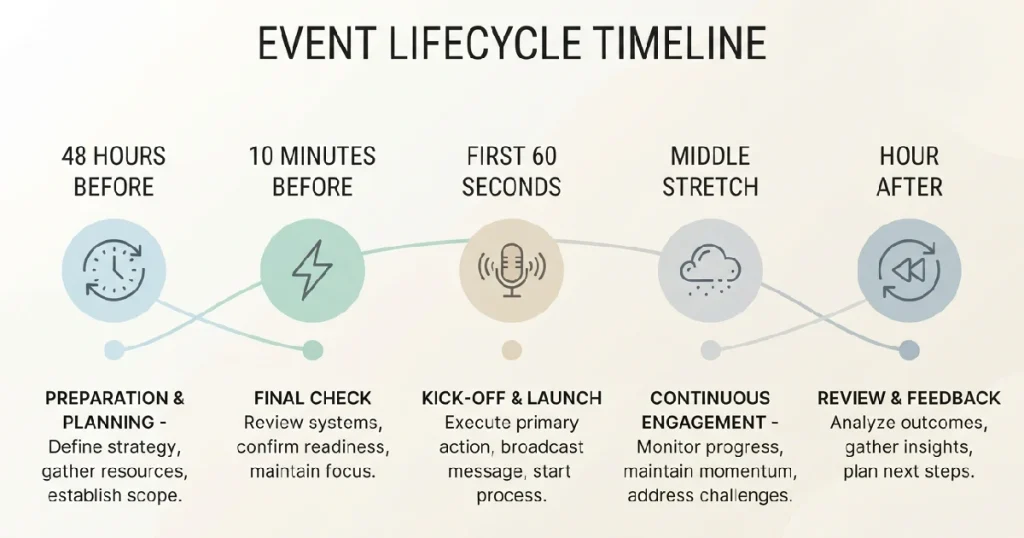
Five stages. Five fixes. Using the wrong tool in the wrong stage is the entire reason generic advice keeps failing you.
Phase 1: The Two Day Countdown
Feeling nervous before a presentation hits hardest at night, because there’s nothing external to interrupt the loop in your head. Your brain keeps running the same fictional rehearsal over and over.
Maria preps for client pitches two full days in advance and still loses sleep every single time. Her fix wasn’t more prep. It was a container.
Set a timer for ten minutes the night before. Write down every specific worry, the transition you might fumble, the question you can’t answer. When the timer ends, close the notebook. No rehearsing after 9pm. That’s not preparation anymore, that’s anxiety wearing a disguise.
If the dread is sticking around for days at a time and feels bigger than the event deserves, the Mental Health Foundation has solid, non clinical resources worth a look.
Phase 2: The Ten Minutes Before
This stage is chemical, not psychological. Adrenaline is already in your muscles. Breathing alone is too slow here.
Jake, a newly promoted team lead, used to hide in the bathroom shaking before stand ups. Now he does ten slow squats or pushes his palms against the wall for ten seconds, three times through. Then he shakes both hands like he’s flicking off water. That discharges the adrenaline instead of trapping it.
Then, and only then, four rounds of inhale four, hold four, exhale six. For a fuller rule based system covering every stage of the actual presentation, how to manage the physical symptoms of anxiety in real time during a presentation goes deeper.
Phase 3: The First Sixty Seconds
Nervous while speaking in those opening seconds feels catastrophic, but it peaks and fades in under ninety seconds.
Priya memorizes exactly one sentence, not a paragraph. She says it, pauses two full seconds, then continues at about seventy percent of her normal pace. The pause isn’t failure, it’s the mechanism that lets her system downshift.
Here’s the part that matters most. The tremor you hear in your own voice sounds three or four times louder to you than it does to anyone listening.
Phase 4: The Middle Stretch
Around minute four or five, a second wave arrives. Not panic this time, more like fog. Tom describes it as “watching myself from outside the room.”
That’s a cortisol plateau, not a sign he’s losing the audience. His fix is a scripted checkpoint line: “so let me bring that together, the key point is X, and here’s why it matters.” It buys him five seconds and resets his footing. Pressing his thumb into his finger for three seconds does the rest.
Phase 5: The Hour After
Sarah drives home replaying one stumble for the entire commute while ignoring the eighteen minutes that went fine.
That’s your default mode network running an audit biased toward the negative. Her fix is the 3-1 Rule: three things that went adequately, not perfectly, and one thing to adjust. Then the notebook closes and stays closed for 24 hours. No asking coworkers how it went.
What To Do Next

One place to begin is The Worry Window. Pick a fixed time the night before, set ten minutes on a timer, write every fear down by name, then stop. The brain stops simulating a threat once it believes the threat has been logged somewhere.
Another is The 90 Second Discharge. Ten minutes before you speak, find a private spot and move your body hard for under two minutes, squats, wall pushes, a hard hand shake. Adrenaline needs somewhere to go before breathing will do anything useful.
Consider testing The 3-1 Rule right after you finish. Three adequate things, one adjustment, notebook closed. This single habit is often the difference between next week’s talk feeling lighter or heavier than this one.
Frequently Asked Questions
Is it normal to feel nervous before a presentation starting two full days out?
Yes, and it’s actually the most commonly reported stage. Anticipation often produces more sustained distress than the event itself, because your brain treats the threat as unresolved until it’s logged somewhere, which is exactly what the Worry Window is for.
Why does my voice go up an octave when I’m nervous while presenting?
Adrenaline tightens your laryngeal muscles, raising vocal pitch, which is mechanical rather than emotional. Humming one low note for three seconds beforehand resets your baseline, and the audience hears it as far more normal than it feels to you.
I keep watching talks about nervous public speaking and nothing changes, why?
Watching activates understanding, not rehearsal, and your nervous system only recalibrates through repetition under mild real exposure. One spoken sentence in an actual meeting does more than ten hours of passive content.
You Already Have The Map
The stone on your chest Tuesday night isn’t permanent. It has a timeline, and now you know the five stops on it.
You’ll be nervous about speaking in public again next time, and probably the time after. But it’ll be shorter, because you’re finally meeting each stage with the tool it actually needs instead of fighting all five with the same one.
That’s not confidence. That’s logistics, and logistics beats willpower every time.
My Closing Remarks
I’ve sat across from clients who could recite their whole deck in their sleep and still shook in the bathroom beforehand. None of them were broken. They just never had the stages named for them.
Once you can point to a feeling and say “oh, that’s the plateau, it passes,” something loosens. Not all at once. Just enough to get through Thursday a little steadier than Tuesday.
More Related Stories For You
If this resonated, our full breakdown on managing public speaking anxiety from the inside out covers the broader toolkit for every moment you’re in front of a room.
About The Author