
 Sara Carmen
The honest, research-backed playbook for the first 12 months that determines whether your marriage lasts 12 years.
Key Points:
- Marriage Advice for Newlyweds: The first year sets the default communication patterns for decades. What you tolerate now becomes the marriage you live in later.
- Most newlywed conflicts (about 69%) are perpetual, not solvable. The goal is management, not victory.
- The “50% divorce” stat is outdated. Couples marrying today in their late 20s to early 30s have better odds than any generation in 50 years.
Contents
Table of Contents
You said your vows. You danced. You probably posted a few reels of the cake. And then you went home, closed the door, and discovered that marriage is not what the wedding was.
That first year, the one that starts with the honeymoon and ends right around the time the lease on the rental car expires, is the most disorienting stretch of a marriage. Nobody warns you about it because the people who survived it forgot how raw it felt, and the people who didn’t aren’t writing blog posts.
I’ve spent years working with couples in this exact window. The ones who thrive are not the ones with the most chemistry. They are the ones who treat marriage as a skill set they are willing to learn on the job. The ones who struggle are almost always the ones who believe love should be enough, and then feel personally betrayed when it isn’t.
Here is the honest version. The things nobody tells you at the reception. The patterns that quietly decide whether year fifteen feels like a gift or a prison.
The Myth That Is Already Working Against You
Let’s start by clearing the air, because this myth is the first thing quietly damaging your confidence as a married couple.
Myth: “Half of all marriages end in divorce.”
That number is from the 1980s. It is repeated so often it has become folk wisdom, and it is wrong.
According to current U.S. divorce statistics from the CDC’s National Center for Health Statistics, the divorce rate for first marriages has dropped to roughly 41%, and for couples who marry in their late twenties to early thirties, the rate is meaningfully lower. Researchers have attributed part of this decline to what’s known as the divorce decline phenomenon, a steady, decades-long drop in divorce rates since the early 2000s.
Reality: The odds are actually in your favor, and the timing of your marriage works in your favor too.
The median age at first marriage is now 30.8 for men and 28.8 for women, the highest in recorded history. Older newlyweds bring more emotional regulation, more financial stability, and clearer sense of self into the union. All three are protective.
The implication for you: Stop walking into your marriage like you’re walking into a coin flip. You’re walking into a skill. And skills are learnable.
What Actually Kills Marriages (It Is Not Arguing)
Every couple argues. Argue with me about this. Argue with your spouse. The research is unambiguous. Conflict itself is not the predictor of divorce. The way you fight is.
Dr. John Gottman, a psychologist who has studied over 3,000 couples at the University of Washington, can predict whether a couple will divorce with over 90% accuracy, not by what they fight about, but by identifying four specific communication patterns. He calls them the Four Horsemen of the marital apocalypse: criticism, contempt, defensiveness, and stonewalling.
Criticism is attacking your partner’s character. (“You are so selfish.”) Contempt is treating them with disgust or superiority, eye rolls, sarcasm, mockery. (This is the deadliest one.) Defensiveness is playing the victim to dodge accountability. Stonewalling is shutting down, going silent, physically leaving.
The one that quietly poisons newlywed marriages faster than any other is contempt. Because contempt doesn’t just say “I disagree with you.” It says “I am better than you.” And once that sneaks into the vocabulary, the marriage has shifted from partnership to hierarchy.
The antidote for year one: When you catch yourself being contemptuous, stop. Name what you actually need underneath the contempt. Most of the time, contempt is hurt dressed up in a costume.
The Money Conversation You Keep Avoiding (And Why It Is Killing Your Sex Life)
If the topic of money makes your stomach tighten, you are in the majority. Financial stress is one of the top stressors on newlywed life, and it has a side effect nobody talks about at brunch.
Research consistently finds that financial conflict erodes sexual satisfaction. The mechanism is straightforward. Money fights trigger the body’s threat response. Your nervous system stays activated. You cannot be simultaneously defending yourself against perceived scarcity and feeling safe enough to be vulnerable, intimate, or aroused. Money fights bleed directly into the bedroom, not because the bedroom is broken, but because your body is still in fight-or-flight from the last argument about the electric bill.
The three-step money framework that works:
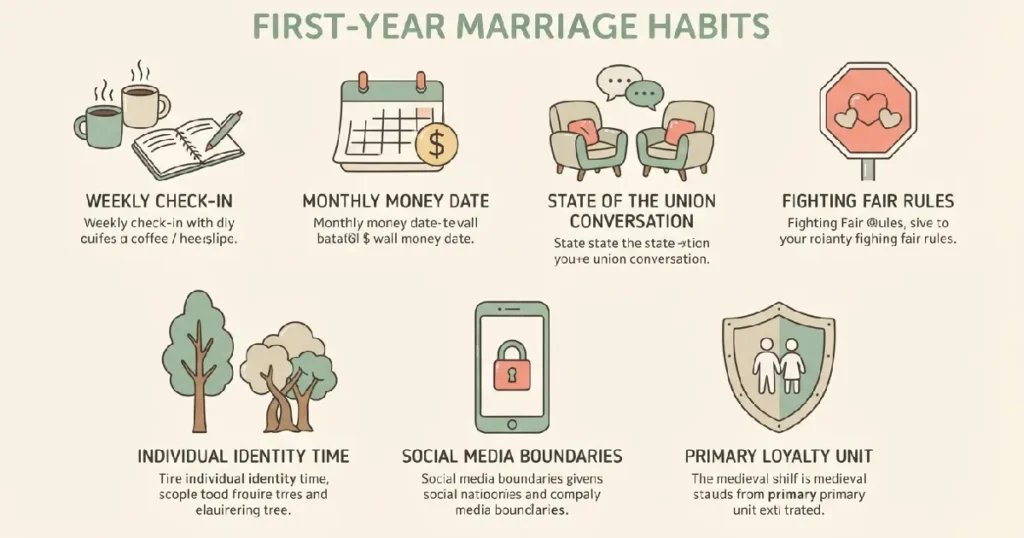
- Schedule a weekly 30-minute “money date.” Not a fight. A standing appointment. Coffee, a shared spreadsheet, a clear agenda. No surprises.
- Name your “money story.” Each of you inherited beliefs about money from your family. Most financial fights are really about loyalty to a childhood story, not the actual numbers.
- Decide together what “ours,” “yours,” and “shared” means. A common setup: a shared account for joint expenses, plus individual accounts that preserve autonomy. There is no single right answer, but there is a wrong one: pretending you’ll figure it out.
According to a study published in the journal Family Relations, couples who report higher financial communication also report higher relationship and sexual satisfaction. Money is not just about money. Money is about feeling like a team.
69% of Your Arguments Will Never Be “Solved”
Read that again. Read it one more time.
Gottman’s research found that approximately 69% of marital conflicts are perpetual. They are not solvable. They are differences in personality, values, or background that will reappear in slightly different clothing for the entire length of the marriage.
The couple who fights about whether the dishes should be done the same day or the next day is not arguing about dishes. They are arguing about order, fairness, and what “respect” looks like, and they will be arguing about some version of that for forty years.
The goal is not to solve the unresolvable. The goal is to learn the topography of your partner’s recurring complaints, and to navigate them without flooding. Flooding is what Gottman calls the physiological state of being emotionally overwhelmed during conflict: heart racing, hearing nothing, defending everything.
Three rules for fighting fair in year one:
- No character attacks. Disagree with the behavior. Never attack the person.
- Call a time-out with a return time. “I need 20 minutes. I will come back at 7:40.” Then come back. Unreturned time-outs are just silent stonewalling with a fancier label.
- Use repair attempts. A repair is any statement or gesture that prevents conflict from escalating. “I’m sorry, that came out wrong.” “We’re on the same team.” A repair attempt is a marriage’s version of a fire extinguisher. Have several. Use them early.
What you say in year one stays. Conflict residue, the emotional memory left behind after fights, accumulates. Couples who learn to fight gently now will have decades of goodwill stored up for the harder seasons ahead.
Social Media Is Quietly Comparing Your Marriage to a Lie

You know the couples. The ones whose grid looks like a Hallmark card. Anniversary trips. Matching outfits. Captioned love notes.
Here is what the data says: about 91% of couples feel inspired by social media, but nearly 48% admit to struggling with the gap between picture-perfect online ideals and their real-life budget. That’s a recipe for silent resentment.
The dopamine trap is real. Posting your marriage for external validation can create a feedback loop where the performance of intimacy starts to feel more rewarding than the intimacy itself. Couples who curate their marriage publicly often report feeling privately hollow. The marriage becomes content.
Healthy boundaries in year one:
- Agree on what is “ours” and what is private. Some couples keep their marriage off social media entirely. Others curate carefully. The point is the conversation.
- Notice the comparison reflex. When you scroll past an anniversary trip you can’t afford and feel a stab of “we’re failing,” that is the algorithm working, not reality.
- Protect your marriage from strangers. The most intimate details of your relationship do not need a comment section.
You Are Still Two People, and That Is a Good Thing
The most damaging wedding-era myth is the “two become one” idea. It sounds poetic. It is psychologically catastrophic.
A marriage made of two whole people is stronger than a marriage made of two half-people trying to fuse into a single whole. In the newlywed period especially, many couples drift into a black hole of couple-only isolation. They stop seeing friends. They abandon hobbies. They merge their identities so completely that neither person can remember who they were on their own.
This is where resentment breeds quietly. Resentment is what happens when unmet needs accumulate in silence.
The healthier frame: Build a marriage with three time zones.
- We-time. Shared rituals, shared meals, shared experiences. Non-negotiable.
- Me-time. Solo hobbies, solo friendships, solo purpose. Non-negotiable.
- We-and-the-world time. Friends, family, community, the larger life you are building together. Non-negotiable.
A marriage is not a closed system. It is an ecosystem. The healthiest marriages are made of two people with strong roots who choose to grow in the same direction, not two vines strangling each other for the same trellis.
Proactive Versus Reactive: The Couples Who Last Know the Difference

Here is the part that will feel counterintuitive.
Crisis couples counseling often does not work. One large survey found that 67% of respondents who had tried couples therapy reported no meaningful improvement in their marriage. That sounds discouraging, until you understand why.
Late-stage therapy is like showing up to the ER with stage-four symptoms. The damage is structural. Premarital counseling, by contrast, reduces divorce risk by roughly 30%. Early intervention works because the patterns have not yet hardened.
The lesson is not that therapy is useless. The lesson is that prevention beats rescue, every time.
Build these habits in month one, not year three:
- A 15-minute weekly check-in. Not a debrief. A pulse. “How are we? What do you need? What do I need?”
- A monthly “state of the union” conversation. Once a month, 45 minutes, no kids, no phones, agenda-light. What’s working? What’s stuck? What do we want to build next?
- An annual goals conversation. Once a year, treat your marriage like a project worth a real review.
Couples who treat their relationship like something they actively maintain, not something they set up once and hope survives, are the ones still holding hands at the airport in their seventies.
The In-Law Reality Check
This one needs fewer words and more spine.
Putting family approval above your partner’s needs is one of the most common early-marriage mistakes. It is also one of the most corrosive. The moment a parent, sibling, or in-law realizes that they have more pull with you than your spouse does, the foundation of the marriage begins to crack, slowly at first, then all at once.
The action step: Have one direct, kind, early conversation with your spouse about your primary loyalty unit. Make it explicit. “It’s us now.” That is not betrayal of your family of origin. It is the basic architecture of a healthy marriage.
My Closing Remarks
I have sat across from couples on the edge of divorce, and I have sat across from couples on the edge of their first home purchase. Often, the difference between those two tables is not love. It is what they did in year one. The hard truth is that the first year of marriage is not a honeymoon. It is a construction site. The romance is not the foundation. The skills you build, the fights you fight well, the boundaries you set, those are the foundation. Treat year one like training, not performance. Your future self will thank you, repeatedly, for the rest of your life.
My Closing Reflections
Here is what I will say to you, directly, the way I would say it over coffee. Marriage is not supposed to be effortless. The first year is hard because it is real. The people who stay married are not the ones who never struggled. They are the ones who decided that the struggle was worth it, and who got smart about it early. Do not wait until the cracks are deep. Start the repair now, while the walls are still easy to fix. You have more power than you think. Use it this week. Not someday. This week.
More related stories for you:
For a deeper look at how personality patterns shape relationship dynamics, read The Life Post’s guide to narcissistic personality traits and what they reveal about power, control, and emotional safety in partnerships.
About The Author