David Wall

You can know a height is safe and still feel terrified. Here’s how to work with that fear instead of letting it control your life.
Key Takeaways
- Learning how to get over acrophobia starts with naming your exact sub-type: falling, jumping-intrusion, or trapped-at-height.
- The Cognitive Descent Protocol gives you four specific moves (Map, Name, Disrupt, Expose) instead of vague advice to “just relax” near a railing.
- Whether you search how to get over height phobia or acrophobia specifically, this piece covers construction workers, intrusive thoughts, and the honest truth about hypnosis.
Quick Answer: To get over acrophobia, start by identifying your dominant fear sub-type: falling, jumping-intrusion, or trapped-at-height. From there, follow a graduated cognitive-behavioural sequence: map your avoidance patterns, disrupt the specific thought loop, then complete controlled real-world exposures matched to your sub-type, usually across 6 to 8 structured sessions.
Contents
Table of Contents
Tom climbs to the second level of the scaffold and stops. His hand locks onto the rail. His vision narrows at the edges like someone dimmed the lights in a tunnel. He tells his site manager his knee is acting up again. That’s the fourth time this month he’s used that excuse.
We’ve all heard someone say “just don’t look down” like it fixes anything.
If you’re reading this you already know that line doesn’t help. You’ve heard it from a partner who thinks you’re being dramatic, or a boss who thinks you’re being difficult, or your own head at 2am wondering what’s actually wrong with you.
Here’s the binary running in Tom’s head every time he’s on that scaffold. If he goes up another level his jaw locks and he freezes. If he doesn’t go up he loses the contract. Either way he loses something.
Acrophobia isn’t a personality flaw and it isn’t a lack of willpower. It’s a DSM-5 recognized specific phobia with measurable physical markers: racing heart, vestibular disruption, a feeling of detaching from your own body. This piece isn’t ten breathing tips. It’s a treatment sequence for people whose fear crossed a clinical line a long time ago.
What 5% of Adults Share: The Clinical Reality of Acrophobia
Specific phobias affect roughly 12.5% of adults in the U.S. at some point in their life according to the National Institute of Mental Health. Acrophobia alone makes up an estimated 5 to 6% of that figure, making it one of the most common specific phobias on record.
Here’s a self check you can run right now. Your fear counts as clinical acrophobia if it has lasted more than six months. If it makes you avoid specific work tasks or events. If your body reacts with a real panic response within about ten seconds of exposure. If that’s you, structured treatment works. This was never a willpower problem.
This is also exactly why “just face it” backfires. Clinicians call unstructured forced exposure “flooding.” It tends to reinforce the panic response rather than resolve it, because the amygdala encodes the terror, not the survival.
Acrophobia also isn’t one single fear. It splits into three patterns: fear of falling, fear of losing control and jumping, and fear of being stuck at height with no way down. Which one is yours changes your whole treatment path.
The Cognitive Descent Protocol: 4 Steps To Get Over Acrophobia
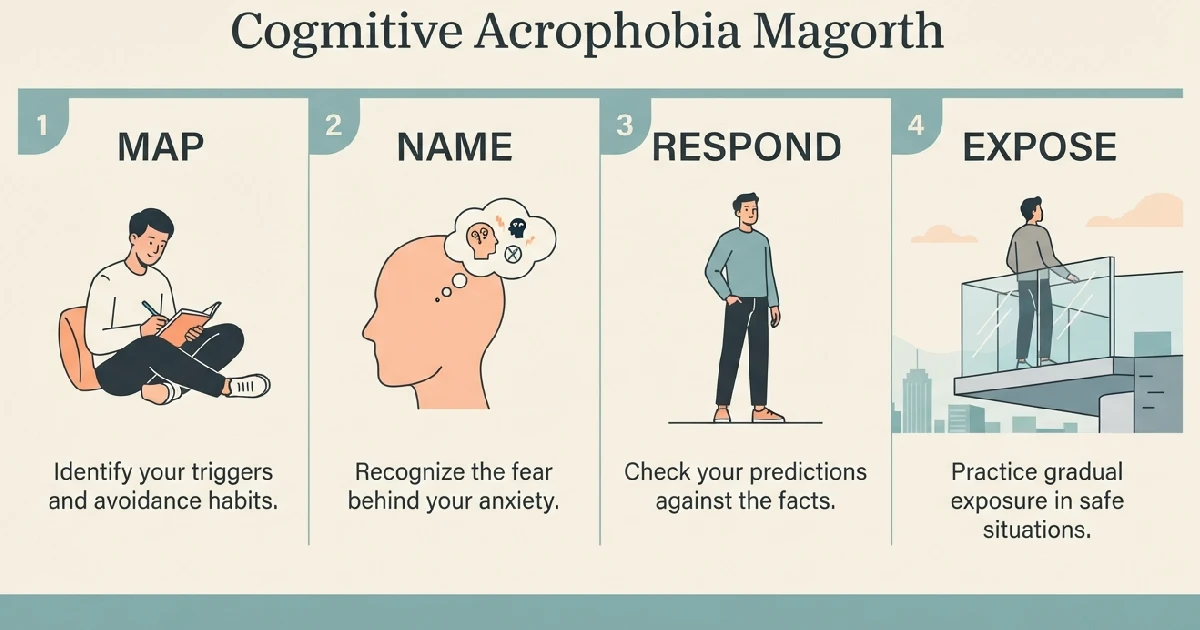
This protocol starts at the top, with the thought running the show, instead of starting with your body the way most grounding exercises do.
Step 1: Map Your Avoidance Architecture
For seven days keep a log. Every time you take the long route to dodge a footbridge, or volunteer for ground floor work, or say “you go on the ride, I’ll hold the bags,” write it down. Note the trigger, the body sensation, the thought that fired, and what you did to escape it.
Marcus, an electrician in Ohio, realized through his log that he’d avoided attic jobs for three years without telling his boss why. He assumed it was a one off thing. The log showed it happened eleven times in a single week.
Step 2: Name And Disrupt The Thought Loop
If you’re falling dominant, the thought is usually “I’m going to lose my balance.” Fight it with sensory fact checking. Press your feet flat. Put a hand on something solid. Say out loud “my feet are on concrete, my hand is on steel, I am supported.” That’s proprioceptive evidence beating a false prediction, not positive thinking.
If your fear is the jumping urge, you’re searching for how to get over fear of jumping from heights without feeling like a dangerous person. The move here is different. You label the thought instead of arguing with it. “I’m having the thought that I might jump. That’s a thought, not an instruction.” Research on the high-place phenomenon, l’appel du vide in French, suggests close to half of people with zero suicidal history report this exact sensation.
If you’re trapped dominant, the fix is exit mapping. Before you go up, find two ways down and look at them. That single habit cuts a surprising amount of the cornered feeling.
Step 3: How To Get Over Fear Of Heights In Construction
If height is part of your job you don’t need to cure the phobia before returning to work. You need a phased plan. Try a line like this with your supervisor: “I’m working through a balance and confidence issue with occupational health. I need two weeks of ground and first level tasks before moving back up. I’ll flag when I’m ready.”
Tom, the roofer from earlier, used almost that exact line and kept his pension track while he worked the protocol over six weeks.
Step 4: Graded Exposure Until You’re Bored
Visualize the exact scenario first, narrating the facts out loud at home for five minutes. Then do the real thing. You’re not aiming for fearlessness, you’re aiming for boredom, the point where standing on that balcony feels about as exciting as standing in your kitchen. Most people need five to eight reps per level.
For readers who need how to get over fear of heights quickly, the American Psychological Association’s guidance on exposure based treatment points to intensive condensed formats, like one three hour session a day for five days, producing results close to an eight week weekly program. That’s the honest answer. It takes professional intensity, not a weekend hack.
Three Questions People Search At 2am But Never Say Out Loud

I get the urge to jump at a height. How do I get over fear of jumping from heights without thinking I’m suicidal?
You’re not. This is the high place phenomenon. Research published in the Journal of Affective Disorders found a large share of people with no suicidal history report it. Your brain ran a worst case simulation and mislabeled it as an impulse. Use the labeling script from Step 2, and if the thoughts persist or feel foreign to who you are, tell your doctor specifically that you’re having “intrusive thoughts at heights.”
How To Get Over Fear Of Heights Hypnosis: does it actually work?
Partly, and only as a sidekick. Hypnosis can lower anticipatory anxiety and make you more willing to do exposure work, but it doesn’t rewrite the fear association by itself. Skip anyone selling a one session miracle cure. Look for someone registered with the British Society of Clinical Hypnosis or the American Society of Clinical Hypnosis, and only use it alongside real exposure work.
I have scaffolding work in ten days. How do I get over fear of heights quickly without cutting corners?
Combine daily visualization, short grounding drills at low elevation, and one session with a therapist who runs intensive phobia work. Skip alcohol. Skip “surprise yourself” exposure. Your goal for day ten isn’t zero fear, it’s doing the job at 30% discomfort instead of 95%. That’s a real clinical win.
What To Do Tonight
The Avoidance Log Opener. Open your notes app right now. Type today’s date. Write the word “log.” That’s step one. Tomorrow add the first entry: what you avoided, and what you told yourself about why.
The Defusion Card. Write this on an index card or in your phone: “I’m having the thought that I might jump. That’s a thought, not an instruction.” Keep it somewhere you’ll see it before your next height exposure. Say it out loud the next time the thought fires instead of pushing it away.
The Exit Map Habit. Before you go up anywhere, even a parking garage ramp, spend ten seconds finding two ways back down. Point at them if it helps. This one habit handles a surprising amount of the trapped feeling on its own.
One place to begin, if none of this feels doable alone, is a short call with a CBT therapist who specifically lists phobia work or intensive exposure programs. Consider testing the log for three days before deciding whether you need more support. You’re not committing to six months on day one. You’re committing to tonight.
You’re Not Broken, You’re Miscalibrated
Tom still climbs scaffolds. He just doesn’t lie about his knee anymore. He told his site manager the truth, ran the protocol, and kept both his pension track and his sense of himself as someone who doesn’t fold under pressure.
How to get over acrophobia was never really a courage question. It’s a calibration question. Your threat system has the volume knob stuck at nine. This protocol is the hand that turns it back down to three.
You don’t need to be brave tonight. You need to be systematic.
My Closing Remarks
I’ve sat across from roofers who thought they were cowards and parents who thought they were dangerous, and neither one was true. Acrophobia lies about what kind of person you are. It never tells you the truth, which is simply that a signal got stuck too loud. You don’t have to fix it alone tonight, but you can start the log before you sleep.
More Related Stories For You
If your fear of heights feels more like everyday discomfort than a diagnosis, read How to Get Over Fear of Heights: 7 Key Secrets for the body first grounding approach.
About The Author