
 Elena Garcia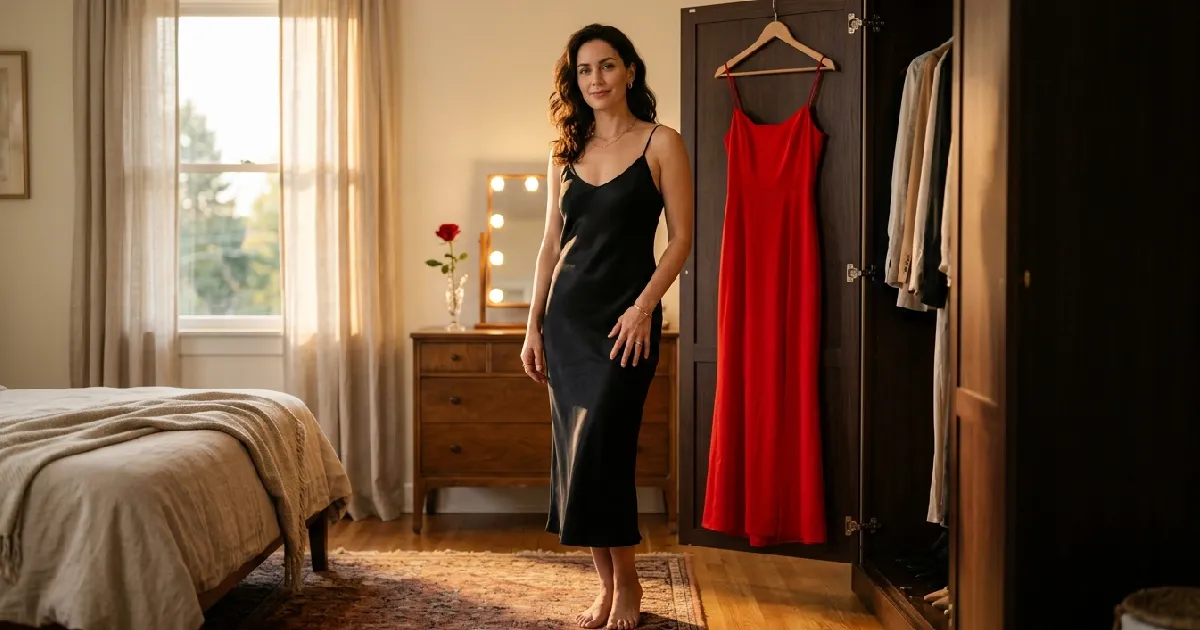
The color you reach for when the world demands red says more about your emotional wisdom than your relationship status.
Key Points
- Do You Wear Black on Valentine’s Day because it feels like armor, and research shows that choice is more powerful than you think.
- The pressure to wear red or pink on February 14 is a social script, not a moral obligation.
- Black clothing activates confidence and self-protection through a real psychological mechanism called enclothed cognition.
Contents
Table of Contents
The Hook
You are standing in front of your closet on the morning of February 14. The red dress hangs there like a dare. It screams romance. It whispers expectations. You reach past it and pull out your black blouse, your black trousers, your favorite black dress. The moment your hand touches the fabric, your shoulders drop. You can breathe again.
But then the voice creeps in. Are you sending the wrong message? Are you being a downer? Are you secretly heartbroken, and will everyone know?
You are not alone in this moment. Millions of people face the same quiet battle every Valentine’s Day. The world has painted a very specific picture of what love looks like on this day, and that picture is drenched in red, pink, and glitter. But your instinct to wear black is not a flaw. It is not a cry for help. It is a signal, and it deserves to be understood.
Context & Problem Definition
Valentine’s Day has become something far more complicated than a celebration of love. According to research published in Psychology Today, the holiday functions as a temporal landmark. That means it acts like a checkpoint in the calendar where people evaluate their relationships, compare their lives to others, and feel intense pressure to perform romance. The article notes that this evaluative quality can make the day feel less like a celebration and more like a relationship performance review. Nothing drains romance faster than the pressure to perform it.
This pressure does not stay confined to gifts and dinner reservations. It bleeds into everything, including what you wear. Social media has turned private affection into public theater. Research from Montclair State University found that terms like “shop” and “gift” appeared over 130% more frequently than the word “love” in Valentine’s Day social media posts. The holiday has been commercialized to the point where your outfit becomes part of the product you are expected to display.
When the culture demands visible proof of romance, your clothing becomes a costume. And costumes are exhausting.
The expectation to wear specific colors on Valentine’s Day creates a unique form of outfit anxiety. You are not just choosing what looks good. You are choosing what proves something. That pressure is especially sharp for people who already struggle with social anxiety or who feel their relationship status is under scrutiny. The clothing becomes evidence in a trial you never agreed to attend.
The problem runs deeper than fashion. A study from the National Center for Biotechnology Information examined how Valentine’s Day affects people with anxiety, depression, and borderline personality features. Researchers found that people without dates often forecasted more negative emotions for the day than they actually experienced. The dread of the day was worse than the day itself. Much of that dread came from anticipating judgment, from imagining that others would evaluate their relationship status, their plans, and yes, their outfit.
Your closet on Valentine’s Day is like a stage door. Everyone expects you to step out in costume. Black is choosing to step out as yourself.
The Core Content Myth vs. Reality

Myth: Black on Valentine’s Day Means You Are Sad, Angry, or Anti-Love
Most people assume that wearing black on a day dedicated to love must mean something is wrong. You must be mourning a breakup. You must be rebelling against the holiday. You must be trying to make a statement.
Here is the reality. In color psychology, black is not simply the absence of color. It is the absorption of all colors, and with that absorption comes a complex set of associations. Black is linked to power, elegance, sophistication, and authority. It is the color of the little black dress, the tuxedo, the judge’s robe. People who wear black are often perceived as more intelligent, more attractive, and more confident than those wearing other colors.
Research on enclothed cognition, a term coined by psychologists Hajo Adam and Adam Galinsky, reveals that what you wear literally changes how you think and feel. In their landmark study, participants who wore a lab coat identified as a doctor’s coat showed significantly better attention and focus than those who wore the same coat described as a painter’s smock. The symbolic meaning of the clothing altered the wearer’s psychological state. When you put on black, you are not declaring war on love. You are likely activating feelings of control, protection, and self-assurance.
That is not anti-love. That is pro-you.
Myth: You Owe the World a Performance of Romance Through Your Outfit
There is an unspoken rule on Valentine’s Day. You are supposed to look soft. You are supposed to look accessible. You are supposed to look like you stepped out of a greeting card. If you do not, people might ask what is wrong.
But here is what no one tells you. The expectation to perform romance through your appearance is a social script, not a moral law. Social scripts are the invisible rules that tell us how to behave in certain situations. They are useful sometimes. They help societies function. But they become harmful when they override your own comfort and authenticity.
When you wear red or pink because you feel you should, you are not expressing yourself. You are complying. And compliance on a day that is supposed to be about love creates a strange disconnect. You are performing affection while potentially feeling resentment, anxiety, or invisibility.
A study on clothing and self-expression found that women who used fashion as a tool for individuality rather than camouflage reported higher body confidence and greater extroversion. The research showed that when people choose clothes that reflect who they are rather than who they think they should be, they experience a measurable boost in self-assurance. Your Valentine’s Day outfit should not be a mask. It should be a mirror.
Myth: Red Is the Only Correct Color for Attraction
Red gets all the credit on Valentine’s Day. The red dress effect is real. Studies have shown that men and women wearing red are perceived as more attractive and sexually desirable. Red increases heart rate and signals passion. It makes sense that the holiday has claimed it.
But black holds its own power. A survey cited in color psychology research found that black came first or second in almost every positive trait measured, including confidence, intelligence, and sexiness. Nearly half of women and 64% of men agreed that black exudes self-sufficiency. Black does not scream for attention. It commands it quietly.
Think about it this way. Red asks for validation. Black does not need it.
If you are building a Valentine’s Day outfit around what will make you feel most like yourself, black deserves a place at the table. It is not a consolation prize. It is a legitimate style choice with deep psychological roots.
Maya’s Black Dress
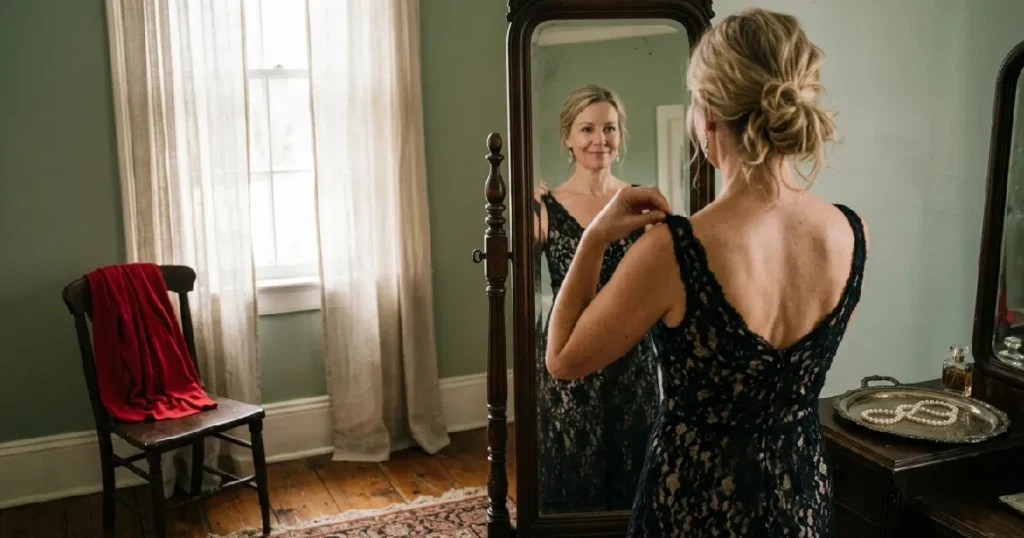
Maya, a 34-year-old marketing director, used to force herself into red every February 14. She bought the dresses. She wore the lipstick. She played the part. And every year, she felt like she was watching herself from outside her own body.
Three years ago, she stopped. She wore a simple black slip dress to dinner with her partner. No red. No pink. No hearts. She remembers looking in the bathroom mirror and feeling something she had not felt in years on that holiday. She felt present. She felt like herself.
Her partner noticed too. “You seem more relaxed tonight,” he said. She was. Because for the first time in years, she was not wearing a costume. She was wearing her own skin, and it happened to be black.
Practical Application The “Now What?”
If you have been wearing black on Valentine’s Day and feeling guilty about it, or if you have been avoiding black because you feared the judgment, here are four ways to reframe your relationship with your closet on February 14.
Name the Armor
The next time you reach for black, pause and ask yourself what you are seeking from it. Is it protection from the noise of the holiday? Is it a desire to feel grounded? Is it simply because you like how you look? Naming the need strips away the shame. You are not being difficult. You are being intentional.
When you name the function your clothing serves, you move from unconscious habit to conscious choice. That shift alone can reduce anxiety. Consider writing down one word that describes how you want to feel on Valentine’s Day. If that word is “calm,” “strong,” or “invisible,” black might be exactly the right tool for the job.
Try the “Color Boundary” Exercise
Before you get dressed, imagine that your outfit is a conversation with the world. If wearing red feels like you are agreeing to a conversation you do not want to have, that is valuable information. Your clothing should reflect your internal state, not contradict it.
One useful question to ask yourself: “If I wear this, will I spend the evening thinking about my outfit, or will I forget about it and enjoy myself?” If the answer is the former, consider that your body is trying to tell you something. Listen to it. The best Valentine’s Day outfit ideas are the ones that let you stop thinking about your outfit.
Practice the “Intentional Black” Framework
Not all black outfits are created equal. There is a difference between throwing on black because you gave up and choosing black because it makes you feel powerful. The difference is intention. When you choose black with purpose, accessorize with one element that feels personal to you. A bold necklace. A textured scarf. A striking shoe. A leather jacket if you are going for an edgy Valentine’s Day look.
This signals to yourself and others that your black is a choice, not a default. It is the difference between hiding and curating. An intentional black Valentine’s Day outfit can be just as festive, just as romantic, and far more authentic than any prescribed color scheme.
Reclaim the Narrative
If someone comments on your black outfit, you do not owe them an explanation. You do not need to joke about being anti-love or make excuses about laundry day. A simple “I feel great in black” is enough. The more you practice owning your choice without justification, the more you reinforce to yourself that your preferences are valid.
This is not about being defensive. It is about being done with apologizing for your own taste. When you stop explaining, you start belonging to yourself.
Final Takeaway
You are standing in front of your closet again. The red dress still hangs there. It is beautiful. It is valid. It is just not you today. You slide into your black outfit. The fabric feels right against your skin. You look in the mirror, and for the first time, you do not see someone rebelling against a holiday. You do not see someone who could not find a date. You see someone who knows what she needs to feel like herself.
That is not a small thing. On a day designed to make you perform, choosing authenticity is an act of quiet courage.
The world will keep selling you red. You are allowed to buy black.
Your clothing is not a press release about your love life.
My Closing Remarks
I have worn black on Valentine’s Day more times than I can count, and I used to apologize for it with self-deprecating jokes. Then I started paying attention to how I actually felt. I felt sharper. I felt calmer. I felt like me. If you are reading this and feeling seen, I want you to know that your instincts are not broken. The culture is loud, but your inner voice is louder. Trust the black. It has never lied to me.
More Related Stories for You
- Wondering if casual wear works for the holiday? Read our guide on whether jeans are okay for a Valentine’s date.
About The Author