Nicole Adkins

Learn why fighting your brain backfires and how a simple shift in awareness halts runaway mental loops.
Key Takeaways
- Mindfulness and negative thoughts are not natural enemies because watching your mind works better than trying to silence it.
- Stepping back to the observer threshold stops everyday worries from turning into quicksand.
- Real relief comes from changing how much you believe a painful thought instead of forcing yourself to feel positive.
Quick Answer: Mindfulness and negative thoughts work together by changing your relationship to mental distress. Instead of fighting painful feelings or forcing positive affirmations, mindfulness teaches you to notice negative thoughts as passing mental events. This practice strips away their authority, stops repetitive rumination spirals, and grounds your nervous system in real time.
Contents
Table of Contents
It is 2:14 in the morning and you are wide awake staring at the ceiling. Your brain decides right now is the perfect time to replay something awkward you said four years ago. Or maybe you are stressing about an email you sent right before leaving work on Friday.
We have all been stuck there exhausted while the mind runs the exact same loop over and over. You tell yourself to calm down, but pushing it away just makes the thoughts louder. Your chest gets tight and you feel completely trapped by your own head.
That is not a personal failure or a broken personality. It is rumination, plain and simple. The brain gets tricked into thinking that if it chews on an impossible problem long enough it will definately find safety.
Here is the truth most wellness trends skip: mindfulness and negative thoughts actually belong in the same room. Real mindfulness is not about living in a blank white room with zero stress. It is about learning to step back so those thoughts loose their power to drag you under.
What Mindfulness Is Not: The Control Trap That Makes Negative Thoughts Louder
Most people try meditation because they want their brain to shut up. That makes complete sense, but treating mindfulness like an eraser creates a trap.
When you sit down expecting complete silence, every single worry feels like a personal failure. You start thinking negative thoughts about your inability to meditate, which just adds another layer of shame to the pile. You end up judging yourself for having a human brain that produces thoughts.
Why Trying to Calm Down Can Become Another Compulsion
Trying too hard to relax is often just panic dressed up in spiritual clothes. You check your pulse, monitor your breath, and demand immediate peace from your nervous system.
When you treat calm as an urgent demand, your brain assumes there is an active threat nearby. That control effort turns into a subtle compulsion. You are not practicing presence; you are just fighting your inner experience with your eyes closed.
The Difference Between Observing a Thought and Analyzing a Thought
There is a huge difference between noticing a thought and getting dragged into an argument with it. Observing means you see the worry arise, name it as mental activity, and let it sit there.
Analyzing means you climb inside the thought to figure out what it means about your future or your secret flaws. A leading clinical finding shows that mindfulness can accidentally become rumination or mental checking when people inspect their doubts instead of letting them pass.
Take someone like Sarah. She sits on her rug trying to do mindfulness negative thoughts exercises after a tough meeting with her boss. Instead of noticing her anxiety, she spends twenty minutes dissecting every word she said to prove she is not incompetent. She thinks she is meditating, but she is really just running an anxious investigation.
The Observer’s Threshold: How to Catch a Negative Thought Before It Catches You
To break this cycle, you need a clear line between your awareness and your mental chatter. We can call this the Observer’s Threshold.
The threshold is the split second where a thought pops up into your head before you decide to grab it and spin a story. If you can catch the thought at the doorway, you do not have to live inside it.
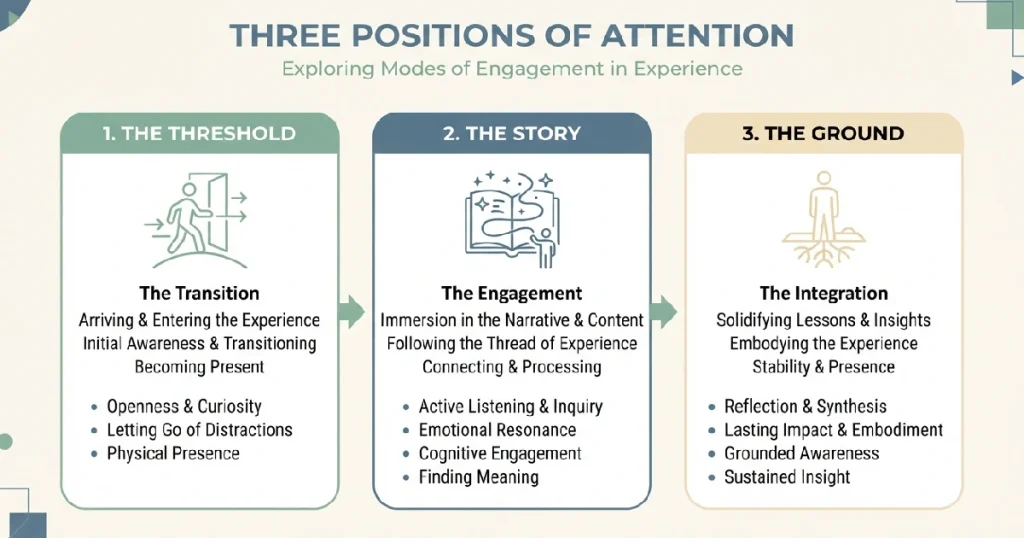
Threshold, Story, Ground: The Three Positions of Attention
Your mind is always moving through three distinct zones.
Position one is the Threshold. A sentence pops into your head like “I am going to ruin this project.” At this stage, it is just electrical noise and language.
Position two is the Story. This is where you grab the thought and add ten chapters of disaster. You start imagining getting fired, missing rent, and moving back home.
Position three is the Ground. This is your physical body right now in the room. It is the weight of your feet on the floor, the hum of the refrigerator, and the air moving through your nose.
Clinical neuroscience confirms that cognitive defusion and decentering reduce the believability of negative thoughts by shifting focus out of the story. Developing this skill means you practice mindfulness of current thoughts by watching them from the riverbank instead of jumping into the rushing water.
The 90-Second Notice: A Repeatable Threshold Drill
A pure emotional wave only lasts about ninety seconds in the bloodstream. Any distress that sticks around longer than that is being kept alive by the story you are feeding it.
When a spike of dread hits, set a timer on your watch or phone for a minute and a half. Sit still and just watch the physical sensations in your throat, stomach, or chest. Do not debate the thought; just ride the chemical wave untill it starts to drop.
Mindfulness for Negative Thoughts That Repeat: Working With Rumination, Not Against It
Rumination is addictive because it disguises itself as problem-solving. Your brain tricks you into believing that reviewing your mistakes one more time will protect you from future pain.
Real problem-solving leads to action in the physical world. Rumination just spins its wheels in the mud and burns up your energy.
Why the Spiral Feels Productive
When you re-read an awkward text message in your head for the fiftieth time, you feel like you are doing something. You feel vigilant.
The trouble is that the brain cannot distinguish between a real tiger in the room and an imagined social disaster. A clinical study confirms that brief mindfulness practice lowers rumination and negative affect throughout regular daily routines. It will not instantly rewire your brain chemistry overnight, but it turns down the volume so you can breathe.
The One More Look Rule for Overthinking
To stop the spin, you need a concrete rule. We call this the Two-Pass Rule.
If a worry runs through your head twice and has not produced a new action step, a calendar invite, or a clear phone call to make, it is pure rumination. Tell yourself: “I have reviewed this twice. Any further thinking is just spin.” Then move your body into a new room.
Mindfulness Exercises for Obsessive Thoughts: Dosage, Timing, and the Backfire Protocol
When thoughts become sticky and obsessive, generic wellness advice about taking deep breaths can actually make things worse. You need structured, brief tools with clear time limits.
Using mindfulness exercises for obsessive thoughts requires a light touch. If you try to meditate for an hour while in a state of high alarm, you will likely just panic.
The 3-3-3 Grounding Interrupt
When your head feels like a swarm of bees, drop the internal focus completely. Shift all your attention to the room around you.
Name three things you can see, like the corner of a desk, a coffee mug, and a shadow on the wall. Name three sounds you can hear, like traffic outside, the air conditioner, and your own breathing. Move three parts of your body, like your ankles, your fingers, and your shoulders.
The Stream and Rocks Flow Around Practice
Imagine you are sitting on the bank of a cold mountain stream. Your thoughts, memories, and fears are rocks sitting in the water.
You do not need to push the rocks out of the creek. You do not need to smash them into sand. Just let the water flow around them. You are the bank, steady and unaffected by whatever sits in the water.
When to Stop Meditating and Switch to Sensory Grounding
There is a real phenomenon called the backdraft effect. Sometimes, turning your attention inward exposes so much buried stress that your system redlines.
If watching your thoughts makes your heart race or brings on a wave of panic, stop sitting in silence. Open your eyes immediately. Wash your hands with cold water, walk outside barefoot on the grass, or turn on a podcast. Grounding through your external senses is far safer when the internal noise is too loud.
How to Calm Down Mind Obsessive Thoughts Without Making Them the Enemy

Fighting an obsessive thought is like wrestling a pig in mud; you both get dirty, and the pig likes it. The more you tell yourself “I must not think about this,” the more important that thought appears to your threat system.
To calm down mind obsessive thoughts, you have to strip them of their special status. They are just mental junk mail.
The Not Now Signal
When a catastrophic scenario lands in your head, do not push it away and do not invite it in for coffee. Give it a simple neutral label.
Say out loud or in your mind: “I see that thought. Not now.” You are not claiming the thought is false, and you are not arguing with it. You are simply choosing where to spend your attention for the next ten minutes.
The 10-Minute Post-Practice Check-In
Progress does not mean you never have an anxious thought again. Real progress looks like this:
- The thought shows up, but you believe it twenty percent less than you did last month.
- You notice you are spiraling after five minutes instead of losing three hours to it.
- You can feel an uncomfortable sensation in your chest while continuing to wash dishes or talk to your family.
- You stop demanding that your mind be perfectly quiet all the time.
When Mindfulness Is Not Enough: The Clinical Line
Mindfulness is a daily mental hygiene practice, not a magical cure for deep clinical conditions. There are times when self-directed awareness exercises are simply not enough.
If repetitive thoughts stop you from leaving your house, make it impossible to hold down a job, or come with rituals you cannot resist, you need professional support. Therapy styles like Exposure and Response Prevention (ERP) and Acceptance and Commitment Therapy (ACT) are built specifically for severe loops. Knowing your limits is part of real wisdom.
Learning how mindfulness and negative thoughts interact allows you to build genuine mental resilience over time. You stop waiting for your head to become a quiet sanctuary, and you start living your life right in the middle of the noise.
5 Grounded Ways to Break the Spiral Today
- The Mental Stamp: When a harsh thought hits, silently say “thinking” or “worrying.” Giving it a dry, boring label stops you from turning it into a dramatic story.
- The Sensory Pivot: Put your hands under running tap water for thirty seconds. Switch between cold and warm to pull your nervous system right out of your head.
- The Two-Pass Boundary: If a problem has run through your mind twice without offering an immediate action step, declare it junk data and physically stand up.
- The Posture Reset: Drop your shoulders away from your ears, unclench your jaw, and let your belly soften completely. The mind follows physical cues from the body.
- The Five-Minute Delay: When you feel an urgent need to figure out an emotional worry, tell yourself you will analyze it in five minutes. Most loops loose their grip before the timer runs out.
Frequently Asked Questions
Does mindfulness make negative thoughts worse at first?
Yes, it can happen alot in the beginning. When you finally get quiet, you notice mental noise that was already running in the background. Seeing it clearly feels like it got worse, but you are just finally paying attention.
What is the difference between mindful observation and rumination?
Observation notices a thought as a brief event and steps back. Rumination takes that thought as a serious puzzle and tries to solve it with more thinking. Observation breaks the loop; rumination feeds it.
How do I use mindfulness for obsessive thoughts without turning it into a compulsion?
Keep your practices short and stick to a strict timer. Notice the thought, anchor your feet on the floor, and return to whatever physical task you were doing. Never use meditation to make a scary feeling disappear.
The Path Forward
You do not need to wage a war against your own mind to find relief. The next time you find yourself stuck in a midnight loop, step back to the threshold and watch the noise pass without giving it the wheel.
A thought only has as much authority over your life as you decide to hand it.
My Closing Remarks
Sitting with your own noisy mind is messy work, and anyone who tells you it should feel peaceful right away has not spent much time doing it. Be gentle with yourself when your thoughts pull you under; catching the spiral even once a day is real growth. If this resonated, take a breath, let your shoulders drop, and remember you can handle whatever shows up next.
More Related Stories for You
Learning to manage runaway mental chatter is also essential when handling social pressure or preparing high-stakes public remarks, such as delivering the best best man speech without letting anxious overthinking ruin your delivery.
About The Author