
 Sara Carmen
How to argue about real problems without tearing down your relationship or losing your peace of mind.
Key Takeaways
- Practicing fair fighting rules for couples protects your bond from the silent damage of contempt and late night yelling.
- Arguments stop being dangerous when you trade personal attacks for clear boundaries around one problem at a time.
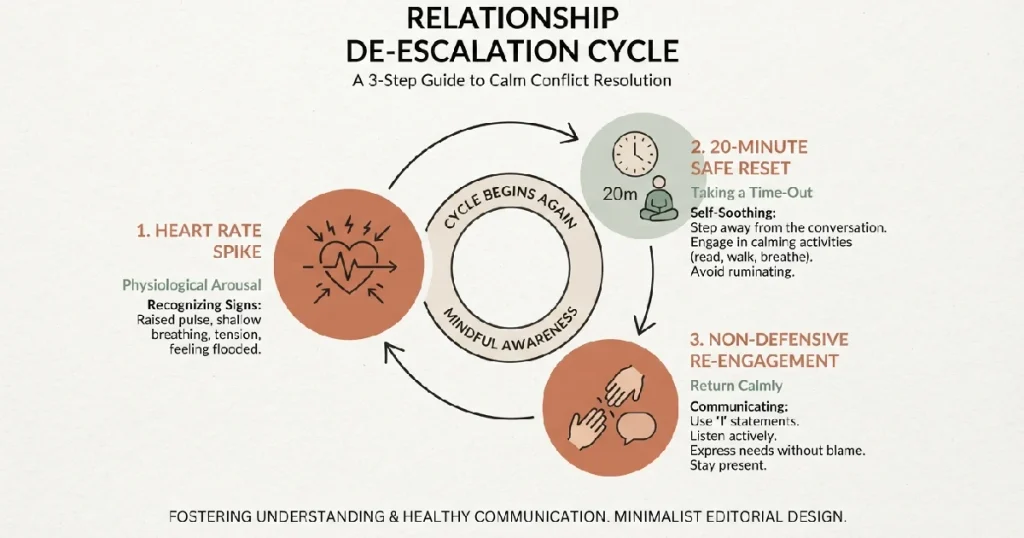
- Taking a twenty minute physiological reset lets your racing pulse settle down so you can actually hear what your partner needs.
Quick Answer
Fair fighting rules for couples are simple communication boundaries that keep disagreements safe and productive. Rather than trying to win an argument, both partners agree to ban personal insults, avoid bringing up ancient mistakes, pause when overwhelmed, and focus on solving one specific issue together without harming their connection.
Contents
Table of Contents
Why We Turn Everyday Disagreements into Wars
It is 11:15 on a Tuesday night. Somebody left a wet towel on the bathroom floor, or maybe forgot to unload the dishwasher again.
Suddenly, you are not talking about towels or dishes. You are screaming about how your partner never helps with anything, how their mother ruined Thanksgiving back in 2021, and why you feel so alone in this house.
We have all sat on the edge of the bed feeling that cold, sick knot in the stomach. You look at the person you chose to build a life with, and you wonder if you made a huge mistake. You start thinking that maybe you two are just broken.
Here is what years of sitting with couples in clinic offices will teach you. The problem is almost never the towel, and it is rarely that you fell out of love.
The real issue is that our bodies treat an everyday disagreement like a life or death attack. When your heart starts pounding in your ears, you stop seeing your spouse and you start seeing an enemy.
Learning fair fighting rules for couples is not about turning into two robotic, polite strangers. It is about setting up basic guardrails so a messy Tuesday night fight does not burn down the house you spent years building together.
The Hidden Engine of Dirty Fighting
The Hidden Neurobiology: What Flooding Does to You
When an argument gets nasty, logic leaves the room. That is not a personal failure, it is basic human biology.
Psychologist John Gottman spent decades studying couples in his lab, and he found that when a person’s heart rate climbs past 100 beats per minute, something called diffuse physiological arousal happens. We call it emotional flooding during arguments.
Your adrenal glands dump cortisol and adrenaline into your bloodstream. Blood rushes away from your prefrontal cortex, which is the part of your brain that handles patience, humor, and empathy, and straight into your large muscles.
Take Sarah and Mark. Mark comes home from work feeling completely depleted. Sarah has been home managing toddler tantrums all day and feels isolated.
When Sarah asks Mark why he forgot the groceries, Mark hears: You are failing as a provider. His pulse spikes to 115. Sarah sees his jaw tighten and his eyes glaze over, and she hears: I do not care about you.
They are not actually communicating anymore. They are two nervous systems in panic mode, throwing grenades just to feel safe.
Dirty fighting happens when we mistake our panic for truth. If you try to resolve a deep issue while your chest feels tight and your breath is shallow, you will almost definately say something you regret by morning.
Ten Fair Fighting Rules for Couples That Actually Work
Rule 1: Kill Kitchen-Sinking and Stick to One Issue
Kitchen-sinking is what happens when an argument about grocery receipts turns into an audit of the last seven years of your marriage. You throw in the kitchen sink because you want to build an open-and-shut case.
Elena and David struggled with this every single weekend. David would mention that Elena spent too much on takeout. Within two minutes, Elena was bringing up the time David forgot their anniversary in 2019, followed by how David talks to his sister.
Nobody can defend against five accusations at the same time. The brain gets overwhelmed, throws up a wall, and stops listening.
To practice healthy conflict resolution in marriage, you have to keep the topic so small that you can actually solve it. If the talk is about takeout food, stay on the takeout food.
Rule 2: Ban Universal Words Like “Always” and “Never”
The fastest way to make your partner stop listening is to tell them: “You always ignore me,” or “You never do what you say.”
These words are universal accusations. They are almost never true, and they instantly shift the focus from the actual problem to an argument about facts and grammar.
Your partner will stop thinking about your pain and start thinking of the one time last month when they did the dishes just to prove you wrong.
Strip those two words completely out of your vocabulary during a fight. Talk about the single event that just happened.
Rule 3: Use the Safe Time-Out Contract (The 20-Minute Return Pause)
Walking away during a fight without saying when you will come back is not taking a break. It feels like abandonment, and it sends your partner’s anxiety through the roof.
In attachment theory, originally developed by John Bowlby, sudden silence triggers our deepest fears of being dropped. The pursuing partner panics and pounds on the door, while the retreating partner shuts down even harder.
If you need space, you must agree on a return time. You say: “I am getting flooded right now, so I am stepping outside for twenty minutes. I will be back at 7:45 to keep talking.”
Then, you actually come back at 7:45. That single habit turns a scary withdrawal into a safe boundary.
Rule 4: Cut Out Contempt and Eye-Rolling
Contempt is pure relational poison. It shows up as eye-rolling, sneering, mocking, and hostile sarcasm.
Research shows contempt is the number one predictor of divorce because it puts you on a pedestal looking down at your partner. It says: I am superior to you, and you are pathetic.
Jason used to smirk whenever Chloe got emotional during disagreements. Chloe would immediately explode into tears and rage. Jason thought he was just being rational, but his smirk was telling Chloe that her feelings were a joke.
You can be angry without treating your partner like they are beneath you. Critiquing an action is fair, but attacking someone’s basic dignity is dirty fighting.
Rule 5: Speak from the Soft Hurt Beneath the Anger
Anger is a secondary emotion. It works like a suit of armor that covers up softer, scarier feelings like grief, fear, loneliness, or feeling inadequate.
It feels alot safer to yell, “You do not care about this family!” than it does to whisper, “I am terrified that you are losing interest in me.”
When you stay inside the angry shell, your partner only sees the armor and they put their own armor on.
Try peeling back one layer. If you tell your partner what actually hurts underneath the anger, you change the whole room.
Rule 6: Put a Hard Stop on Arguments After 9:00 PM
There is an old piece of advice that says you should never go to bed angry. Honestly, that advice causes so much unnecessary damage.
After 9:00 PM, your prefrontal cortex is exhausted, your blood sugar is low, and your stress tolerance is shot. Fighting at midnight usually leads to saying cruel things just to force an ending so you can sleep.
It is completely fine to go to bed angry if you agree to put the conversation on pause.
Say: “We are both running on fumes right now. Let’s get some sleep and pick this back up tomorrow morning after coffee.” Sleep acts like a biological reset button.
Rule 7: Never Weaponize Past Confidences
When your partner tells you their deepest fears, childhood shame, or private failures, they are handing you a loaded gun.
Using that information during an argument is crossing an unforgivable line. If they told you they always felt unloved by their father, you do not get to say, “No wonder your dad couldn’t stand you,” when you are mad about money.
That kind of blow creates scar tissue that can last for decades. Keep your partner’s private wounds completely off-limits, no matter how heated things get.
Rule 8: Learn to Spot and Accept Micro-Repairs
In the middle of a bad fight, couples will often throw out tiny peace offerings without even realizing it.
A repair attempt can be a quiet sigh, a self-deprecating joke, a sudden drop in voice volume, or an awkward touch on the shoulder.
Constructive arguing rules for couples depend on whether the other person accepts that peace offering. If your partner tries to crack a gentle joke to break the tension, and you scowl and say, “This is not funny,” you crush the bridge they just tried to build.
Look for those clumsy little white flags. When you see one, have the courage to take it.
Rule 9: Stop Using Weaponized Therapy Speak
A big issue popping up in modern relationships is using therapy terms as weapons.
People read a post online and suddenly start diagnosing their partner during dinner. Calling your spouse a “narcissist,” telling them they are “gaslighting” you, or labeling their bad mood as “toxic” is often just fancy tone-policing.
It lets you play the enlightened therapist while treating your partner like a broken patient.
Drop the labels. Instead of telling your spouse they are gaslighting you, say: “I remember that conversation differently, and it hurts when you tell me my memory is wrong.” Speak like a human being, not a psychology textbook.
Rule 10: Trade Winning for Finding the Unmet Need
If one of you wins an argument, your marriage just lost.
A marriage is an ecosystem. When one person gets beaten into submission, the whole system becomes resentful and bitter.
Every single recurring fight is just an awkward, messy attempt to get an unmet need met.
Instead of trying to prove that you are right and they are wrong, pause and ask the single best question in relationship psychology: “What do you need right now that you feel you aren’t getting from me?”
What to Do Next: Three Scripts for Real Life

You do not need to memorize all ten rules right away. You just need a few solid tools you can use when things start getting shaky.
Here are three simple strategies you can test out the next time an argument starts brewing.
1. The Safe Pause Script
When you feel your pulse picking up speed or your teeth grinding together, stop the debate immediately. Use this simple line:
“I love you, but my body is going into fight mode and I am losing my temper. I need twenty minutes to cool down so I don’t say something stupid. I will be sitting on the porch and I will come back inside at 8:15.”
2. The Camera Test
Before you bring up a complaint, run it through the camera test. Ask yourself: Could a video camera record this, or am I mind-reading their motives?
- Instead of: “You deliberately left your mess because you expect me to be your maid.”
- Try this: “Your boots are sitting in front of the front door, and I felt frustrated when I tripped over them coming inside.”
3. The Non-Defensive Pivot
When your partner comes at you with heat, your first instinct is to counter-punch. Consider testing a calm pause instead, followed by this sentence starter:
“You are upset, and I want to understand it. Can you tell me the main thing you need me to hear right now without bringing in last week?”
Frequently Asked Questions
What if my partner refuses to follow these fair fighting rules?
You cannot force someone else to change, but you can change the dance steps. When you refuse to take the bait, stop counter-attacking, and hold your own boundary by taking a twenty-minute pause, the old fighting pattern collapses on its own.
Is it really safe to go to bed angry?
Yes, absolutely. Exhaustion turns small issues into catastrophic arguments, and trying to force a resolution at midnight usually makes things worse. Giving each other permission to sleep and revisit the topic the next morning gives your nervous system a chance to reset.
How can we tell the difference between a time-out and stonewalling?
A healthy time-out always includes a specific return time and is used to calm your heart rate down. Stonewalling is an open-ended refusal to engage, where one partner shuts down, leaves the room, and gives the cold shoulder without any reassurance that they will return to work through the issue.
Closing the Loop
Let us go back to that wet towel on the bedroom floor at 11:15 at night.
You still have to deal with the chores, the bills, and the daily exhaustion of being adults. That stuff does not magically disappear just because you read an article.
The difference now is that you have a map. You know that when the room gets loud, it is not because you married the wrong person, it is just your nervous system screaming for safety.
A lasting marriage is never built on avoiding conflict, but on refusing to turn each other into enemies when things get hard.
My Closing Remarks
I have sat with so many couples who thought their love was completely dead, only to discover they were just exhausted from years of dirty fighting. Breaking these old habits feels clumsy at first. You will mess up, you will lose your temper, and you will forget these rules more than once. That is completely normal. What matters is that you both agree to apologize, reset, and keep protecting each other even when you are furious. You really can learn how to fight fair in a relationship, one quiet pause at a time.
More Related Stories for You
If you notice that your arguments frequently slide into stone-cold silence or personal attacks, you might want to look at our guide on understanding the four horsemen of marriage to spot the deeper habits that break relationships down.
About The Author