Sara Carmen

Why do couples who talk every day still feel like roommates, and what quietly closes that gap?
Key Takeaways
- Most couples try to build emotional intimacy with big talks, while the research keeps pointing at tiny responses repeated daily.
- A complaint like “you’re always on your phone” is often a hidden request for connection, and hearing it that way can change your whole evening.
- For many people, desire arrives after closeness begins, which flips the usual order of romance.
Quick answer: To build emotional intimacy, turn toward your partner’s small bids for connection: answer their comments, ask one follow-up question, and respond warmly to good news. Ten-minute daily check-ins, pressure-free affection, and fast repairs after friction create the felt sense of being known, safe, and chosen.
Contents
Table of Contents
It’s 9:40 p.m., and we’ve both been home for hours: crossed paths in the kitchen, sorted Thursday’s logistics, now two glowing rectangles on the same couch. You try “How was your day?” and get “Fine.” Nobody did anything wrong. The distance grew anyway.
Most advice on how to build emotional intimacy treats closeness as a conversation problem. The research points somewhere smaller: the dozens of daily micro-moments where one person reaches out and the other turns toward, away, or against. Miss enough of those and “fine” becomes the honest answer.
What follows is the map I use with couples: seven specific moves that fit ordinary weeks with jobs, kids, and low batteries. You’ll know what to say, what to count, and what to skip.
Secret 1: Why Small Bids Beat Big Talks
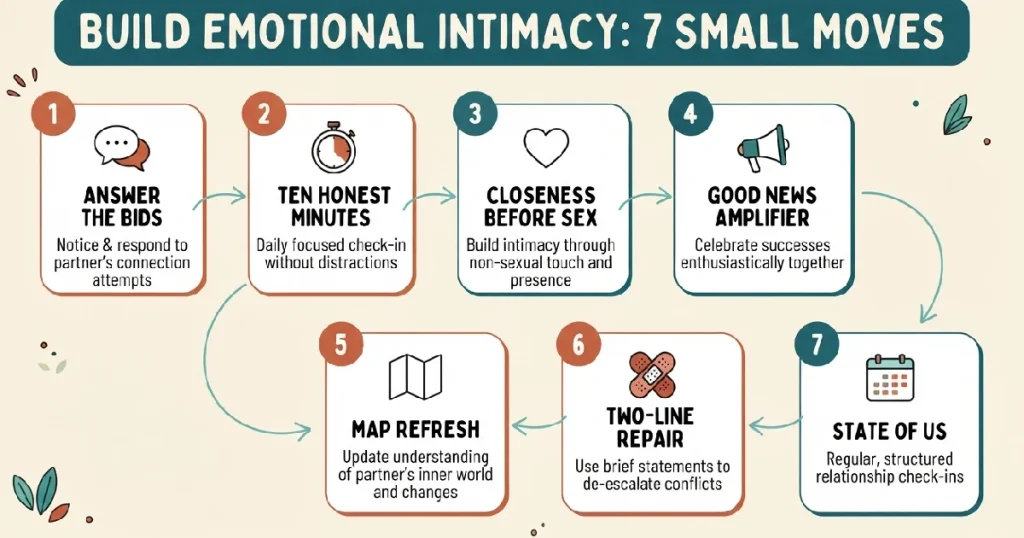
A bid is the Gottman Institute’s term for any attempt to connect: a comment about the weather, a sigh, a meme sent at 2 p.m. Every bid asks a silent question. Are you there for me?
In Gottman’s newlywed research, couples still married six years later turned toward each other’s bids 86% of the time. Couples who divorced averaged 33% (Brittle, 2015). Same households, same busy weeks. The difference lived in seconds.
Here’s what those seconds sound like:
| The bid | Turning away | Turning toward |
|---|---|---|
| “Look at this article.” | “Mm.” (eyes stay on the phone) | “Send it to me. What caught you?” |
| “You’re always on your phone.” | “I work all day. Give me a break.” | “Fair. Five minutes, then I’m all yours.” |
| A long sigh from the doorway | Silence | “Rough one? Sit with me.” |
That second row hides the trickiest edge case. Complaints are often bids in work clothes. Under “you never look up” sits “I miss you.” Answer the request underneath and the complaint usually dissolves.
Turning toward can take two seconds. A nod, a “tell me in a sec,” an actual glance across the room all register. Mid-deep-work, a deferral counts, but only if you return: “I want to hear this, give me ten minutes.” Keep the appointment, because broken deferrals teach your partner to stop asking.
One place to begin: run a three-day bid audit. Tally every reach you notice, yours included. Most couples I work with catch fewer than half at first. Aim to catch one more per day; the benchmark sits at 86%, and perfection was never the standard.
Secret 2: How to Build Intimacy in Marriage With Ten Honest Minutes
The Gottman Method calls it the stress-reducing conversation: ten minutes each about pressure from outside the relationship. Work, your mother, the commute. The rule that makes it work: understanding comes before advice.
Most partners skip straight to solutions, and it lands as dismissal. “Have you told your boss?” treats your feelings as a problem to close. “That sounds brutal, no wonder you’re fried” says I’m with you. Solutions can come later, if wanted.
The cleanest script I know: “Do you want comfort or ideas right now?” Ask it before you open your mouth. It prevents the advice ambush that turns check-ins into spats.
Two guardrails keep the ritual alive on hard weeks:
- No logistics. Calendars, budgets, and kid admin stay outside the ten minutes. They impersonate connection while starving it.
- No fixing races. If venting loops past the timer, ask “what would make tomorrow 5% easier?” and leave it there.
Edge case: the partner who needs to decompress alone first. Pushing talk at the door backfires. Give a twenty-minute buffer, then try side by side, since walks and dish duty loosen people who freeze face to face. Building emotional intimacy on empty evenings means shrinking the ritual until it fits, then protecting it.
Secret 3: How to Build Emotional Intimacy Before Sex Starts at Breakfast
Searches for how to build emotional intimacy before sex usually hide a quieter worry: “we only touch when one of us wants something.” That pattern has a predictable ending. When every hug reads as an initiation, the lower-desire partner starts dodging all touch. Affection becomes a contract, and both people lose.
Sex researcher Rosemary Basson’s model of responsive desire explains the flip. Many people, especially in long-term relationships, feel desire after closeness and pleasant touch begin. Waiting for spontaneous desire before being affectionate puts the cart miles ahead of the horse.
Consider testing a pressure-free week:
- Hugs, hand-holding, and the Gottman-suggested six-second kiss, with zero escalation unless both clearly want more.
- Say the quiet part out loud: “This hug has no agenda.” Watch shoulders drop.
- If you’re the higher-desire partner, name the ache without the invoice: “I miss you. Can we just be close tonight?”
Notice what shifts when touch stops carrying expectations. Dodging fades first. Warmth returns next. Desire tends to follow on its own schedule, and chasing it scares it off.
One trade-off worth naming: planned closeness beats the spontaneous closeness that never happens. Schedule the window. Drop the agenda inside it.
Secrets 4 to 7: Four Emotional Intimacy Exercises You Can Start Tonight
These four moves produce the fastest visible change in the couples I work with. The stories are composites with details changed, drawn from patterns that repeat across very different households.
Secret 4: The Good News Amplifier
A 2004 set of studies found that how partners respond to good news tracks relationship health. Engaged, enthusiastic responses were linked with higher intimacy and daily satisfaction (Gable et al., 2004). Psychologists call this capitalization. Most couples audit their conflict skills and never audit their celebration skills.
The behavioral rule: one enthusiastic follow-up question before any comment of your own. “Wait, they picked you? What did they say, word for word?” That move, active-constructive responding, doubles the joy instead of halving it.
| Response style | What it sounds like |
|---|---|
| Active-constructive | “Amazing! What did they say exactly?” |
| Passive-constructive | “Nice, babe.” (eyes on screen) |
| Active-destructive | “Hope you can handle the extra hours.” |
| Passive-destructive | “Cool. What’s for dinner?” |
Watch the quiet joy-killers in rows two through four. Your partner’s small win is a bid wearing party clothes, and it deserves a party.
Secret 5: The Map Refresh

Gottman calls your working knowledge of a partner’s inner world a love map. Here’s the trap: most of us hold an old edition. You know who they were in 2019. Their current worries, wins, and friendships have quietly rerouted.
Once a week, ask one question you don’t know the answer to:
- “What’s taking up the most space in your head this week?”
- “What’s something you’re secretly proud of lately?”
- “Who’s been getting on your nerves?”
Then let the silence sit. “I don’t know” often means “I’ve never been asked.” Offer two guesses and let them correct you. Correction counts as sharing.
Secret 6: The Two-Line Repair
Gottman’s conflict research puts healthy couples near five positive exchanges for every negative one (the 5:1 ratio), and repair attempts are how couples climb back mid-fight. A repair attempt is any line that lowers the temperature: “I got sharp, can I try that again?” or “Truce? We’re on the same team.”
One composite: a couple whose fights ran three hours learned to name flooding, that heart-pounding state where listening shuts down. Gottman’s clinicians flag roughly 100 beats per minute as the danger zone. Their script: “I’m flooded. Twenty minutes, then I’m back.”
The return is the whole medicine. A pause without a promised return lands as abandonment, so honor the return time. Their fights shrank to twenty-five minutes, then to ten.
Secret 7: The Twenty-Minute State of Us
Once a week, same slot: a weekly relationship check-in, twenty minutes, phones away. Open with three specific appreciations: “Thanks for handling bedtime Tuesday. I noticed.” Then two questions: “What went right for us this week?” and “What felt off?” Close with the one that does the heavy lifting: “How can I make you feel loved this week?”
The pitfall is turning it into a performance review. Appreciations outnumber complaints, and either person can postpone once, with a new time set within 48 hours. A meeting that feels like a summons gets avoided; a meeting that feels like being chosen gets protected.
One honest limit: these moves assume two basically safe people. If contempt is the default or affection feels unsafe, emotional safety comes first, and a couples therapist or individual support belongs ahead of any exercise.
Frequently Asked Questions
How long does it take to rebuild emotional intimacy?
Most couples feel the first softening within one to two weeks of steady bid-turning, with a sturdier bond around six to eight weeks. Ten protected minutes daily beats one grand weekend.
Can I build emotional intimacy if my partner won’t work on it?
Partly. You control half the loop, and turning toward their bids plus faster repairs often softens the pattern within weeks. Chronic contempt or stonewalling is the signal to bring in professional support.
How to improve emotional intimacy in marriage after years of feeling like roommates?
Start with Secrets 1 and 3: answer bids daily, add pressure-free touch. Long drift usually needs one honest talk about the distance itself, ideally with a couples therapist if that talk stalls.
Back to that couch at 9:40 p.m. The phones haven’t moved, and Thursday still needs sorting. What changed is your read of the moment: the sigh is a bid, the complaint is a request in work clothes, the good news is an easy test you can pass with one question. You don’t need a free weekend or a personality transplant, just the next small moment, handled well.
Closeness grows in the seconds you turn toward each other.
My Closing Remarks
I’ll be honest: I still miss bids. I catch myself half-listening while the kettle boils, put the phone down, and start over. Repair counts as much as getting it right, maybe more.
The couples who find their way back from roommate mode rarely have calmer schedules than yours; they just decided the small moments were the relationship. You can make that decision tonight, kettle and all.
More Related Stories for You
- Curious what comes after intimacy? Read the 7 relationship secrets that separate thriving couples from merely surviving ones.
About The Author