
 Sara Carmen
The patterns that end a relationship rarely arrive as one dramatic event. They arrive as something you almost talked yourself out of noticing.
Key Points
- Deal breakers in relationships are repeated patterns of contempt, secrecy, and boundary violations, not a single bad week you should learn to absorb.
- Your attachment system can override your own limits when fear of losing the bond feels more dangerous than the harm itself.
- A 90-day pattern rule, a four-sentence boundary script, and a two-strike decision give you a clear way to protect yourself before the damage becomes your new normal.
Contents
Table of Contents
We have all sat in the dark with a phone in our hands, rereading a message that should have been simple and somehow was not. We tell ourselves we are overthinking. We tell ourselves every couple hits a rough patch. Then we put the phone down and go to sleep next to someone we no longer fully trust.
That quiet second-guessing is how most deal breakers in relationships actually arrive. Not as a slammed door. As a slow leak you keep mopping up.
Someone might think a sarcastic jab at dinner is just their partner’s sense of humor. But what they don’t see is the cortisol spike that follows, the same stress hormone your body releases when it senses physical danger.
Someone might think a hidden credit card is a private money habit. But what they don’t see is the crack it puts through the trust the whole relationship stands on.
Someone might think staying is loyalty. But what they don’t see is that their nervous system has already started leaving.
Here is the short answer you came for. A deal breaker is not a preference you failed to compromise on. It is a repeated pattern that makes emotional safety impossible. Contempt, dishonesty, financial secrecy, stonewalling, unequal emotional labor, control, and a refusal to change after harm are the patterns that successful couples will not absorb. The earlier you name one and act, the less it rewires how you trust.
What Actually Qualifies as a Deal Breaker in Relationships
A preference is “I wish you texted more during the day.” A deal breaker is “You mock me when I tell you I am hurting, and you do it again after I have asked you to stop.”
Preferences can flex. Deal breakers change the terms of safety. Once a pattern makes you smaller, quieter, or less honest just to keep the peace, you are no longer negotiating a difference. You are negotiating your self-respect.
The difference lives in repetition, not intensity. A raised voice during a grief-filled week is a bad day. A raised voice that appears every time you name a need is a pattern. One forgotten bill is a mistake. A secret account is a strategy.
The Difference Between a Bad Day and a Broken Pattern
Ask three questions before you decide what you are looking at.
Did this happen once under unusual stress, or has it shown up in more than one setting?
Did your partner take responsibility without being cornered?
Did the behavior change after you named it clearly?
If the answers are “more than one setting,” “no,” and “no,” you are not being dramatic. You are collecting data.
The 90-Day Rule: When a Concern Becomes a Confirmed Deal Breaker
Your mind will bargain. It will say give it more time, wait until after the trip, wait until work calms down. That bargaining is not wisdom. It is the attachment system trying to keep the bond intact.
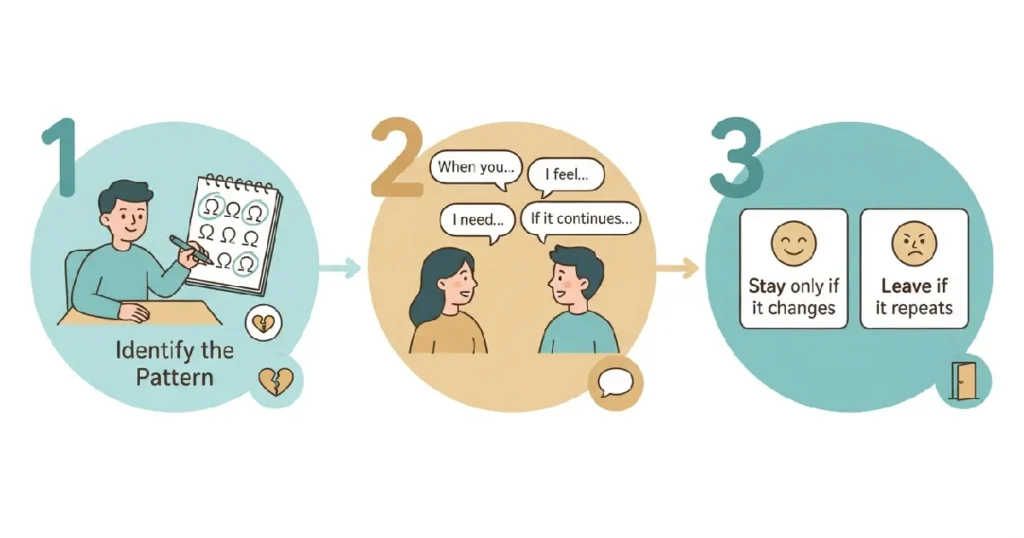
Use a 90-day pattern rule. From the day you first notice the same harm repeating, you get one clear conversation and a 90-day window to watch what happens next. If the pattern continues after you have named it, it is no longer a concern. It is a confirmed deal breaker.
This window matters because the longer you live inside a violation, the more your nervous system files it under ordinary. Researchers studying attachment in romantic bonds have shown that people with anxious attachment override their own stated limits far more often than securely attached people, driven by abandonment fear lighting up the brain’s threat circuitry. You can read a wide body of that work through the National Library of Medicine’s attachment research. The point is simple. Waiting does not make the decision cleaner. It makes the harm feel like home.
Left unexamined, this pattern does not just strain the bond. It quietly becomes the reason the bond ends.
The 7 Deal Breakers in Relationships Successful Couples Refuse to Tolerate
These are not personality quirks. They are relationship red flags with a psychological cost. Each one erodes the same thing: your ability to relax around the person who is supposed to be safest.
1. Contempt and Chronic Disrespect
Contempt is more than rudeness. It is the move that says “you are beneath me.” Eye-rolling. Mocking your feelings. A smirk when you cry. A joke at your expense in front of other people, followed by “you’re too sensitive.”
Decades of observational research from the Gottman Institute identified contempt as the single strongest predictor of relationship failure, with prediction accuracy above 90 percent in their couple studies. That is not a metaphor. When you are on the receiving end, your body treats it like a threat. Cortisol rises. Heart rate climbs. Repair attempts, those small bids to reconnect after a fight, start landing on closed ground.
If you have started editing yourself mid-sentence to avoid that look, the relationship is already teaching you to disappear.
2. Repeated Dishonesty and Digital-Age Infidelity
Lying is not only about where someone slept. Emotional infidelity now includes a hidden dating app “just for validation,” a secret second phone, and a sustained private intimacy with someone, or something, your partner will not admit exists. That includes AI companions used as a substitute for real vulnerability at home.
The American Psychological Association’s relationships research has been tracking how digital secrecy and blurred intimacy are changing what partners experience as betrayal. Brain imaging work has already shown that social rejection activates the same neural regions as physical pain. Your trust architecture does not care whether the third party had a pulse. It cares that you were shut out of the truth.
One lie can be repaired. A system of hiding cannot, not without full disclosure and a long stretch of rebuilt honesty you can actually verify.
3. Financial Secrecy and Hidden Debt
Financial infidelity is not a budgeting disagreement. It is a trust violation wearing a receipt.
Hidden credit cards. Secret crypto wallets. A buy-now-pay-later balance your partner never mentioned. Money you thought was shared that was already spent. The National Endowment for Financial Education has reported that a large share of coupled adults admit to hiding a purchase, account, or debt, and many call the discovery relationship-ending.
This matters because money conflict remains one of the most common reasons couples separate in national marriage and divorce data from the CDC. Treat financial secrecy as a question of character and safety, not spreadsheets. If someone will hide a number from you, they will hide a story from you.
4. Emotional Unavailability and Stonewalling
Stonewalling is the shutdown. The blank stare. The “I’m done” that arrives before any real conversation starts. The partner who goes silent for hours or days and then acts as if your need to talk is the real problem.
Everyone needs a pause during flooding, that overwhelmed state when the nervous system cannot process more conflict. A pause has a return time. Stonewalling has a vanishing act. Over months, you stop bringing anything real to the person who is supposed to hold it. That is how loneliness grows inside a shared apartment.
5. Refusal to Share Mental and Emotional Labor
This is the quiet deal breaker. No affair. No explosion. Just you running the household in your head while your partner lives in the house.
Emotional labor is the invisible work of remembering, planning, soothing, scheduling, and noticing what everyone needs. When one person carries most of it, resentment does not arrive as a fight. It arrives as numbness. You stop asking. You start managing. You become a supervisor in your own relationship.
A partner who will not see the load after it has been named is not confused. They are declining the work of being an equal.
6. Control, Isolation, and Boundary Punishment
Watch what happens after you say no. A healthy partner may feel disappointed. An unsafe one punishes the boundary.
They sulk until you reverse it. They mock the boundary as “rules.” They cut you off from friends, then call it closeness. They track your location and call it care. Control often wears the costume of love until you try to take up space without permission.
If your world has gotten smaller since this person arrived, that is not romance. That is occupancy.
7. Unwillingness to Seek Help After Repeated Harm
Everyone can have a blind spot. A deal breaker is the refusal to look at it.
You have named the harm more than once. You have asked for counseling, a pause on the drinking, a real plan for the lying, a fairer split of the load. They agree in the moment and change nothing. Or they agree that you are the problem for needing change at all.
A person who will not get help after repeated harm is telling you the future in plain language. Believe the pattern, not the apology.
Maya, 34, sat in my office and said she did not have a “real” reason to leave. Her partner had never hit her. He paid half the rent. On paper it looked fine. Then she listed the last year. He rolled his eyes when she talked about her mother’s illness. She found a credit card in a name she did not recognize. When she asked about it, he called her controlling and went silent for two days. She told herself she was lucky he was still there. That is deal-breaker fatigue: the third, fourth, and fifth violation stop registering as emergencies because your system has adapted to the alarm. We wrote her non-negotiables on an index card. Thirty days later he hid another purchase. She did not hold a new debate. She used the exit she had already decided on. The grief was real. So was the air in her lungs.
Why You Stay Past Your Own Deal Breakers

If you have ignored a limit you swore you would never ignore, you are not uniquely weak. Most people in this situation do not realize their brain is running an old survival program.
Anxious Attachment and the Fawn Response
Anxious attachment develops when love in earlier life felt inconsistent. Your system learned that closeness can vanish, so it treats distance like danger. The amygdala, the brain’s alarm center, fires. Logic gets outvoted.
The fawn response is the next move. It is the instinct to appease, smooth, and self-abandon so the other person does not leave. You become fluent in their moods and illiterate in your own. That is not a personality flaw.
That’s not weakness. That’s wiring.
Deal-Breaker Fatigue: How Violations Become Invisible
Think of a deal breaker as a hairline crack in the foundation. You can walk over it for months. You can even decorate around it. Then one ordinary Tuesday the floor gives way, and you realize the house was never as solid as you needed it to be.
Each unaddressed violation raises your threshold. What once felt unthinkable becomes “not ideal.” What once felt not ideal becomes “just how they are.” This is why signs you should leave a relationship often look obvious to friends and foggy to you. You are standing on the crack. They are looking at the house.
Sunk-Cost Bias and the Investment Trap
Sunk-cost bias is the mental error of staying because of what you have already spent: years, a lease, a child, a version of yourself you built around this person. The mind says leaving would waste all of that. The truth is the opposite. Staying after the pattern is confirmed wastes the years still ahead of you.
In my practice I have watched people stay three years past the moment they already knew, not because they lacked intelligence, but because leaving meant admitting the investment had already failed. Naming that trap is often the first honest sentence of the exit.
How to Address Deal Breakers in Relationships Before You Lose Yourself
Knowing the pattern is not the same as having language. Boundaries in relationships fail when they are vented as speeches and never tied to a consequence you will actually keep.
The Four-Sentence Boundary Script
Say this once, calmly, without a courtroom exhibit of every past offense:
“When you [specific behavior], I feel [emotion]. I need [specific change] starting now. I am not asking you to be perfect. If this pattern continues, I will [concrete consequence].”
It sounds like this: “When you mock me in front of your friends, I feel humiliated. I need that to stop completely. I am not asking you to be perfect. If it happens again, I will leave the gathering and we will be sleeping apart while I decide whether I stay in this relationship.”
The power is not in the poetry. It is in the follow-through. A boundary without a kept consequence is a request your partner has already learned to outlast.
Keep this conversation in a private room. It is not content. It is not a group-chat referendum. The repair, or the ending, deserves that much dignity.
The Two-Strike Decision Matrix
| What happened | What you do next |
|---|---|
| First clear violation after you name the boundary | Use the four-sentence script. Observe for 30 days. Write down what actually changes, not what gets promised. |
| Second violation of the same boundary | Offer time-limited couples therapy with a real end date, or you leave. Do not open a third negotiation on the same harm. |
This is not cruelty. It is how you stop training someone that your limits are opening statements.
When Therapy Helps, and When It Does Not
Couples therapy can help when both people can admit the pattern and both people are safe enough to speak. Emotionally Focused Therapy and structured methods like the Gottman approach give language to the cycle instead of the blame.
Skip couples work, and go to individual support first, if there is ongoing deception, financial control, isolation, or any form of intimidation. Joint sessions are the wrong room when one person is still managing the other person’s rage. If you keep overriding your own deal breakers, attachment-focused individual therapy can help rewire the abandonment alarm that keeps voting against you.
Leaving and Healing After a Deal Breaker

If you leave, the pain can feel like proof you made a mistake. It is not. Romantic attachment uses some of the same reward circuitry involved in craving. The bond can take roughly three to four months to quiet, sometimes longer. Your chest aches because a chemical story is ending, not because the pattern you left was actually fine.
Weeks 1 to 3: No Contact and Nervous-System Regulation
Hold a hard no-contact stretch of at least 21 days. No “checking they got home.” No late-night thread rereads. Your brain will hunt for one more hit of the person who hurt you.
Twice a day, give your body a way down from the alarm. Box breathing works: inhale for four, hold for four, exhale for four, hold for four. Cold water on your face. A walk without the phone. You are not being dramatic. You are down-regulating a withdrawal.
Weeks 4 to 8: Rebuilding Identity Outside the Relationship
Ask one question in a notebook every morning: “What did I tolerate that I will never tolerate again?” Then rebuild one ordinary ritual that belonged to you before this person edited your days. Thursday dinner with a friend. The class you dropped. The bedtime that was yours.
This is identity work. The relationship took up rooms in your head. You are moving back into them.
Weeks 9 to 18: Re-Entering Dating With a Written List
Do not go back into dating with a vibe and a hope. Write three to five non-negotiables on a card you can hold. Review it before a second date. Share it with one honest friend who will not romanticize your loneliness.
You are not being rigid. You are refusing to relearn the same lesson with a new face.
Building a Relationship That Respects Your Deal Breakers
If you stay, because the pattern actually changed, protect the change. Once a month, sit down for a 15-minute non-negotiables check-in. Each of you names one boundary that felt respected and one that felt thin. No courtroom. No scoreboard. Just a habit that keeps the hairline crack from hiding under the rug again.
Teach your limits without a character attack. “I need financial transparency because secrecy makes me feel unsafe” will land better than “you are a liar.” You can be clear and still be decent. Decent is not the same as available for unlimited harm.
It is 11 p.m. again. The text is still there. You can still feel the pull to explain it away, to become smaller, to wait one more season. You also have something you did not have at the start of this page: a name for the pattern, a window to watch it, a script to speak, and a decision rule that does not require you to betray yourself in order to be kind.
A deal breaker is not a demand you invented to be difficult.
It is the sound of you coming home to yourself.
My Closing Remarks
I have sat across from people who could name their deal breaker on day one and still stayed for six years. I used to call that a failure of courage. It is not. It is a nervous system doing its old job, keeping you tied to whoever feels like home, even when home is the thing hurting you. If this is you, stop calling it confusion. Call it a pattern. Then pick one non-negotiable this week and defend it like your future self is in the room. Because she is. And she is tired of being the one who always leaves herself last.
More Related Stories for You
- When a hard conversation or a breakup starts to spill onto your feed, remember why it still matters to keep your relationship private.
About The Author