
 Sara Carmen
Your racing heart isn’t broken. It’s protecting you. Here’s how to teach it that this relationship is different.
Key Points
- These relationship exercises for trust work by calming your nervous system first, because no amount of logic quiets a pounding heart.
- Hypervigilance almost always traces back to an old wound, not the actual behavior of the person standing in front of you right now.
- Small, repeated rituals rebuild safety faster than one long heart-to-heart conversation, and you can start tonight with just one.
Contents
Table of Contents
We’ve all done it. Stared at a text message for four minutes, reading meaning into a missing exclamation point. Your body tenses before your mind even knows why. This is what relationship anxiety feels like from the inside, and it has almost nothing to do with logic.
Someone might think you’re the calm one in your relationship, always put together. But what they don’t see is the mental spreadsheet running quietly in the background, tracking every late reply and every shift in tone.
Someone might assume your partner did something wrong tonight because you went quiet at dinner. But what actually happened is your body flagged a neutral comment as a threat, and your nervous system beat your rational mind to the punch.
Someone might think you don’t trust your partner. But the truth is often the opposite. You don’t trust yourself to survive being blindsided again.
Left unexamined, this pattern doesn’t just strain a relationship. It can quietly become the reason it ends.
Relationship exercises for trust are structured, body-based practices that teach your nervous system safety through repetition, not persuasion. They work because trust isn’t a decision you make once. It’s a pattern your body learns to expect, one small, consistent moment at a time.
Why Traditional Advice Fails: Relationship Anxiety and Hypervigilance
Telling someone with relationship anxiety to “just trust more” is like telling someone with a broken leg to just walk normally. It ignores where the injury actually lives.
Your amygdala, the almond-shaped structure in your brain that detects threat, doesn’t distinguish well between a real danger and a partner who came home twenty minutes late. It fires the same alarm either way.
Meanwhile your hippocampus, the part of your brain that stores memory and context, pulls up every past betrayal on file and hands it to your amygdala as evidence. Together, they build a case before your rational brain even gets a vote.
This is why cognitive solutions so often fail. You can tell yourself all day that your partner is trustworthy. It won’t slow your heart rate or unclench your jaw, because the alarm isn’t coming from the thinking part of your brain. It’s coming from a survival system that learned somewhere along the way that closeness could be dangerous.
Most people in this situation don’t realize their hypervigilance was once a useful skill. If you grew up in a home where moods shifted without warning, or you loved someone who lied, scanning for danger wasn’t paranoia. It was a reasonable response to an unpredictable environment.
That’s not weakness. That’s wiring.
The problem is that the same scanning that once protected you now works against you. Clinicians sometimes call this “case-building”: the habit of collecting small, ambiguous behaviors, a delayed text, a shorter hug, a change in tone, and assembling them into proof of betrayal. It feels like due diligence. It actually functions like a courtroom where your partner is always the defendant and never gets a verdict of not guilty.
If you’ve wondered how to stop overthinking your relationship, understanding this loop is the real starting point, not just managing the thoughts it produces.
The Insight Most Couples Miss: Watching for Threats Can Create Them
Here’s the part almost no one talks about. When you live in a state of constant surveillance, watching your partner’s face, tracking their tone, waiting for the shoe to drop, your nervous system doesn’t just experience stress. It transmits it.
Researchers studying emotional co-regulation, including work associated with the Gottman Institute on physiological flooding, have found that one partner’s anxiety can raise the other partner’s heart rate within minutes, without a single word exchanged. Your partner feels surveilled, and their body responds by wanting to pull away.
So your partner withdraws, not because they’re hiding something, but because being constantly monitored is exhausting for anyone. And when they withdraw, it looks exactly like what you feared. The loop closes itself.
This is what most trust advice completely misses. It’s not only your fear that needs attention. It’s the cycle your fear quietly creates.
So how do you break a loop that started before words were even involved? You don’t argue your way out of it. You practice your way out of it.
7 Progressive Relationship Exercises for Trust You Can Start Tonight
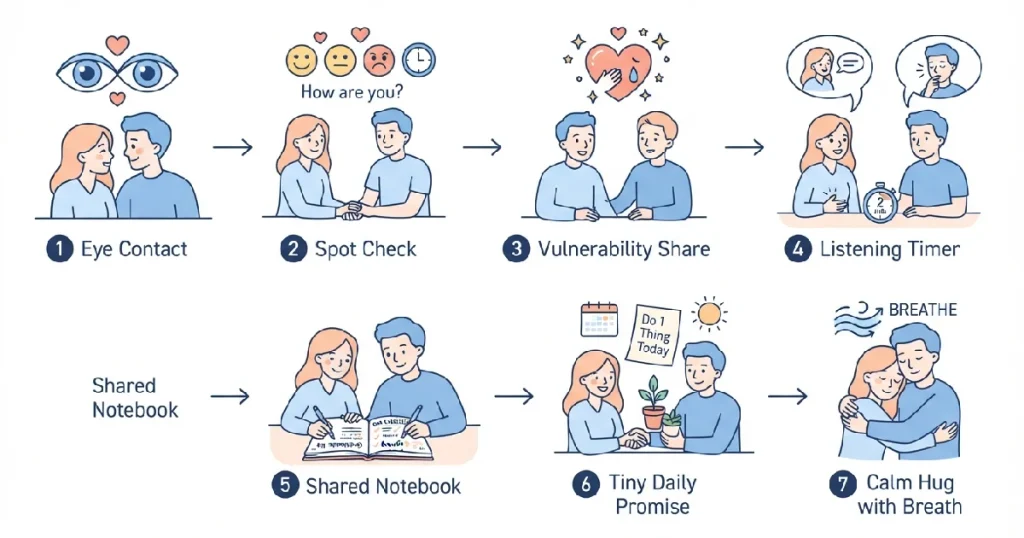
These trust-building exercises are ordered from most body-focused to most conversation-focused. Start wherever feels least threatening, and resist the urge to do all seven in one night. Slow is what makes this actually stick.
1. The Three-Minute Eye Contact Reset
Why it works: Sustained eye contact activates your vagus nerve, the pathway responsible for shifting your body out of fight-or-flight and into a state researchers call ventral vagal calm. It’s hard to fully threat-scan someone while staying locked in warm eye contact with them.
How to do it: Sit facing your partner, knees almost touching. Set a timer for three minutes. Hold eye contact without talking. When you feel the urge to laugh or look away, stay anyway.
2. The Frequent Spot Check
Why it works: This stops your mind from filling ambiguous silence with worst-case scenarios, a mental habit psychologists call catastrophizing.
How to do it: During the day, especially when tension feels present, pause and say one sentence naming your state. “I’m quiet because I’m tired, not upset with you.” Ten seconds now saves ten worried minutes later.
3. The Vulnerability Invitation
Why it works: Trust grows through small, repeated bids for connection that get met with acceptance instead of dismissal.
How to do it: Share a minor insecurity, or a private, proud memory unrelated to the relationship. Pay attention not to what your partner says, but how gently they hold it. That’s your real data.
4. Uninterrupted Active Listening Blocks
Why it works: Feeling genuinely heard lowers amygdala reactivity, the same alarm system driving your overthinking.
How to do it: Set a timer for five minutes. One partner speaks freely about their feelings, no interruption, defense, or advice allowed. The listener only reflects back what they heard. Then switch.
5. The Strength and Character Log
Why it works: This directly counters the negativity bias, our brain’s tendency to weigh bad information far more heavily than good. A well-known analysis by psychologist Roy Baumeister and colleagues found negative experiences carry roughly four times the psychological weight of positive ones.
How to do it: Keep a visible notebook. Each day, both of you write one specific, objective thing you respect about the other. Read it together weekly, not only when things feel shaky.
6. Micro-Commitment Follow-Throughs
Why it works: Trust rebuilds through predictability, not grand gestures. Small kept promises retrain your brain to expect reliability instead of disappointment.
How to do it: Choose one tiny, non-negotiable daily agreement, calling at exactly 6 p.m., taking out the trash unasked. Keep it for two full weeks before adding another.
7. Somatic Co-Regulation Through Touch and Breath
Why it works: Sustained physical contact combined with synchronized breathing lowers cortisol and encourages oxytocin release, both of which calm your fight-or-flight response.
How to do it: Hug for a full twenty seconds, matching your breathing to your partner’s. Notice your shoulders drop. That’s your nervous system downshifting in real time.
For a fuller list of structured formats, this collection of trust-building exercises offers useful variations worth exploring once you’ve mastered these seven.
15 Deep Questions for Emotional Intimacy and Security
Once your body feels calmer, these questions give your mind somewhere useful to go. Save them for a relaxed evening, never mid-argument. Processing this list while flooded only pours fuel on the fire.
- Where exactly do you feel mistrust or anxiety show up in your body?
- What specific, minor thing I do accidentally triggers a defensive reaction in you?
- Are you carrying any unexpressed anger, resentment, or fear of abandonment today?
- What stories is your mind generating right now about my commitment to us?
- How can I better hold space for your hard emotions without making it about me?
- Do you feel like you’re under surveillance in this relationship, and how do we shift that?
- What does safe, authentic vulnerability look like to you?
- What did your early family life teach you about whether people are safe?
- Do you feel a need to control me or your surroundings in order to feel secure?
- What does a meaningful apology look like to you, beyond the words “I’m sorry”?
- What’s a choice you’re privately proud of that I don’t fully know about?
- How can I reassure you right now that I’m not pulling away?
- Do you trust yourself to be okay even if someone else disappoints you?
- What’s one piece of real evidence that proves we’re a team fighting the problem together, not each other?
- How can we celebrate a repair we handled well recently?
Pick two or three per sitting. This isn’t a one-night download. It’s a slow excavation.
4 Tips to Rebuild Trust in a Relationship and Reclaim Self-Trust

Every exercise above works better once you address the belief underneath it. These four shifts matter as much as any single practice.
Your hypervigilance is a shield, not a character flaw. Severe watchfulness is a threat-detection adaptation built by past pain to keep you from being blindsided again. It isn’t proof something is wrong with you.
Ask whether you trust yourself, not just your partner. Much of relationship anxiety comes from doubting your own ability to spot real red flags or survive betrayal, not from actual evidence in front of you.
Learn your attachment style before you diagnose your relationship. Anxious and avoidant attachment patterns, formed in childhood, often decide whether your nervous system defaults to panic or shutdown during completely normal moments.
Separate yesterday’s evidence from tonight’s actual behavior. The person who hurt you before is not necessarily the person sitting across from you now. Actively sort historical wounds from real-time, current data.
Practical Application: What to Do in the Next 24 Hours
The One Tonight Rule. Instead of trying all seven relationship exercises for trust at once, choose one and practice it consistently for two weeks before adding another. Consistency beats intensity every time.
The Sentence Swap. The next time your mind starts building a case, replace “What did that mean?” with “What’s the kindest, most likely explanation?” It won’t erase the anxiety instantly, but it interrupts the spiral before it fully forms.
The Evidence Journal. Keep a private note on your phone. Each time your partner follows through on something small, log it. In three weeks, reread it during a moment of doubt. It becomes hard evidence your amygdala can’t argue with.
A useful question to ask yourself tonight: which one of these seven exercises feels only slightly uncomfortable, not terrifying? Start there.
Moving From Surveillance to Emotional Safety
Think back to that text message you reread four times at the start of this article. The words probably haven’t changed. But now you have a body-based practice standing between you and the spiral, instead of just willpower.
Trust was never going to arrive through more thinking. It arrives through small, repeated moments where you turn toward each other instead of away, what researchers call sliding door moments, the tiny forks in the road that either build a bridge or widen a gap.
Trust is like a plant that’s been stepped on. It doesn’t need a lecture on why it should grow. It needs consistent light, water, and time you can’t rush through sheer willpower.
Pick one exercise from this list. Just one. Try it tonight, not all seven.
Your nervous system isn’t asking you to think your way to safety. It’s asking you to practice your way there, one small moment at a time.
My Closing Remarks
In my years working with couples caught in this exact loop, the real relief I see isn’t when fear disappears completely. It’s when clients realize the fear was never proof they were broken or unlovable. It was proof their body worked exactly as designed. I’ve watched partners go from checking phones nightly to simply asking a direct question, because their nervous system finally had enough real evidence to relax. That shift is available to you too.
More Related Stories for You
- Once trust starts feeling steadier, many readers find themselves wondering what comes next. If that’s you, this piece on signs he’s going to propose might be worth a read.
About The Author