
 Sara Carmen
A step-by-step guide to trading relationship anxiety for real, lasting emotional security, one small action at a time.
Key Points
- Learning how to build trust in a relationship starts with small, repeatable actions, not grand romantic gestures.
- Rebuilding trust after betrayal follows a predictable timeline, and knowing it removes the panic of wondering if you’re healing wrong.
- Four research-backed relationship exercises for trust turn abstract healing into something you can actually practice tonight.
Contents
Table of Contents
Most of us were never taught how to build trust in a relationship. We were taught how to fall in love, how to spot red flags after the damage is already done, and how to argue about whose turn it is to load the dishwasher. But the slow, unglamorous work of becoming safe for another person? Nobody handed us that manual.
You know the feeling. Your partner’s phone buzzes and your stomach tightens before your brain even catches up. You tell yourself you’re being ridiculous, and some days you believe it. Other days, the doubt just sits there in your chest like a stone you can’t set down.
Why Building Trust in a Relationship Feels So Fragile Right Now
Here’s the part almost no one explains: trust isn’t a feeling you either have or don’t. It works more like a forecast. Your brain is constantly running a background prediction, asking whether this person is safe or whether you need to protect yourself.
Psychologists call this a working model of attachment, meaning the mental blueprint you’ve built based on how reliable your closest people have actually been over time. It’s not fixed. According to guidance from the American Psychological Association, secure relationships are built through consistent, responsive behavior, not through declarations of love said once and never repeated.
In plain terms, trust grows less from what someone says and more from what they repeatedly do.
That’s an important thing to sit with if you’ve been feeling anxious in your relationship lately. You’re not broken, and you’re not “too much.” Your nervous system is simply doing its job, scanning for safety based on the evidence it’s been given so far. The good news is that evidence can change. Here’s exactly how to change it.
The 5 Practical Steps to Build Trust in a Relationship
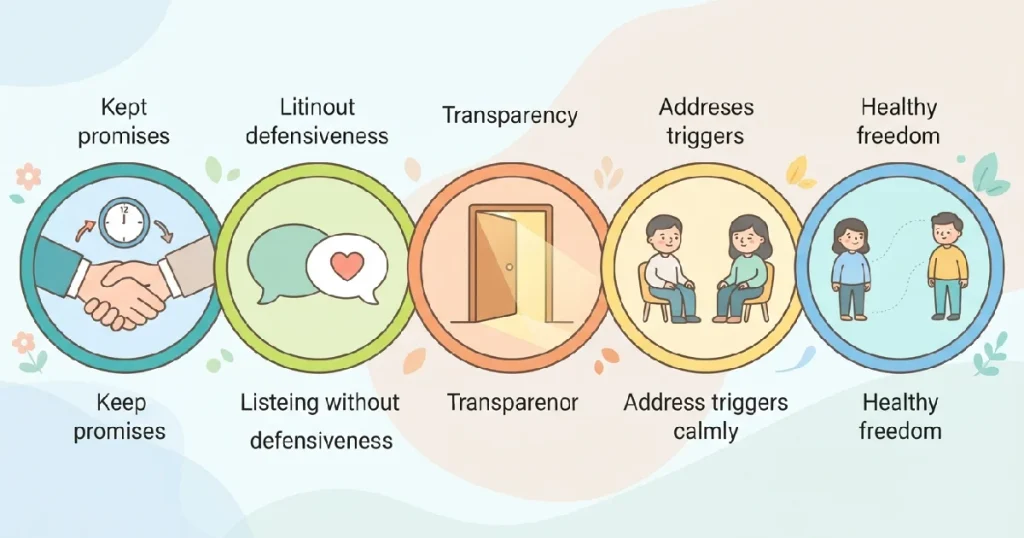
Think of trust like a callus. It forms slowly, one small point of friction at a time, layer after layer, until it can hold real pressure without tearing. Rip it off before it’s had time to thicken, and you’re back to raw skin again. These five steps exist to give the callus time to form.
1. Keep Your Promises, Even the Boring Ones
Say you tell your partner you’ll call at six. Six comes and goes, and so does the call. To you it’s nothing, you got busy. To your partner’s nervous system, it’s data. It just registered that your word and your action don’t always line up.
Trust rarely builds in the big romantic moments. It builds in the small, unglamorous follow-through: the laundry you said you’d handle, the text you promised to send, the ride to the airport at five in the morning. Researchers sometimes describe this as behavioral consistency, meaning your actions match your words across time and situations, not just when it’s convenient.
The fix is almost boring in its simplicity. Do what you say, when you say it. If you genuinely can’t, say so immediately instead of letting your partner discover it on their own.
2. Listen Without Getting Defensive to Protect Emotional Security
When your partner tells you something you did made them feel insecure, your first instinct might be to explain yourself. That instinct is human. It’s also usually the wrong move.
The moment you lead with defense, your partner hears one message underneath your words: your feelings are an inconvenience to me. Try leading with validation instead, something as simple as “that makes sense you’d feel that way.” You can still explain your side later. Just do it after they feel heard, not instead of it.
This single shift, listening before defending, is one of the fastest ways to build emotional security with your partner during a hard conversation. It tells them their inner world matters more to you than winning the argument.
3. Practice Radical Transparency for Open Communication in Couples
Nothing erodes safety faster than a partner who feels like they have to play detective just to know where you’ll be tonight. Radical transparency means offering the information before it’s requested. A quick text saying “running late, grabbing dinner with the team” costs you ten seconds. Its absence can cost your partner an entire evening of spiraling.
This isn’t about surveillance or losing your independence. Open communication in couples works best when it’s proactive rather than defensive, offered freely instead of extracted under pressure. When your partner never has to wonder, their mind stops rehearsing worst-case scenarios and starts relaxing into the relationship instead.
That tight feeling in your chest isn’t overreacting. It’s your nervous system doing math.
Neuroeconomist Paul Zak’s research on oxytocin, sometimes nicknamed the trust hormone, found this chemical rises when someone treats you in predictable, safe ways, and drops when they don’t. Every kept promise is a small chemical vote for safety. Every broken one is a withdrawal. This is the piece that changes everything: your body is running a real, ongoing assessment of the relationship. The steps in this list aren’t just nice ideas. They’re literally the raw material your partner’s brain uses to decide whether you’re safe.
4. Address Emotional Triggers Calmly Before They Become a Fight
Every relationship has trigger points, specific situations that spike insecurity faster than others. Maybe it’s a text left unanswered for hours. Maybe it’s an ex’s name mentioned casually. Waiting until you’re mid-argument to address these is like trying to fix a smoke detector while the kitchen is already on fire.
Instead, bring it up on a calm night, not during conflict. Ask directly: “What are the moments that make you feel most insecure with me?” Then actually sit with the answer instead of minimizing it.
Couples who map their triggers ahead of time tend to argue less about the same recurring issue, because they’ve already built the plan before the fire starts.
5. Give Your Partner Healthy Freedom to Deepen Trust
It sounds backward, but one of the strongest trust signals you can send is stepping back. Letting your partner have a night out with friends, a hobby that doesn’t include you, or their own opinions without a fight communicates something powerful: I trust you enough not to control you.
Attachment researchers describe a secure partner as a “secure base,” someone whose steady presence allows the other person to explore the world freely, precisely because they know they have somewhere safe to return to. Clinginess, even when it comes from love, often reads as the opposite of trust.
Give your partner room to breathe. Paradoxically, that room is often what brings them closer, not further away.
Rebuilding Trust After Infidelity: How to Repair a Relationship After Betrayal

Everything above works well for repairing everyday cracks. If you’re here because of an affair, a lie that shattered everything, or a breakup that left you both raw, the timeline and the rules change. If you’re trying to rebuild trust after infidelity, the process follows its own logic, and it starts with the hardest step of all.
Offer an open book, immediately. The partner who broke trust doesn’t get to decide what feels like too much transparency anymore, at least not for a while. Passwords, locations, and honest answers to hard questions need to be available without hesitation. This isn’t punishment. It’s the fastest way to remove the constant question mark hanging over the relationship.
Expect a real timeline, not a magic reset. Genuine emotional security with your partner after a betrayal rarely returns in weeks. Clinical work from The Gottman Institute on affair recovery notes that couples often need somewhere between two and three years of consistent rebuilding before trust feels solid again. Not because something is wrong with them, but because trauma responses genuinely take time to settle. Expect setbacks. They don’t mean you’re failing.
Let your apology live in your behavior, not your vocabulary. “I’m sorry” loses meaning fast if the same pattern repeats six months later. Real remorse looks like months of the exact behavior your partner needed to see, delivered without being asked, over and over, until it becomes boring proof instead of a performance.
Left unaddressed, this specific kind of wound doesn’t just sit quietly in the background. It tends to resurface at the worst possible moments, usually during your next hard season, and it’s often the real reason relationships that could have healed end up ending instead.
4 Collaborative Relationship Exercises for Trust You Can Try Tonight
Reading about these steps is one thing. Actually practicing them is where the real shift happens. These four relationship exercises for trust turn insight into muscle memory.
The Trigger Mapping Session. Grab a notebook together. Each of you writes down two or three situations that spark insecurity, then you talk through one small step for handling each one together. A useful question to open with might be, “What’s one thing I do without realizing that makes this harder for you?”
Scheduled Trust Outings. Pick one activity that usually triggers anxiety, maybe a solo night out or a new joint hobby. Plan every detail together calmly ahead of time, then follow through exactly as agreed. Each time you execute the plan as promised, you’re building a track record your partner’s nervous system can actually rely on.
Daily Truth-Share Exchanges. Set aside ten minutes every evening to share one honest thought, fear, or small secret without fear of judgment. Consider making it a ritual, like tea before bed. The goal is to make truth-telling feel ordinary instead of like a confession.
Collaborative Future Planning. Work together on something bigger than tonight, a shared savings goal, a career move, a trip you’re both building toward. Supporting each other’s dreams out loud reinforces that you’re on the same team, working toward the same outcome.
Trust in a Relationship Is an Everyday Choice
Remember that tightening in your chest when a phone buzzes. That reaction isn’t going anywhere overnight, and it doesn’t need to. What changes is what happens next. Instead of spiraling, you now have five concrete moves, a realistic timeline, and exercises you can actually schedule this week.
Trust was never going to return in one conversation or one apology. It returns the way it left, one small, repeated action at a time, until what once felt raw finally has the chance to thicken into something that can hold real weight.
The couples who make it through aren’t the ones who never doubted. They’re the ones who kept choosing consistency on the days it would have been easier not to.
Trust isn’t found. It’s built, one honest, unremarkable day at a time.
My Closing Remarks
I’ve sat across from more couples than I can count who believed their trust was gone for good. Most of the time, it wasn’t gone. It was just untested. What actually rebuilt it was never a single breakthrough conversation. It was the unglamorous, repeated choice to show up honestly on ordinary days. If you’re in the hard middle of this right now, you’re not behind schedule. You’re doing the real work most people never realize is required.
More Related Stories for You
- If you’re also thinking about where this relationship is headed long term, you might enjoy reading about the subtle signs he’s going to propose.
About The Author