
 Sara Carmen
Why his silence feels louder than any fight, and what it actually means for your marriage.
Key Points
- An emotionally unavailable husband isn’t always cold or angry. Sometimes he’s pleasant, dependable, and still miles away.
- His withdrawal usually traces back to an old survival pattern, not a lack of love for you.
- You’ll leave this guide with 10 clear signs to name what you’re living with, plus 5 strategies to protect your own peace starting today.
Contents
Table of Contents
Most of us picture loneliness as being alone. Nobody warns you that the loneliest you will ever feel is lying next to someone who won’t look at you. You go through the motions of marriage together, splitting bills, coordinating school pickups, watching the same shows on the couch. And still, by the end of most days, you feel like you’re living with a roommate who happens to share your last name.
Someone looking at your marriage from the outside might think you have it good. He shows up for work every day. He never raises his voice. He’s a decent, involved father. But what they don’t see is the three-day silence after a small disagreement, or the way his jaw tightens the second you try to talk about your feelings.
A friend might tell you that you’re overthinking things. But what she doesn’t see is you rehearsing your sentences in the shower before bringing up anything sensitive, terrified of the wall that goes up the moment you say the wrong thing.
That gap between how your marriage looks and how it feels is exhausting. It also isn’t your imagination. Below are 10 signs your husband may be emotionally unavailable, why this pattern forms in the first place, and 5 real strategies to help you stop chasing a connection that keeps slipping out of reach.
What Does It Mean to Have an Emotionally Unavailable Husband?
An emotionally unavailable husband isn’t simply having a bad week or an off day. It’s a steady pattern where closeness itself feels unsafe to him, even when he genuinely loves you.
He may be generous with his time and terrible with his feelings. He may build you a beautiful home and still be unable to tell you what’s actually going on inside him. That contradiction is what makes this so disorienting for the partners living it.
Much of this traces back to attachment theory, the psychological framework explaining how our earliest bonds with caregivers shape how safe we feel with closeness as adults. A child raised by a parent who was dismissive, distracted, or uncomfortable with emotion learns an early lesson: needing someone leads to disappointment. So the nervous system adapts. It quietly turns down the volume on emotional signals to avoid getting hurt again.
That adaptation has a name, avoidant attachment, and it doesn’t disappear in adulthood. It just moves into the marriage bed. According to WebMD’s breakdown of avoidant attachment, adults with this style often equate independence with safety and vulnerability with danger, even when their conscious mind wants closeness just as much as anyone else.
It also helps to know this exists on a scale. Some husbands pull away only under real stress, like a job loss or a health scare, then return once the pressure lifts. Others live with a permanently sealed inner world, one that never fully opens no matter how safe the relationship becomes. Knowing where your husband falls on that spectrum matters, because it shapes how much room there is for real change.
10 Signs Your Husband Is Shutting You Out Emotionally

Emotional unavailability rarely announces itself. It shows up in a hundred small moments that, on their own, seem forgivable. Here’s what the pattern often looks like when you put those moments together.
1. Logistical but never intimate. Your conversations run smoothly when they’re about the mortgage, the kids’ schedules, or what’s for dinner. The second you try to talk about how you’re actually doing, the conversation goes flat.
2. Defensive shifting and deflection. Mention that you feel disconnected, and instead of curiosity, you get blame. Suddenly you’re the one who’s “too sensitive” or “always starting something.”
3. The “I’m fine” stonewall. When stress rises, he goes cold and pulls back entirely. This is a recognized pattern called emotional stonewalling in relationships, where withdrawal becomes a way to regain a sense of control when things feel overwhelming.
4. Pretending the conflict never happened. After a tense standoff, he simply resets, expecting affection or normal conversation without ever circling back to what actually happened.
5. Mechanized, routine physical intimacy. Physical closeness feels like a task getting checked off rather than a way of feeling close to you.
Most people in this situation don’t realize how much this particular sign eats away at self-worth. It’s not really about sex. It’s about wanting to matter beyond the physical, and slowly learning that you might not.
6. Fierce hyper-independence. He handles hard things completely alone, refusing help even when he’s clearly drowning. Asking for support feels, to him, like a form of exposure.
7. Low responsiveness to your distress. When you cry or get upset, he looks uncomfortable, confused, or minimizes what you’re feeling entirely, as if your pain is an inconvenience rather than information.
8. Weaponized logic. He frames calm detachment as maturity and your emotional honesty as drama, positioning himself as the reasonable one in every disagreement.
9. Living on eggshells. You’ve started filtering every sentence before it leaves your mouth, scanning for anything that might trigger another cold spell. This constant self-monitoring is one of the clearest signs of an emotionally detached partner, and it’s quietly draining you.
10. The flaw-finding escape strategy. Right when things start feeling genuinely close, he begins zeroing in on small imperfections in you, almost as if he’s building a case to justify pulling away again.
If several of these sound painfully familiar, you’re not imagining your marriage. You’re watching a defense system in action, one you didn’t build and can’t fix alone.
Understanding the Cycle: The Anxious-Avoidant Relationship Trap
Here’s where things get interesting, and a little less personal than it feels.
When you reach for closeness and he pulls back, you likely reach harder. That’s a completely human response. But your reaching, to his nervous system, can feel like pressure closing in from every direction.
Picture his inner world as a castle with a drawbridge that lifts on its own. It isn’t that he consciously decides you’re a threat. His system detects closeness approaching and raises the bridge before he’s even had time to think it through.
This creates what psychologists call the anxious-avoidant relationship trap: your pursuit confirms his fear that intimacy is suffocating, while his withdrawal confirms your deepest fear of being unwanted. Two nervous systems, running two very old scripts, feeding each other in a loop neither of you consciously chose.
That’s not weakness. That’s wiring.
According to the Simply Psychology overview of the anxious-avoidant dynamic, this pairing is remarkably common in long-term relationships precisely because it’s self-reinforcing. Each partner’s coping strategy accidentally activates the other’s deepest fear. In my practice, I’ve seen this dynamic in couples who love each other deeply but are speaking entirely different emotional languages, one asking for reassurance, the other asking for space, both convinced the other is the problem.
5 Proven Strategies to Regain Your Peace and Handle the Distance
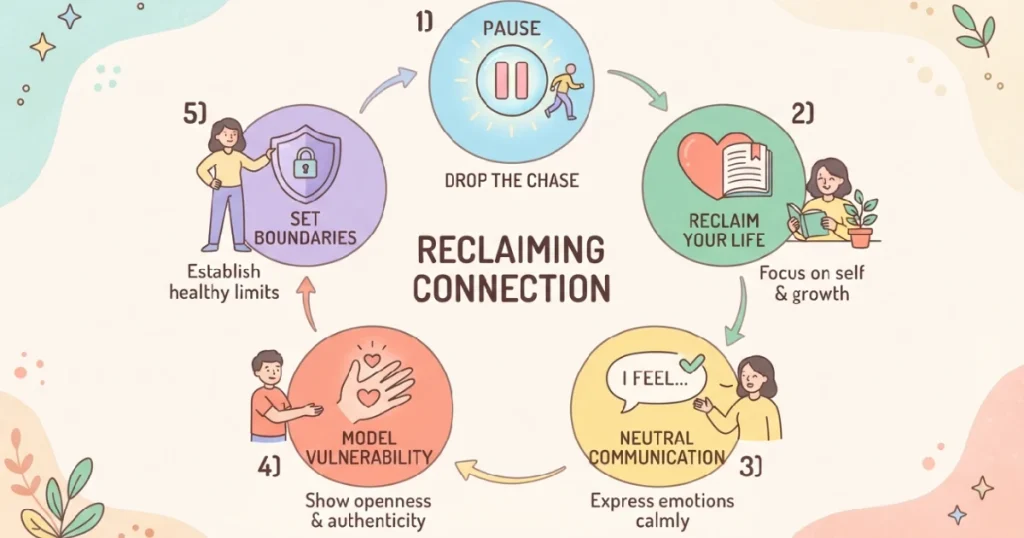
You cannot force your husband’s nervous system to feel safe. But you have far more control here than it might feel like right now.
1. Drop the emotional chase.
Consciously step out of the pursuit. When he’s flooded and shutting down, pushing harder for a deep talk in that exact moment almost never works. Giving his system room to settle, even for a few hours, often opens a door that pressure keeps slammed shut.
2. Reclaim an independent life.
Redirect the energy you’ve been spending trying to fix his distance into your own friendships, hobbies, and interests. A 2021 study on relationship satisfaction found that partners who maintained strong outside social ties reported lower loneliness even in emotionally distant marriages. Your joy doesn’t have to wait for his growth.
3. Communicate through neutral “I” statements.
Try saying, “I feel isolated when we don’t connect after work,” instead of “You always shut me out.” The first invites conversation. The second invites his defenses to slam shut before you’ve even finished the sentence.
4. Model vulnerability without expectation.
Share a small worry or a good moment from your day without demanding he match it. You’re not performing. You’re quietly teaching his system, through repetition, that sharing doesn’t lead to punishment.
5. Set clear, healthy boundaries.
There’s a real difference between accepting an avoidant style and tolerating silent treatments that go on for days. Learn where your limit is, and be willing to name it plainly: this pattern isn’t sustainable, and something has to shift.
One place to start this week is simply noticing your own chase pattern. The next time you feel the urge to demand an immediate response after conflict, try waiting one full hour before you speak again. Notice what happens in his behavior, and in your own body, during that pause.
When Is It Time to Seek Professional Help?
If years have passed with no shift, or every attempt at closeness is met with total resistance, it may be time to bring in outside support. Emotionally Focused Therapy, a well-researched approach built directly around attachment theory, helps couples trace exactly where the pursue-withdraw loop begins and gently re-pattern it in a setting that feels safe for both people.
Reaching out for help here isn’t a sign your marriage has failed. It’s a sign you’ve stopped pretending you can fix this alone, which is often the first real step toward change.
Conclusion: Shifting From Exhaustion to Self-Preservation
Understanding his walls doesn’t erase the ache of living behind them. But it does something important: it stops you from blaming yourself for a silence that was never about your worth.
You cannot lower his drawbridge for him. You can, however, stop standing outside it, waiting. Reclaiming your own peace, your own friendships, your own sense of self isn’t giving up on the marriage. It’s the first honest step toward healing it.
The version of you who no longer waits at the gate is the one who finally gets free.
My Closing Remarks
I’ve sat with more women than I can count who whispered some version of “maybe I’m asking for too much.” You’re not. Wanting to be known by the person you married is not too much. What I want you to walk away with tonight isn’t just a list of signs, but permission to stop shrinking yourself around someone else’s fear. Your peace matters just as much as his comfort does.
More Related Stories for You
- Curious how emotional readiness shows up earlier in a relationship, before the wedding even happens? Take a look at these signs he’s going to propose to understand how commitment cues reveal a partner’s emotional openness long before marriage begins.
About The Author