
 Nicole Adkins
Six honest conversations that decide whether your marriage thrives or quietly falls apart.
Why the quietest cruelty is the hardest to name, and how to find your way back to yourself.
Key Points
- Covert narcissistic abuse rarely looks like abuse at all. It looks like heavy sighs, cold silence, and a partner who “just needs more understanding.”
- These 10 hidden signs of covert narcissistic abuse explain why smart, caring people end up doubting their own memory and judgment for years.
- Learn how vulnerable narcissism traits, trauma bonding, and passive-aggressive manipulation work together, and what real emotional validation and healing actually looks like.
Contents
Table of Contents
Everything you have learned about narcissistic abuse might be the reason you missed it.
You were watching for grandiosity. Loud demands. A person who needed to be the center of every room. So when you found yourself with someone shy, sensitive, maybe even self-critical, your guard came down. That was your first mistake, and it was not really a mistake at all. It was a completely reasonable response to bad information.
You’ve tried to explain the exhaustion to friends and it never lands right. There’s no dramatic story. No slammed doors. Just a slow, constant drain that leaves you apologizing for things you didn’t do and questioning feelings you know are real. You start to wonder if something is wrong with you.
There isn’t.
What you’re describing has a name in clinical literature. It’s called covert narcissistic abuse, and it is one of the most under-recognized forms of psychological mistreatment in long-term relationships today.
Surface vs. Reality: The Scenarios You Recognize
Someone might think your partner is just quiet and a little insecure. What they don’t see is the silent treatment that lasts three days over a minor disagreement, and how you end up begging for a conversation that should have taken ten minutes.
Someone might think your mother is the most selfless person they know. What they don’t see is how every one of your milestones somehow becomes about her exhaustion, her sacrifice, her unrecognized suffering.
Someone might think your coworker is refreshingly humble. What they don’t see is the backhanded comment disguised as concern, delivered with a soft voice and a sympathetic tilt of the head, that leaves you replaying it for the rest of the day.
This is the confusion at the center of covert narcissistic abuse. The public performance and the private experience do not match, and you are the only one holding both halves of the picture.
What Is Covert Narcissistic Abuse? Understanding Vulnerable Narcissism Traits
Covert narcissism, often referred to in clinical research as vulnerable narcissism, describes a pattern of entitlement and low empathy hidden behind a shy, hypersensitive, or self-deprecating exterior. This isn’t a casual personality quirk. It reflects a structural pattern of relating to others where control and admiration are the goal, but the strategy for getting there is indirect.
Overt narcissists demand the spotlight. They brag, dominate conversations, and openly expect special treatment. Covert narcissists get to the same destination, control over you and the relationship, through a completely different route. They play the perpetual victim. The unrecognized martyr. The one who suffers quietly and therefore deserves your endless patience.
According to the National Institutes of Health Diagnostic Overview, pathological narcissism includes both grandiose and vulnerable presentations, and the vulnerable type is marked by hypersensitivity to criticism, chronic feelings of shame, and a tendency to withdraw rather than confront. That withdrawal is not passivity. It’s a mechanism.
Here’s the part most people miss. The manipulation in covert narcissistic abuse relies on indirect aggression rather than open conflict. Boundaries erode a little at a time. Reality gets bent just enough that you start questioning your own perception rather than theirs. That bending of reality is a close cousin of gaslighting in relationships, and it works precisely because nothing is ever said outright.
Most people in this situation don’t realize that the confusion itself is the tactic, not a side effect of it.
10 Hidden Signs of Covert Narcissistic Abuse and Passive-Aggressive Manipulation

1. Passive-Aggressive Stonewalling
The tactic looks like withdrawal. Ice-cold silence. Ignoring a direct question instead of answering it.
Instead of resolving conflict, they simply disappear emotionally while standing right in front of you.
The impact leaves you frantic. You over-apologize. You chase reconnection over disagreements that were never that serious to begin with.
2. The Weaponized Victim Facade
Every situation somehow gets rerouted back to their pain, their stress, their misfortune. It doesn’t matter what you’re going through.
Your actual trauma or achievement gets quietly eclipsed by their need to be the one who is struggling most.
This traps you in a permanent caretaking role, where your own emotional needs simply stop registering as relevant, to them or eventually to you.
3. Public Dog-Whistling and Backhanded Insults
They deliver cruel comments disguised as helpful advice, deep concern, or an inside joke that only the two of you would understand.
To anyone watching, it sounds innocent. Sometimes even kind.
But it needles you with pinpoint accuracy, quietly wearing down your confidence while keeping them completely protected from outside criticism.
Maya’s Story: The Partner Who Never Raised His Voice
Maya spent six years with a man everyone described as gentle. He never yelled. He never called her names.
But every time she brought up something that bothered her, he grew quiet, then tired, then sick. Migraines. Chest tightness. A sudden need to lie down.
By the time she left, Maya couldn’t remember the last time she had finished a sentence about her own feelings. She thought she was the difficult one. She wasn’t.
4. Systematic Deflection, DARVO, and Gaslighting in Relationships
When you calmly raise a boundary, they respond with a pattern researchers call DARVO: Deny, Attack, and Reverse Victim and Offender. In plain terms, they deny what happened, attack you for bringing it up, and somehow end up positioned as the injured party.
This is one of the clearest markers of gaslighting in relationships, because the original issue never gets addressed at all.
You walk away apologizing for how you brought something up, rather than getting an answer to the thing you actually raised.
5. Micro-Boundary Violations
Small personal boundaries get ignored under the cover of forgetfulness, clumsiness, or good intentions. Reading your messages “by accident.” Showing up somewhere you asked them not to.
Each one alone seems too minor to mention.
But that’s the point. These small violations gradually wear down your sense of autonomy, making the larger boundary crossings much easier to pull off later.
Why smart, empathetic people fall for this. Here’s something rarely said out loud: covert narcissistic abuse doesn’t target weakness. It targets conscience. The more empathetic, self-aware, and fair-minded you are, the more susceptible you become, because you keep giving them the benefit of the doubt they never extend to you. Your integrity becomes the very thing they exploit. That’s not a character flaw. That’s a design feature of the dynamic, and understanding it is the first real crack in the confusion.
6. Conversational Hijacking and Dissociation
You start sharing something you’re proud of, and their eyes drift to a phone, or the topic shifts abruptly back to their own grievances.
Over time, this trains you to believe your voice, your goals, and your inner world simply don’t matter much.
That’s not you being too sensitive. That’s your nervous system responding exactly the way it was conditioned to.
7. Triangulation via Pity
They compare you, unfavorably, to a third party. An ex who was “so understanding.” A coworker who “actually listens.”
This creates an artificial competition you never signed up for.
The result is that you find yourself working harder and harder for approval that always stays just out of reach.
8. Empty, Self-Referential Apologies
“I’m sorry you feel that way.” “I guess I’m just the worst partner ever.” These are not apologies. They’re deflections dressed up as accountability.
Real repair requires naming the harm and the impact. This does neither.
Instead, it shuts down the conversation entirely by forcing you to comfort them during an apology they actually owe you.
9. Somatic Symptom Mirroring
Right when you need support, or right before a big event of yours, they develop a sudden illness, a panic spike, or overwhelming fatigue.
This isn’t always conscious manufacturing. Sometimes the body genuinely responds to the threat of losing control.
Either way, the effect is the same: the emotional and logistical focus of the room snaps back to them.
10. Selective Kindness and the Double Bind
Warmth shows up when they want compliance. Cold, transactional distance shows up the moment you hold a boundary.
This creates what psychologists call a double bind, a situation where you feel wrong no matter which way you move.
Stand your ground, and you’re punished. Give in, and you lose a little more of yourself. Either way, you end up believing the problem is you.
The Vicious Cycle of Vulnerable Narcissism and Trauma Bond Recovery
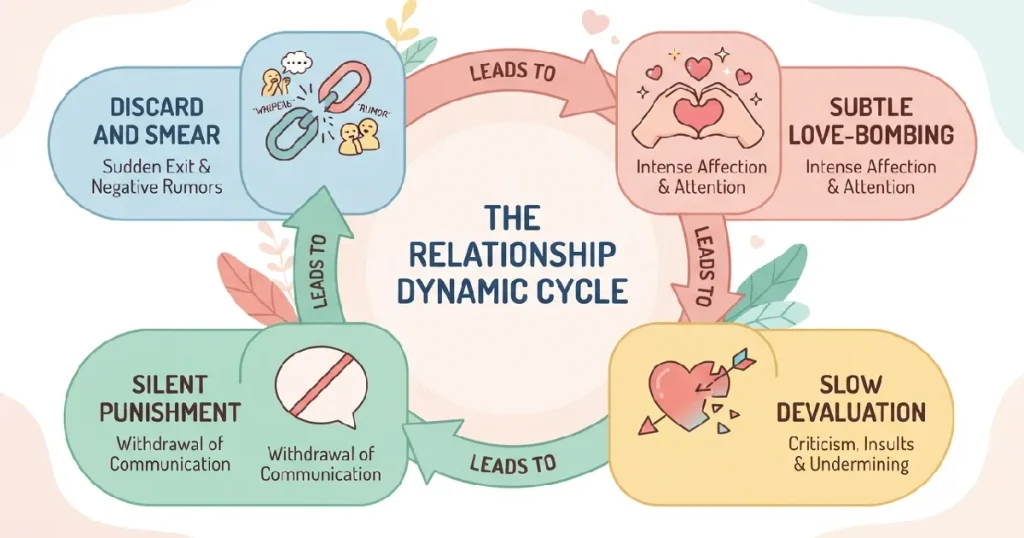
Living inside this dynamic doesn’t feel like a slow decline while it’s happening. It feels more like the air in the room is being turned down one percent at a time, so gradually that you start blaming your own lungs instead of the room.
Subtle love-bombing opens the relationship. They mirror your emotions with startling accuracy and present themselves as a wounded soul only you have the capacity to understand.
Slow devaluation follows. The warmth gets replaced, piece by piece, with sighing, eye-rolling, and affection that only shows up when you’re compliant.
The discard and the smear campaign close the loop. They leave without explanation, or push you toward leaving, then quietly recast themselves as the victim to anyone who will listen.
According to research on traumatic bonding first outlined by psychologists Dutton and Painter, intermittent kindness paired with unpredictable coldness creates a powerful attachment, not despite the abuse, but partly because of it. This is the biological root of trauma bond recovery being so much harder than people expect. Your brain isn’t broken. It’s responding exactly the way a brain wired for connection is built to respond to intermittent reward.
Reclaiming Your Sanity: How to Protect Yourself From Covert Narcissistic Abuse
The Grey Rock Method. Become intentionally uninteresting. Emotionally flat. Give short, factual answers that offer nothing for them to grab onto. If they say something baiting, you might respond with a simple “okay” and nothing more. The boredom this creates is often more effective than any argument.
Clean, enforced boundaries. State the rule once, plainly. “If you give me the silent treatment, I’m going to leave the room.” Then actually leave the room, without asking permission or waiting for agreement. A boundary you explain and then abandon isn’t a boundary. It’s a suggestion.
No contact as a nervous system reset. Complete physical and digital separation isn’t about punishing anyone. It’s the clearest way to let an overloaded nervous system finally settle, without the constant static of intermittent contact pulling it back into alert mode.
A useful question to ask yourself this week: where in my life am I still explaining myself to someone who has never once tried to understand me?
Steps to Emotional Validation and Healing After Covert Narcissistic Abuse
Unpacking the trauma bond takes more than willpower. It takes time, and often, it takes support that understands the specific mechanics of intermittent reinforcement rather than general relationship advice.
This is exactly why choosing a trauma-informed therapist matters so much more than standard couples counseling, which a covert manipulator can charm and redirect with startling ease. In my practice, I’ve watched clients finally exhale for the first time in years the moment a professional simply said, “What happened to you makes complete sense.” You can read more about practical coping approaches in this detailed clinical resource.
Emotional validation and healing starts with a small, radical act: believing your own perception again, one small memory at a time.
The Air in the Room Is Yours to Control Now
Remember that room where the oxygen kept getting quieter, and you kept blaming your own lungs? You now know exactly who was turning the dial.
You are not too sensitive, too dramatic, or too much. You were simply outmatched by a pattern nobody taught you to recognize, until now.
That knowledge is yours to keep. It doesn’t leave with the relationship. It stays with you, standing guard over every door you choose to open next.
My Closing Remarks
I’ve sat across from so many people who apologized for crying about a relationship with “no real abuse” in it. I always tell them the same thing: quiet damage is still damage. Your exhaustion was never irrational. It was information. You survived something real, and you’re allowed to say so, out loud, without evidence, without permission from anyone but yourself.
More Related Stories for You
- Curious what healthier relationship dynamics actually look like once you’ve broken the pattern? Read about the qualities of a good partner to see the contrast for yourself.
About The Author