
 Nicole Adkins
You can love them fiercely and still refuse to fund the thing that is killing them.
Key Points
- Learning how to help a person with drug addiction starts with one hard truth: rescue and support are not the same thing.
- Cash-free aid, harm reduction, and ordinary connection keep someone alive without feeding the cycle.
- You can hold the relationship and still refuse to become the supply line.
Contents
Table of Contents
We tell ourselves that love should be enough. That if we stay close, cover one more missed shift, and send one more transfer, they will finally feel how much they matter. We keep pouring. And they keep sinking.
You have tried. You have really tried. You have stayed up until 3 a.m. waiting for a text that never came. You have rewritten the same speech in your head a hundred times. You have paid a bill you could not afford because the alternative felt like abandonment. And still the same pattern returns. You start to wonder if you are failing them. You are not failing them. You have been using the wrong kind of help.
Someone might think handing over two hundred dollars is keeping their adult child off the street. But what they don’t see is that the money often becomes the next dose, not the next meal.
Someone might think cutting all contact is the only way to stay sane. But what they don’t see is that isolation is one of the strongest drivers of overdose.
Someone might think if they loved harder the addiction would loosen. But what they don’t see is that the brain’s reward system has been chemically rewritten, and love alone cannot rewrite it back.
Here is the short answer. You help a person with drug addiction by protecting their life without funding their use. That means cash-free support, firm boundaries, naloxone within reach, and ordinary human connection that does not wait for perfect sobriety. You open the door. They walk through it.
That is the core idea of this entire piece. True help saves a life. It does not soothe your panic in the moment. Those two goals often pull in opposite directions, and most families never get told that out loud.
Addiction is a substance use disorder, or SUD. That is the clinical name for a medical condition in which repeated drug use changes the brain’s reward circuitry, the network that tells you what is worth chasing. Understanding that substance use fundamentally alters the reward circuitry of the brain can help you approach the crisis with factual empathy rather than anger, as outlined by the (NIDA). The person you love is not choosing chaos for sport. Their brain has learned that the substance is survival. Your job is to stop feeding that lesson.
The Hardest Shift: Support vs. Enabling
Support keeps a person alive and connected. Enabling removes the natural cost of use so the illness can keep running.
Most people in this situation don’t realize how quietly they crossed that line. You crossed it because you are decent. Because watching someone you love shake, lie, or disappear feels unbearable. Enabling is not a character flaw. It is love with no map.
Identifying the Sneaky Signs of Enabling
Enabling looks like care from the inside. You pay rent after they spent the paycheck. You call their boss with a fake stomach flu. You lie to relatives so no one “worries.” You hand them cash “just this once” because they promised food, not fentanyl.
Falling into codependent habits can inadvertently delay an individual’s recovery milestones; reviewing the classic warning signs detailed by WebMD’s Addiction Enabling Feature can help families spot and halt dangerous transactional patterns early. Codependency, in plain language, is when your sense of safety becomes tied to managing another person’s crisis. You stop living your life and start running theirs.
If your help consistently prevents them from feeling the weight of their own choices, it is not help. It is a subsidy.
Embracing Compassionate Detachment
Compassionate detachment means you keep the bond and drop the compliance. You still answer the phone. You still say “I love you.” You do not jump into every fire they start.
Think of a cracked cup. You have been pouring money, alibis, and sleep into it for months or years. The cup never fills. You are the one who ends up empty. Detachment is not slamming the cupboard. It is stopping the pour and handing them a different cup: groceries, a ride, a treatment bed, a walk around the block.
Left unexamined, this pattern does not only drain your bank account. It can quietly become the reason you lose your own health, your marriage, and the last bit of influence you still have with them.
9 Practical Tips to Help a Loved One With Addiction
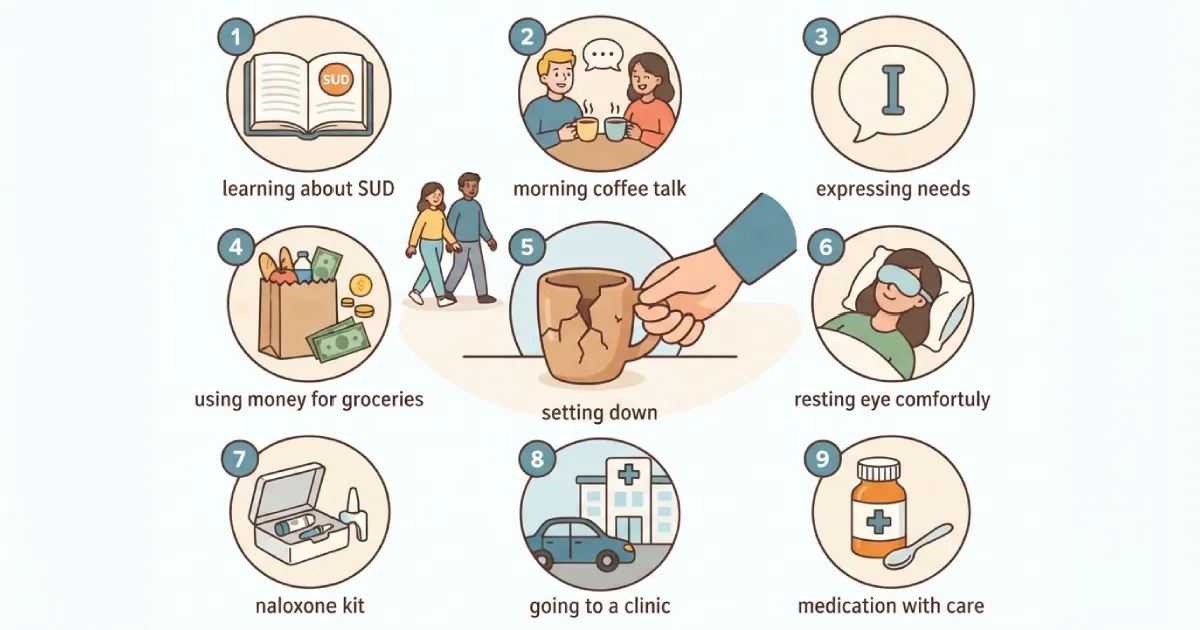
1. Educate Yourself on Substance Use Disorder Before You Intervene
Addiction is a medical condition, not a moral verdict. Tolerance means the body needs more of the drug to get the same effect. Withdrawal is the brain and body protesting when the drug is removed. Triggers are people, places, moods, or even a time of day that light up craving.
There is another piece most families miss. A growing number of people with undiagnosed ADHD use stimulants, cannabis, or opioids to quiet a brain that will not sit still. That is self-medication, not a party habit. If your loved one has always struggled with focus, impulsivity, or restlessness, treatment that ignores that layer often fails. You do not diagnose them at the kitchen table. You do keep that possibility in your pocket when you talk about “getting help.”
2. Start the Conversation About Drug Addiction at the Right Moment
Do not open this talk in the middle of a high, a hangover rage, or a family holiday. Pick a private room with phones down. Morning, when they are most likely sober, gives you the best shot at a brain that can still hear you.
Choosing a private setting and using non-judgmental phrases are foundational strategies recommended by SAMHSA’s Conversation Guides to effectively introduce options for professional support. You are not staging a trial. You are opening a door while their nervous system can still walk through it.
3. Speak With “I” Statements Instead of Accusations
“You are ruining this family” slams the door. “I feel terrified when I don’t hear from you for two days” keeps it cracked open. The first statement attacks identity. The second names your experience.
Try this shape: I feel [emotion] when [specific behavior] because [impact]. I need [clear request].
“I feel sick with worry when you disappear overnight because I don’t know if you are alive. I need you to send one text by 10 p.m. so I know you are safe.”
You are not asking them to become a different person in one sitting. You are asking for one observable action.
4. Set Financial Boundaries That Stop Enabling Addiction
This is where most helpers freeze. Money feels like love. In active addiction, cash is often a delivery system.
Shift to cash-free aid. Buy the groceries. Pay the landlord directly. Put a bus pass in their hand. Do not put twenties in it.
Use language you can repeat when you are shaking:
“I love you. I will not give you cash. I can drop off groceries tomorrow at noon.”
“I will call the utility company and pay this bill myself. I will not transfer money to your account.”
“I care about you too much to fund something that could kill you. That is not a punishment. That is the line.”
If they escalate, repeat the line once and leave the room. A boundary you argue about is no longer a boundary. It is a negotiation.
5. Protect Your Mental Health While You Help a Person With Drug Addiction
You cannot pull someone out of quicksand if you have already stepped in beside them. Guilt will tell you that rest is selfish. Guilt is lying.
In my practice I have watched capable, loving people lose sleep, marriages, and their own health while waiting for someone else to get well. Family recovery does not wait for their sobriety date. Al-Anon and Nar-Anon exist so you can treat the codependency even if they never enter treatment. That is not giving up. That is staying sturdy enough to remain a real option.
A useful question: If nothing about their use changed for a year, what would you need in order to still have a life?
6. Use Harm Reduction to Keep Them Alive Today

Perfection is a luxury dying people do not have. Harm reduction means reducing the chance of death and injury even while use continues. It is not approval. It is first aid.
Keep a naloxone kit, often known by the brand Narcan, in your home, car, and bag. Learn how to use it. Ask a pharmacist. Tell one other person where it is. If opioids are in the picture, this single step can reverse an overdose long enough for emergency help to arrive.
You can hate the drug and still refuse to let them die on the bathroom floor while you wait for them to “hit bottom.” Bottoms are not always teachable moments. Sometimes they are funerals.
7. Offer Specific Logistics for Addiction Treatment, Not Vague Advice
“You need to get help” is a slogan. It gives them nothing to grab.
Do the unglamorous work. Find an open assessment slot. Check what their insurance actually covers. Offer the ride. Sit in the waiting room. Integrating modern mental health practices is highly beneficial, and the National Institute of Mental Health (NIMH) emphasizes that combining behavioral therapies like Cognitive Behavioral Therapy (CBT) with family-based interventions yields the highest recovery success rates. CBT, in plain language, is a structured way to notice the thought-craving-use loop and practice a different move before the use happens.
Make the first step smaller than their fear.
8. Learn How Medication-Assisted Treatment Helps Drug Addiction
Many families panic when they hear buprenorphine or naltrexone. They think it is “trading one addiction for another.” That myth keeps people in withdrawal and withdrawal drives relapse.
Incorporating evidence-based medical plans can be transformative, as clinical data summarized by the Cleveland Clinic Substance Use Disorder Guide proves that FDA-approved medications efficiently rebalance brain chemistry to drastically mitigate physical cravings. Medication-assisted treatment, or MAT, steadies the brain so counseling can actually land. A person who is not drowning in craving can finally use the skills you have been begging them to use.
9. Build Low-Stress Connection Outside the Addiction Cycle
If every conversation is about the drug, you become another trigger. Isolation feeds use. Ordinary belonging starves it.
Invite them to a meal at your table. Walk a trail. Watch a movie at home. Cook something simple. These are not rewards for sobriety. They are reminders that they are still a person with a name, not a problem with a pulse.
This is the grey area so many of you are living in right now. They have refused treatment. They still want you. You can keep the relationship without keeping the cash flowing. Connection over lectures. Presence over panic.
You can also suggest a shared digital check-in. Recovery apps that log triggers, cravings, and clean days give you a concrete way to talk about patterns instead of character. You are not policing their phone. You are building a simple record you can look at together on a calm morning.
When Diane Stopped Filling the Cracked Cup
Diane’s son Cole was 27 and using opioids after a work injury turned into a daily need. She paid his rent for eleven months. She told his landlord he had the flu. She transferred money at midnight because his voice sounded small. She thought she was buying time. She was buying product.
The night she found him unresponsive on her bathroom tile, she used naloxone for the first time. He lived. The next morning, still shaking, she said the line she had practiced in her car: “I love you. I will not give you cash. I will pay the landlord directly this month and I will drive you to the assessment on Thursday at 9.” Cole swore at her. He also got in the car. He relapsed twice after that. She did not go back to midnight transfers. She went to Al-Anon. She kept inviting him to Sunday eggs. The cup still had a crack. She stopped pretending she could fill it alone.
That is not a movie ending. That is what real help often looks like. Messy. Boundaried. Alive.
What to Do if They Refuse Treatment for Drug Addiction

Defensiveness is not proof you said it wrong. It is often the illness protecting its supply. Do not argue while voices rise. Name the pause. “I can see this is too hot right now. I am going to stop. I love you. We can pick this up tomorrow morning.” Then actually stop.
If one calm talk goes nowhere, a structured family intervention can help. Keep it small, planned, and short. Each person reads a brief “I” statement. Someone has already booked the assessment. Consequences are named in advance and kept. “If you do not go Thursday, you cannot stay in this house.” An intervention is not an ambush of shame. It is a coordinated offer with a clear next step.
And if they still refuse, you do not vanish. You return to cash-free support, naloxone, ordinary invitations, and your own recovery meetings. That is the grey area. Most families live there longer than any brochure admits.
Resources for Families Helping Someone With Addiction
You need a room where their progress is not the agenda.
Al-Anon and Nar-Anon give you language, witnesses, and a weekly reminder that you are not the treatment plan. Family therapy, especially approaches that include CBT skills for the household, can stop the same fight from replaying every Sunday. SAMHSA’s National Helpline at 1-800-662-HELP is free, confidential, and can point you toward local beds and family programs.
Your healing is allowed to start first.
Three Moves You Can Make in the Next 24 Hours
The Cash-Free Rule. Decide tonight that no physical cash and no instant transfers leave your hands. If a real need appears, you buy the thing or pay the vendor. Write the sentence you will say and keep it in your notes app.
The 24-Hour Pause. The next time a frantic request hits your phone, wait one full day before you respond with money or a rescue. Use the day to ask one question: Does this keep them alive, or does this keep the use going?
The Ordinary Invite. Send one low-pressure offer that has nothing to do with rehab. “I’m making pasta at 6. You’re welcome. No speech, just food.” Connection is a harm reduction tool too.
A useful question to sit with: Am I trying to save their life, or am I trying to silence my own terror for one more night?
Those are not always the same project.
You came into this exhausted, scared, and still in love. You now have a different definition of help. You do not have to keep pouring into the cracked cup. You can hold the rope, keep naloxone close, pay the landlord instead of the dealer, and sit across a kitchen table like two humans who still belong to each other.
They may not walk through the door this week.
You can still stop living in the doorway.
My Closing Remarks
I have sat with parents who whispered “I feel like I am killing them by saying no.” I have sat with partners who stayed because leaving felt like a death sentence they would have to sign. If that is you, hear me. Your tenderness is not the problem. Unbounded tenderness is. The bravest thing I have watched families do is stay warm and become immovable at the same time. That combination feels unnatural at first. It is also the first time many people in active addiction meet a kind of love that cannot be spent.
More Related Stories for You
- If the strain of this crisis is leaking into every text, every dinner, and every silent car ride, you may also want to read about how constant digital noise shapes closeness and conflict.
About The Author