
 David Wall
The science-backed way to feel content today while still building the bigger life you want tomorrow.
Key Points
- Learning how to be happy with what you have doesn’t mean killing your ambition. It means separating your worth from your next win.
- Your brain adjusts to almost every gain within weeks, which is exactly why chasing more rarely gives you the relief you expect.
- A simple daily practice called Dual-Track Living lets you appreciate your life right now while still growing toward something bigger.
Contents
Table of Contents
We live like the next win will finally let us breathe out. We build entire identities around the idea that peace is one milestone away.
You’ve felt this too. You hit the goal, and for about six days, everything glows. Then the glow fades, and you’re already circling the next target.
Maya just got promoted to senior director. Her friends think she finally has it made. What they don’t see is that she updated her résumé the same week, already scanning job boards before her new business cards arrived.
Jordan works from home on a schedule he built himself. Coworkers assume he has the good life, sleeping in, working from anywhere he wants. What they don’t see is that Jordan checks his phone at 11 p.m. out of pure habit, because nothing marks the end of his workday anymore.
Priya tracks every dollar across three different apps. People used to whisper that she was cheap. Now they ask her for advice, because being careful with money finally reads as smart instead of small.
None of them are broken.
They are living inside a psychological pattern that most people never get named for them. Here’s the short version: your happiness doesn’t come from arriving somewhere. It comes from how you interpret where you already are, while you keep moving.
The Contentment Paradox: Why Chasing More Fails (and How to Stop)
There’s a reason the promotion, the new apartment, or the bigger savings account never delivers the lasting calm you expected. Researchers call it hedonic adaptation, and it’s one of the most well-documented findings in happiness research.
Unmasking the Hedonic Treadmill in the Digital Age
Hedonic adaptation is your brain’s tendency to return to its baseline mood after almost any positive or negative event. You get the raise. You feel great for a few weeks. Then your brain quietly resets your expectations, and the new salary becomes your new normal.
This idea traces back decades, but a widely cited paper by psychologist Sonja Lyubomirsky and colleagues found that a large share of your day-to-day happiness comes from intentional daily habits, not from external circumstances like income or achievements. In plain terms, what you do each day matters more than what you finally acquire.
Now add wearables, productivity apps, and constant metric tracking into that mix. You can measure your sleep, your steps, your screen time, your savings rate, down to the decimal. That level of tracking was supposed to bring clarity. Instead, it often just gives your brain more numbers to compare against, feeding the hedonic treadmill instead of slowing it down.
This matters because if you don’t understand this mechanism, you’ll keep interpreting your restlessness as a personal flaw. It isn’t. It’s biology doing exactly what it evolved to do.
Why Flexible Lifestyles Aren’t Making Us Happier
Here’s something that surprises most high achievers. Flexible work improves job satisfaction, but large-scale well-being research shows it doesn’t reliably improve overall life satisfaction. The reason is simple. Flexibility without boundaries just moves the stress around instead of removing it.
This is exactly what’s happening to Jordan. His schedule is technically free, but his mind never clocks out. Without a hard stop, his brain treats every hour as potentially “work time,” which quietly drains the rest he’s supposedly gaining. The NIMH’s guidance on caring for your mental health points to the same principle: structure and boundaries, not just freedom, are what protect your mood over time.
But the deeper problem isn’t your schedule. It’s the type of motivation driving you toward the next thing. And that’s where most advice about contentment goes wrong.
Rebranding Ambition: How to Desire Growth Without Disliking Your Present
Most people assume contentment and ambition cancel each other out. Either you’re satisfied and stop growing, or you’re driven and stay unsatisfied. This is a false choice, and believing it is probably what’s exhausting you.
The Danger of Deficit Motivation
Deficit motivation is striving to fix a feeling of “not enough.” Not smart enough. Not accomplished enough. Not secure enough. It works, temporarily, because achievement briefly quiets the discomfort.
But here’s what no one tells you.
The relief never lasts, because the goal was never really about the goal. It was about escaping a feeling. Once you land the promotion or hit the savings target, the underlying feeling of “not enough” is still sitting there, waiting for its next assignment. This lines up with self-determination theory, a well-established framework showing that motivation driven by external pressure or self-doubt produces far less lasting satisfaction than motivation rooted in genuine interest or values.
Expansion motivation is the opposite. You build something because the building itself feels meaningful, not because you’re running from a feeling of inadequacy. The outcome is still important to you. But your sense of worth doesn’t rise or fall with it.
Designing a Dual-Track Mindset for Contentment and Scale
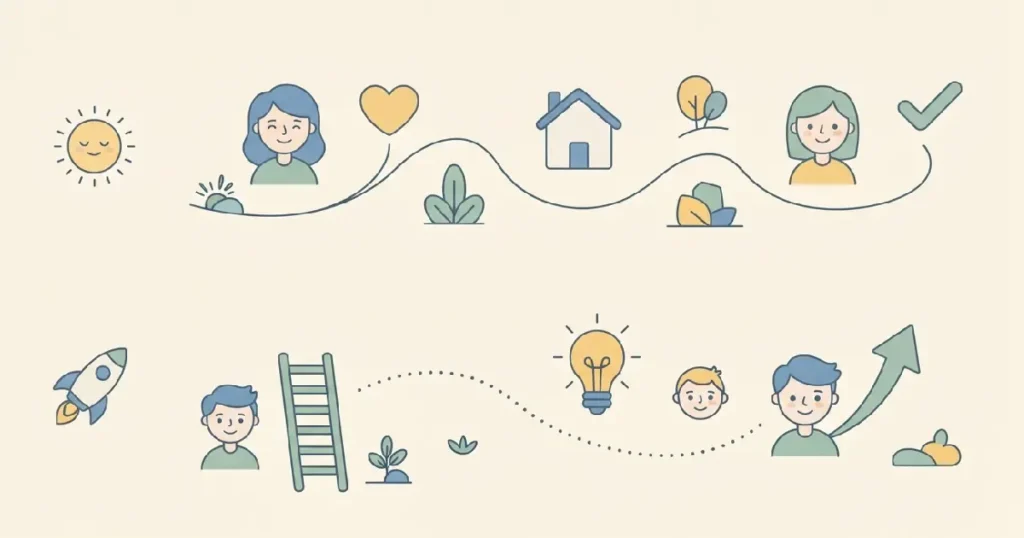
Here’s the reframe that changes everything: you don’t need one mindset for your whole life. You need two, running side by side.
Think of it like running two separate accounts. Track A is your baseline, the fixed, non-negotiable appreciation for what’s already true in your life right now. Track B is your growth playground, where curiosity and ambition live freely without needing to prove anything.
This is the piece most advice about contentment misses entirely. Wanting less isn’t about shrinking your goals. It’s about deciding, in advance, that your emotional baseline is already secure, the same way you’d protect your savings before spending on anything discretionary. Your contentment becomes the fixed cost you pay yourself first. Your ambition becomes what you build with what’s left over, guilt-free.
Maya used this exact shift. Instead of chasing her next title to quiet a fear of falling behind, she started keeping a short list each morning of what her current role already gave her: autonomy, a team she respects, financial stability. That became her Track A. Her job search became Track B, something she explored out of curiosity about her own growth, not panic about her own worth. Within a few months, she noticed she was making calmer, sharper career decisions, because she was choosing from security instead of running from fear.
Practical Strategies to Be Happy With What You Have Right Now

Understanding the mechanism is one thing. Living it daily is another. These are the strategies that actually move the needle.
Turning Frugality Into a Strategic Power Move
Wanting less used to carry a quiet stigma, like it meant you’d given up on bigger things. That perception is shifting fast. A recent Euromonitor consumer survey found that roughly 72 percent of people report real anxiety about rising costs, and in response, careful spending is increasingly viewed as sharp financial judgment rather than a lack of ambition.
Priya’s story reflects this shift exactly. Her habit of tracking every expense used to get mocked. Now it reads as intelligence, because it is. The APA’s research on financial stress confirms that money worries are one of the most consistent predictors of daily anxiety, which means protecting your resources isn’t small thinking. It’s self-protection with a long time horizon.
The takeaway: wanting less isn’t a consolation prize. It’s a form of control you’re choosing on purpose.
Shifting From Superficial Self-Care to Real Emotional Safety
A lot of wellness advice tells you to “just be grateful” while ignoring your actual pressures, your bills, your workload, your exhaustion. That kind of advice rightfully makes people angry. Real contentment isn’t a soft, spiritual add-on. It’s a practical sense of emotional safety, meaning you don’t need external proof to feel secure in who you are.
The Psychology Today library on happiness describes this same distinction: lasting well-being comes from stable internal footing, not from a string of temporary highs. Building that footing means noticing what already feels safe in your life and reinforcing it deliberately, instead of waiting for the next achievement to hand it to you.
Prioritizing Meaning Over Willpower to Avoid Stagnation
Here’s a reframe worth sitting with. Motivation research increasingly shows that emotions function less like fixed commands and more like flexible signals your brain interprets based on context. Neuroscientist Lisa Feldman Barrett’s work on emotion suggests that the same physical sensation, a racing heart, tight chest, can be read as excitement or dread depending on what story your mind attaches to it.
This means the discomfort you feel before a big goal isn’t automatically a warning sign. It might just be your body preparing for something meaningful. Willpower alone burns out fast. Meaning sustains you through the parts willpower can’t touch.
Now What? Putting Dual-Track Living Into Practice

One place to start is The Baseline Audit. Once a week, write down three things already true in your life that don’t depend on any future achievement. Not goals. Facts. This becomes your Track A, the part of you that stays steady no matter what happens with the promotion, the deal, or the next goal.
Another useful tool is The 24-Hour Want Check. Before chasing a new goal or purchase, wait 24 hours and ask yourself one honest question: am I building this because it excites me, or because I feel behind? There’s no wrong answer, but knowing the difference changes how it feels to pursue it.
Consider also The Analog Hour, a fixed block of time each day with no phone, no metrics, no optimization apps. This directly counters the flexible work paradox by rebuilding the boundary your schedule stopped giving you automatically.
A final question worth asking yourself often: if this goal disappeared tomorrow, would my sense of worth survive it? If the answer is no, that goal has quietly slipped from Track B into deficit territory, and it’s worth a closer look.
You Already Have More Than a Starting Line
Wanting more when you’re starving for relief is like drinking salt water when you’re thirsty. It feels like it should help. For a second, it almost does. Then the thirst comes back stronger than before.
Maya, Jordan, and Priya didn’t become happy by wanting less overall. They became happy by learning which want was quenching them and which one was making the thirst worse.
You get to keep your ambition. You just don’t have to keep the fear that’s been dragging it along for the ride.
You now know something most people spend years missing: contentment and ambition were never opposites. They were always meant to run side by side.
My Closing Remarks
In my practice, I’ve watched brilliant, driven people apologize for wanting rest and apologize for wanting more, sometimes in the same session. Here’s my honest take: you were never too much or too little. You were just running one mindset where you needed two. Give yourself permission to feel settled today and hungry for tomorrow. Both can be true. Neither one is the problem.
More Related Stories for You
- If you want to understand how well the people closest to you actually see this side of you, this piece on who really knows you best is worth your time.
About The Author