
 David Wall
Why your brain processes social exclusion like physical pain and how to retrain your nervous reflex to stop the emotional spiral.
Key Points:
- Knowing how to deal with rejection starts with understanding that your brain registers social exclusion identically to physical injury.
- You can interrupt the automatic mental spiral within a ninety second somatic window before the pain becomes a permanent story about your worth.
- Developing long term resilience involves micro dosing controlled social exposures to retrain your nervous system reflex.
Contents
Table of Contents
We have all stood in the shadow of a closed door feeling the sudden coldness of being left outside. It is a quiet agony that makes the room feel too small and your chest feel too heavy. When someone turns away from us the silence that follows can feel louder than any screaming argument. You feel the sting in your throat and the immediate instinct to shrink.
Someone might think you are just overreacting to a minor professional email or a delayed text message. But what they do not see is the sudden physical panic that floods your chest as if you were in actual physical danger.
Someone might think you are simply analyzing what went wrong in your relationship to prevent it from happening again. But what they do not see is the endless loop replaying in your head late at night that systematically tears down your self-respect.
Someone might think a rejection is just a normal part of life that everyone moves past easily. But what they do not see is how that single “no” can make you doubt your entire value as a human being.
When rejection loops in your mind, it triggers the dorsal anterior cingulate cortex, the exact part of the brain that processes physical pain. Your body is not overreacting. It is responding to a deep biological threat. Social exclusion is processed by your nervous system as a physical wound, and until you regulate this somatic alarm, your logical brain cannot heal.
To understand why this hurt is so intense, we have to look at how we evolved. In early human history, being excluded from the tribe was a death sentence. Your brain developed a highly sensitive alarm system to warn you of any threat to your social standing. This alarm system is called the dorsal anterior cingulate cortex (dACC), a brain region that registers social rejection as if it were a physical injury. According to a landmark study on social pain, this shared neural pathway explains why social exclusion causes genuine physical distress. When someone turns you down, your brain does not know the difference between a broken heart and a broken bone.
But the real trouble starts when this immediate reflex turns into brooding rumination, which is the passive and repetitive focus on the causes and consequences of your pain. Instead of letting the biological alarm fade, you replay the event. This constant overthinking acts as an ongoing stressor. A study published in Psychoneuroendocrinology shows that this mental looping prevents your endocrine system from recovering, keeping your cortisol levels high. You are trapped in a biological state of stress that drains your energy and makes you highly sensitive to any future slight. Understanding this mechanism is the key to learning how to deal with rejection because it shows that the physical pain you feel is a biological reflex, not a personal failure.
The Neuroscience of Social Exclusion: Why Rejection Sensitivity Mimics Physical Pain
Inside the dACC: How the Brain Processes Social Pain
Your brain does not process social pain as an abstract thought. When someone excludes you, a specific region called the dorsal anterior cingulate cortex (dACC) fires up instantly. This is the exact neural region that registers the distressing, affective quality of physical pain, such as the actual suffering of a burn or a cut. In my practice, I often see clients who feel deeply ashamed of how much a minor social snub hurts, but this reaction is a hardwired biological reality. According to overview of rejection, the physical ache you feel in your chest or stomach after being rejected is not imaginary. It is a genuine neurochemical event. Your nervous system is screaming because it perceives social disconnection as a threat to your very survival.
The 90-Second Neurological Reflex Window and Rejection Sensitivity
When you experience rejection, your body undergoes a sudden, automatic panic response. According to clinical findings on adult rejection sensitivity, this is a body-first reflex that spikes your heart rate and tightens your muscles. This initial biological surge of noradrenaline and cortisol lasts for roughly sixty to ninety seconds. Harvard neuroscientist Dr. Jill Bolte Taylor has highlighted that any emotional reaction is a chemical process that flushes through your system in about ninety seconds. The intense discomfort you feel is temporary, but the real trouble begins when your logical mind tries to fight this physical wave. If you immediately try to reason with your panic, you will likely spiral. Instead of letting the chemical wave wash over you and dissipate, you attach a painful story to it, which keeps the alarm ringing.
How to Deal With Rejection by Dismantling Brooding Rumination
The Endocrine Cost of Constant Overthinking
If you do not let the chemical wave pass, your brain enters a state of brooding rumination. This is a pattern of thinking where you repeatedly replay the rejection in your mind, asking questions like “What is wrong with me?” or “Why did they choose someone else?” This is not helpful problem-solving. It is a toxic mental loop that actively rewrites your self-concept. A study published in Psychoneuroendocrinology established that this kind of brooding explicitly blocks your body’s endocrine adaptation. This means your cortisol levels remain high because your brain keeps replaying the threat as if it is still happening. You remain in a prolonged, exhausting state of biological stress that leaves you physically fatigued and far more sensitive to future slights.
Shifting Gears: Moving from Why to Somatic Grounding
To break this endocrine trap, you must shift your focus away from the question of “why” and move toward somatic grounding. Somatic grounding is the practice of bringing your attention back to your physical body to calm your nervous system. When a rejection loop begins, your body is in a fight-or-flight state. Trying to think your way out of a physiological panic is like trying to talk a fire alarm into turning itself off. Instead, you must learn to “urge surf” the physical sensations. You can do this by using a physiological sigh, which is two quick inhales through the nose followed by a long exhale through the mouth. You can also splash cold water on your face to activate the mammalian dive reflex, which instantly lowers your heart rate. By focusing on your body instead of your thoughts, you allow the neurochemical surge to clear without turning it into a permanent story about your worth.
Fact-Checking Your Narrative: Relational Value vs. External Constraints

Separating Self-Worth from External Data Points in Rejection in Relationships
The human brain is a highly efficient meaning-making machine, but it has a massive design flaw. It naturally conflates your relational value, which is how much you believe others value having you in their lives, with external constraints. When you experience a rejection in relationships, a job application, or a creative project, your brain immediately assumes you have zero value. But in reality, the decision is almost always driven by structural slots. Structural slots are the situational limitations of the person or organization rejecting you, such as a lack of budget, bad timing, or pre-existing obligations.
To see how this works, consider Marcus, a thirty-two-year-old graphic designer who came to see me. Marcus had recently been rejected by a prestigious design firm, and he was convinced it was because his portfolio was mediocre. He spent weeks in a dark spiral of self-doubt, replaying his interview and questioning his talent. When we analyzed the situation, however, we discovered that the firm had recently lost a major client and had quietly frozen their hiring budget. The rejection had nothing to do with Marcus’s talent or his personal relational value. It was entirely about structural slots. The firm simply did not have an open seat. Once Marcus understood this distinction, his self-narrative shifted from “I am not good enough” to “They did not have the structural space for me.”
The Danger of Catastrophizing and Mind-Reading Traps
When you do not separate your value from external constraints, you fall into cognitive distortions like catastrophizing and mind-reading. Catastrophizing is when you take a single negative event and assume it will lead to a lifetime of failure. Mind-reading is when you believe you know exactly what the other person is thinking, usually assuming they find you boring, incompetent, or annoying. These mental traps turn a simple “no” into a permanent label. You begin to treat a temporary structural obstacle as a final judgment on your worth. According to a comprehensive marriage and relationship guide on rejection, this internal distortion is what causes the most damage. It is not the rejection itself that breaks you, but the untamed story you tell yourself about what that rejection means.
A Three-Week Protocol to Overcome Rejection and Build Resilience
Micro-Dosed Rejection Therapy: Pacing Your Exposures to Fear of Rejection
Many self-help guides suggest overcoming your fear of rejection by diving into high-stakes situations, like asking a stranger for a date or requesting a massive raise. In clinical practice, we know this is a mistake. Flooding an unregulated nervous system with massive social pain does not build resilience. It actually deepens your trauma. Instead, you need micro-dosed exposures. These are tiny, highly predictable, and low-risk situations where you practice somatic regulation while experiencing a mild “no.”
For example, you might go to a busy coffee shop and ask to make a minor substitution that you know they do not allow, or ask a retail clerk for a small discount. The goal is not to get a “yes.” The goal is to feel the immediate physical sting of a polite “no,” and practice staying calm for ninety seconds without creating a narrative. You are retraining your brain to realize that a minor rejection is not a life-threatening emergency.
Retraining the Reflex: A 3-Week Tracking Framework
To make these exposures work, you must use a structured tracking framework. A longitudinal study published in Cognitive Therapy and Research highlights a critical split between rejection concern and rejection expectancy. Rejection concern is the immediate social anxiety and physical arousal you feel when facing a potential “no.” Rejection expectancy is the long-term, flatlined belief that you will always be rejected, which leads to withdrawal and despair. If you suffer from acute concern, you need somatic grounding. If you suffer from chronic expectancy, you need structured proof that your expectations are wrong.
Over the next three weeks, keep a daily log of your micro-exposures. For each exposure, record three simple things:
- The Anticipated Outcome: Did you expect to be rejected?
- The Somatic Peak: What did your body feel like during the first ninety seconds?
- The Structural Reality: What were the actual constraints of the situation?
By tracking these data points, you will begin to see a pattern. You will realize that most “no” answers are not personal attacks, and that your nervous system can handle the discomfort. You are transitioning from passive suffering to active retraining.
▸ THE PRACTICAL APPLICATION: THE S.O.M.A. FRAMEWORK

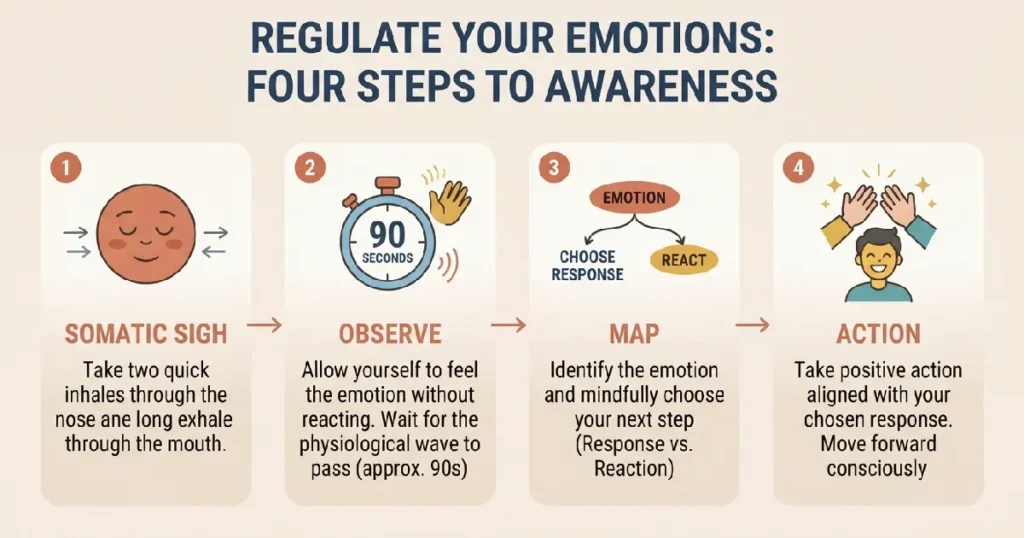
To put these realizations into action, you can use the S.O.M.A. Framework to retrain your brain’s response to social pain. This four-step technique is designed to interrupt the emotional loop before it becomes a permanent narrative about your self-worth.
The first step is Somatic Sighing. The next time you feel the sharp sting of rejection, pause and take two rapid breaths in through your nose, followed by a slow, complete sigh out through your mouth. This simple physical action immediately signals your vagus nerve to slow down your heart rate and lower your physiological arousal. Consider doing this before you reply to an email or say a single word. It creates a small physical buffer between the sting and your response.
The second step is Observe without Narrative. Literally set a timer on your phone for ninety seconds and commit to doing nothing but watching the physical sensations in your body. Notice the heat in your face, the tightness in your throat, or the heavy feeling in your chest. A useful question to ask yourself during this window is: Can I simply allow this physical energy to move through me without trying to explain it? By refusing to feed the physical pain with stories of your inadequacy, you allow the stress chemicals to naturally clear your bloodstream.
The third step is Map the Constraints. Once your body has calmed down, write out the objective structural slots that may have caused the decision. For instance, if a potential partner does not reply to your message, list the non-personal reasons: they might be working a long shift, dealing with family stress, or simply taking a break from their phone. This helps you separate your relational value from their current availability.
The final step is Actionable Recovery. Instead of withdrawing into isolation, take one small, proactive step that affirms your connection to others. This might look like sending a text to a close friend to say hello, or stepping outside to have a brief, friendly exchange with a local barista. By actively engaging with your social world, you remind your brain that one closed door does not mean you have been cast out of the tribe.
▸ THE CLOSE: AN EMOTIONAL LANDING
Rejection is not a sign that you are unworthy of connection. It is simply a sign that you have reached the edge of someone else’s capacity or structural limits. When you stop treating social pain as a personal failure and begin treating it as a physiological reflex, the sting loses its power over your identity. You are no longer at the mercy of every “no” because you know your body can ride out the storm.
Your worth is not a variable that fluctuates based on other people’s structural slots. You do not need to shrink to fit into spaces that are too small for you.
You can breathe through the ninety-second wave. The door might be closed, but you are still whole.
My Closing Remarks:
Honestly, I used to think my sensitivity to rejection was a fatal flaw that would ruin my life. But in my years of practice, I have realized that the deep sting we feel is actually proof of our capacity for profound connection. Do not try to become numb. A numb heart cannot love or lead. Let it hurt, breathe through the ninety seconds, and then stand back up. You are stronger than your brain’s ancient alarm.
More related stories for you:
- If you want to discover how to cultivate true fulfillment in your life, you can read more about what makes you happy to build a stronger foundation of joy.
About The Author