
 Sara Carmen
When the person you love disappears into their own mind, these are the boundaries and small acts that keep both of you afloat.
Key Points
- Learning how to deal with a depressed partner starts when you stop taking their coldness as proof that you are unloved.
- The partners who last do not give more care. They build firmer boundaries and a life that does not collapse when their partner’s mood does.
- You can stay close without becoming their therapist, their parent, or the only person holding the household together.
Contents
Table of Contents
We tell ourselves that love should be enough. We keep showing up. We keep waiting for the person we fell for to walk back into the room. Meanwhile the house gets quieter, the touch disappears, and we start to feel like we are living with a stranger who happens to share our bed.
Someone might think their partner has fallen out of love. But what they don’t see is the heavy chemical weight of clinical depression sitting between two people like wet concrete.
Someone might think they just need to try harder, talk more, or plan a weekend away. But what they don’t see is that standard relationship advice collapses the moment the other person cannot feel pleasure, cannot generate hope, and cannot meet you halfway.
You have been carrying this. You are exhausted. None of that means you have failed.
Here is the part most people get backwards. Learning how to deal with a depressed partner is not about becoming a better caregiver. It is about stopping the slow drowning of two people instead of one. You cannot be their life raft if you are already underwater.
That pattern exists because depression is not a bad attitude. It is a mood disorder that changes brain chemistry, energy, sleep, appetite, and the ability to feel reward. Psychologists call one of its core features anhedonia, which simply means the loss of pleasure in things that used to matter. Another feature is flat affect, a reduced ability to show warmth, humor, or affection even when love is still there. Your nervous system reads that blankness as rejection. That is why this hurts so much, and why cheerfulness as a strategy so often backfires.
Research on couples living with depression has shown that the well partner often absorbs the mood. Psychologists call this emotional contagion, which means feelings can spread between people who live in close contact, the same way a cold does. Left unexamined, this pattern does not just strain a relationship. It can quietly become the reason it ends.
Most people in this situation do not realize that the coldness is a symptom. They take it personally, then they try to love harder, and then they burn out.
Protecting Your Connection Without Drowning
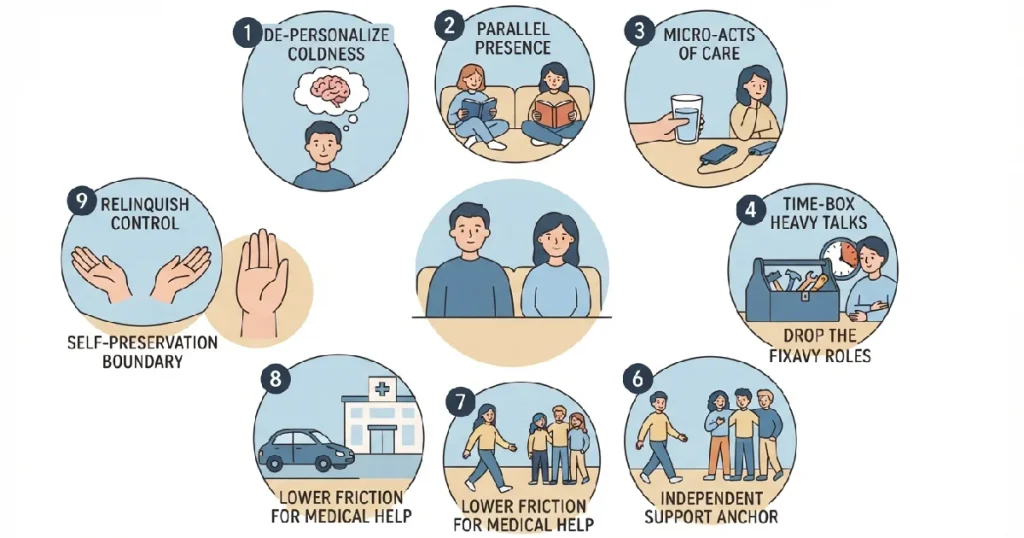
Rule 1: De-personalize the Coldness From a Depressed Partner
Their flat tone, missing affection, and social withdrawal are symptoms of brain chemistry, not a verdict on your worth.
When depression is active, the brain’s reward system goes quiet. Dopamine and serotonin signaling, the chemical messengers tied to motivation and mood, drop. The result can look like indifference. It can also look like irritability, which is one of the most misunderstood signs of depression in adults.
The next time they stare at the wall instead of looking at you, try this inner line: “This is the illness talking. This is not the whole of them, and it is not the whole of us.”
That one sentence will not cure them. It can stop you from building a story in which you are the problem.
Rule 2: Practice Parallel Presence With a Depressed Partner
Sit in the same room without demanding a conversation.
This is sometimes called parallel play in adult life. You read. They scroll. You fold laundry. They lie under a blanket. You are near each other, but no one has to perform closeness.
Conversational pressure is exhausting for a depressed brain. Silence with company is often more regulating than a well-meant “talk to me.” You are offering proximity without a test.
If they want to speak, they can. If they do not, you are still there. That is connection without a demand.
Rule 3: Use Micro-Acts of Care for a Depressed Partner
Do small, quiet tasks that lower the friction of being alive.
Charge their phone. Leave water by the bed. Drop off a simple meal. Take out the trash without a speech about teamwork. According to the Mind guide for friends and family, practical help with everyday tasks can ease real pressure when someone is too depleted to manage basics.
Do not wait for gratitude. Gratitude requires emotional energy they may not have. These acts are not a bargain. They are a way to keep the floor from falling out while you protect the rest of your life.
Managing Your Own Boundaries
Rule 4: Time-Box Heavy Talk With a Depressed Partner
Do not spend hours sitting in a dark room soaking up despair.
Depression can pull you into repetitive negative loops. Psychologists call this rumination, the act of turning the same hopeless thoughts over and over. Sitting inside that loop with them for half the night does not heal it. It often trains both of you to treat misery as the only honest form of intimacy.
Set a container. Twenty minutes of listening. Then a gentle pivot: a shower, a short walk, food, sleep. You can say, “I am with you. I also need to get up now so I can stay steady tomorrow.”
That is not abandonment. That is pacing.
Rule 5: Drop the Fixer Role When You Deal With a Depressed Partner
Stop handing out lifestyle cures.
Unprompted advice sounds like love to the giver and like criticism to the receiver. “Have you tried the gym?” “Maybe if you slept more.” “You would feel better if you just went outside.” Those lines usually land as proof that you do not understand how heavy it is.
Switch to validation. “This sounds brutal. I am right here with you.” Then stop. Listening without a repair plan is often the most skilled thing you can do.
You are a partner. You are not a treatment plan.
Rule 6: Build an Independent Support Anchor Outside the Relationship
You need a life that does not rise and fall with their mood.
Keep the gym hour. Keep the coffee with a friend. Keep the class, the walk, the Sunday call with your sister. The Mental Health Foundation’s guidance on supporting a partner with depression is clear that protecting your own mental health and leaning on outside connections is what makes long-term support possible.
This is where caregiver burnout begins if you skip it. Caregiver burnout is the state of emotional, physical, and mental exhaustion that comes from giving more care than you have the resources to give. It looks like resentment, numbness, snapping at the kids, and fantasizing about leaving even when you still love them.
Most people in this situation feel guilty for wanting a night out. That guilt is a warning light, not a moral failure.
You cannot be their life raft if you are already underwater.
Handling Treatment and the Hard Lines
Rule 7: Lower the Friction for a Depressed Partner to Get Help
If they are too exhausted to start, do the first ugly administrative steps.
Find three providers. Call the clinic. Sit with them while they fill out the portal. Drive them to the first appointment. Early antidepressant treatment often takes four to six weeks before mood lifts, and the first stretch can include emotional numbness or agitation. Knowing that timeline helps you not panic when week two looks worse than week one.
You can remove obstacles. You cannot swallow the pill for them. You cannot do the therapy hour for them. Help with the on-ramp. Leave the driving of recovery in their hands.
Rule 8: Set Self-Preservation Rules With a Depressed Partner
Illness explains a lot. It does not excuse everything.
Depression can make someone withdrawn, slow, and sharp-tongued. It does not give them a free pass to insult you, isolate you from friends, refuse all treatment forever, or use silence as punishment. Draw the line in plain language.
“I will support your healing. I will not stay in a conversation where I am being yelled at. I will not carry this household alone indefinitely if you will not engage with care.”
Then match words with action. Leave the room. Keep the therapy appointment for yourself. Stop covering every consequence. Boundaries without follow-through are just speeches.
Rule 9: Relinquish Control Over a Depressed Partner’s Recovery
You cannot love someone out of a mental illness.
Their recovery depends on their choice to engage with help, even in small, imperfect ways. If they refuse every door you open, you are allowed to ask what kind of life you are signing up for. That question is not cruelty. It is adult reality.
This is the rule people avoid because it sounds like giving up. It is the opposite. It is the moment you stop confusing devotion with self-erasure.
When Lena Stopped Trying to Rescue Him
Lena was 36, married eight years, with a five-year-old who had learned to tiptoe past the bedroom. Her husband, Marcus, had been depressed for fourteen months. He still went to work some days. At home he went dark. No touch. No questions about her day. No birthday dinner. Lena canceled her running group, stopped seeing friends, and sat with him in the dim living room because she thought presence meant sacrifice.
By month ten she was crying in the grocery parking lot and snapping at their daughter for spilling juice. She thought she was failing at love.
What changed was not a miracle speech. She started parallel presence instead of all-night processing. She went back to two gym sessions a week. She told Marcus she would drive him to a first psychiatry visit, and she also told him she would not absorb being spoken to with contempt. He did not transform overnight. She did get her sleep back. She stopped confusing his anhedonia with her unlovability. The marriage was still hard. It was no longer a double drowning.
That is the shift. Not more love. Cleaner love.
The Hardest Questions People Avoid

Is It Clinical Depression or a Toxic Relationship?
This is the gap most polite advice refuses to name.
Depression can look cold, selfish, and unavailable. Abuse can hide behind a diagnosis. Watch the pattern, not the label. Does the harshness ease at all when their energy returns? Do they still show up for work, friends, or hobbies while offering you nothing? Do they use “I’m depressed” to avoid accountability after they have hurt you, then refuse every form of help?
A clinical episode is marked by a drop across life, not a drop aimed only at you. A toxic dynamic often preserves charm in public and dumps the worst behavior on the person who is safest to punish. If you are walking on eggshells, hiding money, or being isolated from support, you are not only dealing with an illness. You are dealing with harm. Get outside counsel from a licensed therapist before you keep shrinking.
How to Deal With Resentment Toward a Depressed Partner
Resentment is what happens when you carry 100 percent of the rent, the children, the dishes, and the emotional weather, then tell yourself a good partner would not mind.
Name it. Do not swallow it and wait to explode. When they have even a little capacity, divide the baseline. You handle school drop-off. They handle one load of laundry, even if it takes all afternoon. Leave non-urgent clutter alone. Perfect houses are not the goal. Shared reality is.
You can also take your bitterness to your own therapist, a friend, or a support space. Unprocessed anger does not make you loyal. It makes you lonely inside the marriage.
Rebuilding Intimacy After a Depression Episode
Depression kills desire. So do many common antidepressants, especially SSRIs, which can blunt libido and delay orgasm. That deadness is usually not a verdict on your attractiveness.
Start below sex. Sit together. A hand on a shoulder. A low-pressure foot rub in dim light with no expectation of more. Ask what feels possible, not what used to be normal. If medication is flattening desire, that is a medical conversation with their prescriber, not a referendum on the relationship.
Attraction can return in pieces. Rushing it often makes both of you feel defective.
What You Can Do in the Next 24 Hours
The 20-Minute Cap. The next heavy conversation gets a time box. When it ends, you stand up and do one ordinary thing: dishes, a shower, a short walk.
The External Hour. Put one non-negotiable block on the calendar this week that belongs only to you. A class. A friend. A gym session. Treat it like a medical appointment.
The One-Sentence Boundary. Write one line you can actually say. Example: “I can sit with you for a bit. I cannot stay if the talking turns into attacks.” Practice it once out loud so it is not brand new in the heat of the moment.
A useful question to ask yourself tonight: “If nothing changed for a year, what would I regret not protecting in my own life?
My Closing Remarks:
I have sat with partners who whispered, “If I were stronger, they would get better.” I do not believe that. Strength is not measured by how completely you vanish. The people who endure this well keep one room in their life that depression is not allowed to colonize: a friendship, a morning run, a weekly hour that still belongs to them. If you take nothing else, take this. Your needs did not become optional when theirs became loud.
More Related Stories for You:
- If you need a closer look at daily support without self-erasure, read this guide on how to help a depressed spouse.
About The Author