
 Sara Carmen
The research on lasting relationships points to something far less romantic and far more useful than “true love.”
Key Points:
- What makes a good marriage isn’t romantic chemistry, it’s a specific, learnable pattern of behavior that researchers have been tracking for decades.
- The strongest predictor of marital happiness turns out to be nearly identical to the strongest predictor that a marriage will survive, according to family science.
- Understanding what makes a good marriage could add years to your life and not just years to your relationship.
Contents
Table of Contents
Everything you have been told about what makes a good marriage might be quietly working against you.
You have tried the date nights. You have read the books about love languages. You still feel, some mornings, like you are sharing a mortgage with a stranger who used to be your best friend. You start to wonder if something is wrong with you, or wrong with the marriage. There isn’t. You just learned the wrong theory of what marriage actually runs on.
Someone watching your relationship from the outside might think you have it figured out. You laugh at the same old jokes. You post the anniversary photo. But what they don’t see is the two of you going quiet at dinner because neither of you wants to bring up the thing that has been sitting between you for weeks.
Someone else might believe their marriage is in trouble because they argue about the same three things every few months. But what they don’t see is that the way they argue, not the fact that they argue at all, is what actually predicts where that marriage is headed.
And someone might assume they have simply “fallen out of love” because the butterflies faded around year four. What they don’t see is that butterflies were never built to last a lifetime, and the research on marital quality was never measuring butterflies to begin with.
What Makes a Good Marriage, According to the Research
Here is the short version, and then we will get into why it works.
What makes a good marriage is not chemistry, compatibility, or how deeply in love you feel on your best day. It is dedication: choosing your partner on purpose, again and again, especially on the days when passion has nothing to do with it.
That one sentence changes the whole question.
Family researchers have long noticed something odd. Commitment doesn’t just predict whether a couple stays together. It predicts whether they are actually happy. A recent report from the Institute for Family Studies and the Wheatley Institute, which analyzed a national sample of married adults, found that commitment, having a protective spouse, shared religious attendance, and frequent date nights are associated with higher quality marriages in America today. Here is the part that should stop you mid-scroll: the strongest predictors of feeling that one’s marriage is “highly unlikely” to end in divorce were the same predictors of being “very happy” in marriage.
Read that twice. The thing that keeps a marriage from ending is the same thing that makes it worth staying in. That is not a coincidence. That is the whole point.
Why does commitment carry this much weight? Because of a distinction psychologists draw between two very different kinds of staying power. Constraint commitment is staying because leaving feels too expensive: shared finances, kids, the fear of starting over. Dedication commitment is staying because you actively choose your partner’s wellbeing as part of your own, even when it costs you something.
Most people mistake one for the other. A couple can go twenty years without divorcing and still be running purely on constraint, quietly resentful, emotionally checked out, staying because untangling a life together feels harder than tolerating the distance. That is not a good marriage. That is a truce.
In my practice, the couples who turn things around are rarely the ones who fall back in love overnight. They are the ones who rebuild dedication one small, deliberate choice at a time.
The Insight Almost Nobody Talks About: Who Even Gets to This Point
Before you can ask what makes a marriage good, it helps to notice something strange about the current marriage landscape. Divorce in the United States is near a historic low, sitting at a divorce rate of 2.4 per 1,000 population, and about 41% of first marriages end in divorce today, down from the widely cited “50%” figure.
That sounds like great news. It is only half the story.
Marriages today are not necessarily healthier than they were forty years ago. They are more selective. People marry later, after more education, more financial stability, and more relationship experience than previous generations. Fewer people marry at all, and the ones who do tend to be better positioned to make it work. The falling divorce rate partly reflects who gets to the altar, not just what happens after.
This matters for you because it means the bar for “good enough to marry” has quietly risen. If you are evaluating your own relationship against some cultural average of “normal,” you are comparing yourself to a much more curated group than your parents were. Give yourself permission to stop measuring your marriage against a statistic that was never describing your situation.
Five Things That Actually Predict a Good Marriage
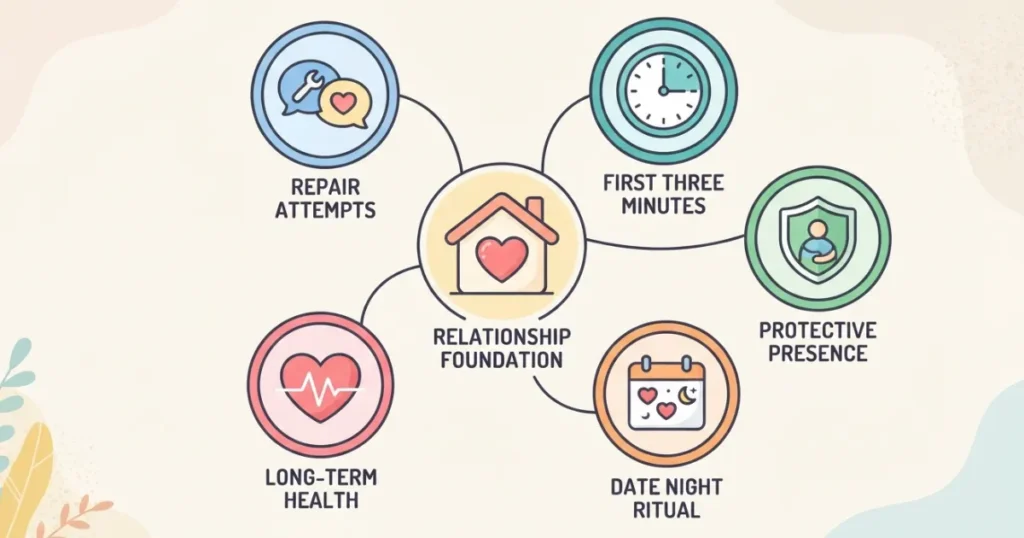
1. Repair Beats Perfection Every Time
The claim: Couples who fight and repair well outperform couples who rarely fight at all.
The evidence: Psychologist John Gottman’s decades of research found that the four communication patterns of criticism, contempt, defensiveness, and stonewalling predict the end of relationships with around 90 percent accuracy. But the presence of those patterns alone tells only part of the story. The presence of the four horsemen alone predicts divorce with only an 82 percent accuracy, but when you add in the failure of repair attempts, the accuracy rate reaches into the 90s. In fact, 84 percent of newlyweds who were high on the four horsemen but repaired effectively were in stable, happy marriages six years later.
So what? You are allowed to fight. The marriage isn’t in danger because of conflict. It’s in danger if neither of you knows how to circle back afterward and say, “That went sideways, let’s try again.”
2. The First Three Minutes of an Argument Give the Whole Thing Away
The claim: How a disagreement starts predicts how it ends, almost every time.
The evidence: In his 1999 research, Gottman predicted divorce with 90% accuracy based on the first three minutes of a conversation. Couples who open a hard conversation with blame (“You never…”) tend to spiral. Couples who open with a specific, ownable complaint (“I felt hurt when…”) tend to stay regulated long enough to actually solve the problem.
So what? Before your next hard conversation, spend ten seconds thinking about your first sentence. That single sentence sets the emotional temperature for everything that follows.
3. A Protective Presence Matters More Than a Provider Role
The claim: Feeling emotionally and physically safe with your spouse predicts marital happiness more strongly than traditional markers like income or ambition.
The evidence: In the same national marriage study, researchers presented spouses with a list of ten personal traits and found that being “protective” stood out sharply above traits like ambitious, confident, or attractive as a predictor of a thriving marriage. Wives who felt certain their husbands were genuinely committed had odds of feeling secure in the marriage that were 306% and 236% higher, respectively, than less committed counterparts.
So what? Protective doesn’t mean controlling or macho. It means your partner is the person you would call at three in the morning without hesitation, and you already know they would pick up.
4. Small, Repeated Rituals Beat Grand Romantic Gestures

The claim: Frequency of connection matters more than intensity of connection.
The evidence: The same research identifies regular date nights as one of four consistent predictors of marital quality, alongside commitment and shared community involvement. It isn’t the expensive dinner that matters. It’s the recurring habit of choosing each other’s company over the dozen other things competing for your attention that night.
So what? Think of love as the flower and commitment as the trellis holding it up. The flower gets attention. The trellis is what keeps it from collapsing the first time the wind picks up. Date nights, check-in conversations, and small rituals are the trellis. Build it before you need it.
5. Marriage Quality in Midlife Predicts Your Health Decades Later
The claim: The state of your marriage in your fifties may affect your physical health more than your cholesterol does.
The evidence: The Harvard Study of Adult Development, one of the longest-running research projects on adult life, followed participants for nearly eighty years. Its director, Robert Waldinger, reported that people’s level of satisfaction with their relationships at age 50 was a better predictor of physical health than their cholesterol levels were. In his own words, “The people who were the most satisfied in their relationships at age 50 were the healthiest at age 80.”
So what? A good marriage is not just an emotional asset. It functions as a health intervention, quietly protecting your body decades into the future. Left unexamined, chronic marital distance doesn’t just strain your relationship, it can shape your health outcomes long after the argument itself is forgotten.
Maya and Daniel: A Short Story About the Trellis
Maya and Daniel came into counseling after eleven years of marriage, both convinced the “spark” was gone for good. On paper, nothing was wrong. No affair, no big betrayal, just a slow drift into roommate territory.
We didn’t spend the first few sessions chasing romance. We built a Tuesday-night ritual: twenty minutes, phones away, one question each about the other’s week that wasn’t about logistics. Daniel practiced the soft startup instead of leading with criticism. Maya practiced naming what she needed instead of waiting for him to guess.
Six months later, Maya told me something that stuck with me. She said the marriage didn’t feel more exciting exactly. It felt more solid. That solidity, it turns out, was the thing she had actually been missing the whole time.
Now What? Three Places to Start This Week

The Repair Rehearsal. Pick one recent argument that ended badly. Sit down together and replay it, but this time, practice the apology or the soft startup you wish you had used. Rehearsing repair outside of a live conflict makes it far easier to access in the moment.
The Protective Check-In. Once this week, ask your partner directly: “Do you feel like I have your back right now?” Then actually listen to the answer without defending yourself. This single question surfaces the emotional safety gap faster than almost anything else.
The Fifteen-Minute Trellis. Consider setting one recurring fifteen-minute window, same day, same time, phones in another room, just to check in. Not to solve problems. Just to stay current with each other’s inner world.
A useful question to ask yourself tonight: are you running on dedication, or are you running on constraint? The honest answer, even if uncomfortable, is the starting point for everything else.
The Marriage You Thought You Wanted Isn’t the One That Lasts
Go back to that dinner table, the one where you and your partner went quiet because neither of you wanted to bring up what’s been sitting between you. You now know something you didn’t know at the start of this piece. The silence isn’t proof the marriage is broken. It’s a signal that the trellis needs tending.
A good marriage was never about finding a person who makes silence unnecessary. It’s about building enough dedication that the silence doesn’t scare you anymore.
Love gets you to the wedding. Dedication is what gets you through year eleven, and year thirty, and the version of your partner you haven’t met yet.
My Closing Remarks
Honestly, I think we’ve sold couples a lie by making love the finish line instead of the starting gun. I’ve watched marriages with plenty of chemistry fall apart from neglect, and I’ve watched “boring” marriages become the safest place two people know. If I could tell you one thing as a friend and not just a clinician, it’s this: stop auditing your marriage for butterflies. Start auditing it for evidence that you both still choose to show up.
More Related Stories for You
- If distance in your marriage feels less like drift and more like something darker, it’s worth understanding the warning signs of a narcissistic partner before assuming the problem is simply communication.
About The Author