
 Sara Carmen
The quiet habits you tolerate this month are the ones that decide whether you still feel like a team next year.
Key Points
- The most useful advice for husband and wife is not how to survive a crisis. It is how to treat tiny drifts as real, before silence hardens into distance.
- Criticism, screens, money talk, and shutdown are not “personality.” They are early patterns you can interrupt with named habits this week.
- Lasting couples are not the ones who never fight. They are the ones who repair fast and keep five small positives in the bank for every hard moment.
Contents
Table of Contents
We tell ourselves a story about marriage that sounds grown-up and calm. We are not yelling. We pay the bills. The kids are fine. So we decide the marriage is fine. Then one ordinary Tuesday you realize you have not really looked at each other in weeks, and the quiet feels heavier than any argument you ever had.
Someone might think a peaceful house means a healthy marriage. But what they don’t see is two people who stopped asking follow-up questions. Someone might think scrolling in bed is just rest. But what they don’t see is a partner waiting for eye contact that never comes. Someone might think “we don’t fight about money” is maturity. But what they don’t see is one person making every financial decision alone and slowly resenting it.
Everything you have been told about “not sweating the small stuff” can make this worse. Small stuff is how a marriage actually ends.
Most marriages do not explode. They thin out. Researchers following divorced adults have found that more than half felt emotionally disconnected for at least two years before they separated. The fights you fear are loud. The damage that lasts is usually quiet. That is why the best advice for husband and wife starts with a simple idea: treat a hairline crack as a structural problem, not a mood.
Think of your marriage like a wooden floor. A floorboard does not snap in one night. It warps from the same drip, the same ignored spot, until one day your foot goes through. The drip is not dramatic. The hole is.
Why small problems in marriage are more dangerous than big fights
The two-year disconnect nobody talks about
When people hear that a lack of commitment ends marriages, they picture someone walking out after one terrible night. That is rarely the story. Commitment usually fades the way color fades in a room you never open the curtains in. You get used to the dimness. You stop noticing what used to be bright.
You tolerate the late-night phone. You swallow the sarcastic joke. You stop bringing up the budget because last time it went badly. You call that peace. It is not peace. It is a nervous system choosing numbness over another round of disappointment.
Most people in this situation do not realize they are already in the early stage of collapse. They are waiting for a bigger symptom to give them permission to care. By the time the symptom arrives, the habit is two years old.
The divorce rate is falling, but that is not the good news you think
According to the CDC National Center for Health Statistics, the U.S. crude divorce rate has sat near a historic low of about 2.4 divorces per 1,000 people. That number gets quoted as proof that marriages are thriving. It is not. Fewer people marry, they marry later, and the ones who do are a more selected group. A falling divorce rate does not mean your Tuesday night disconnection is harmless.
If you chose this person, you already belong to a smaller club than your parents did. Protecting that choice is not romantic fluff. It is daily maintenance.
The 4 communication patterns that start as small habits and end marriages
How the cascade starts with just one complaint
Dr. John Gottman’s long observational work, summarized by The Gottman Institute, named four patterns that predict divorce with striking accuracy: criticism, contempt, defensiveness, and stonewalling. They do not arrive as a set. They arrive as a cascade.
Criticism is not “the dishes are still in the sink.” That is a complaint about a behavior. Criticism is “you never help, you are so lazy.” It turns a moment into a character verdict. Once that becomes the house dialect, contempt walks in. Contempt is the eye roll, the sneer, the joke that is not a joke. Defensiveness follows because no one wants to sit still while they are being ranked. When defensiveness fails, stonewalling takes over: the blank face, the walk-away, the “I am done talking.”
Catch it at Stage 1. A complaint you can repair. A character attack you will spend years undoing.
Contempt is the point of no return. Here is how to spot it early
Contempt is the single strongest predictor of divorce in that research. It is not volume. It is superiority. “Must be nice to come home and do nothing.” A sigh when they speak. Mimicking their voice. You do not need a screaming match for contempt to be in the room.
The antidote is not a grand apology. It is a culture of appreciation so thick that contempt has nowhere to land. One specific thank-you a day is not cute. It is structural.
The modern crack nobody warned you about: screens and emotional neglect
When your phone becomes the third person in your bedroom
A Pew Research Center study of couples found that many partners report the other person is often or sometimes distracted by a phone during conversation. Later surveys keep finding the same bruise: phones in bed, half-listening, a third presence that never gets tired and never needs you.
This is one engine of that two-year drift. You are technically together. You are emotionally elsewhere. The body learns: I am not the most interesting thing in the room.
That is not weakness. That is wiring.
3 specific habits to reclaim your connection daily
Phone-free zones work when they are small and sacred. The dinner table. The first ten minutes after you both get home. The bed until you have said one real thing about the day.
Use a six-second greeting. When you reunite, stop, look, and hold a hug long enough for your nervous systems to register safety. Six seconds is not theater. It is a reset.
Ask one question you cannot answer with “fine.” Then stay for the answer.
The money conversation that predicts your marriage’s future

It is not about how much you have. It is about how you talk about it
Couples who argue about money every week show a much higher risk of divorce than couples who treat money as a shared problem. Income level is not the main story. Tone is. Blame turns a spreadsheet into a character trial. Team language turns it back into math.
Maya and Jordan, a composite of couples I have sat with in practice, looked “fine” for three years. No screaming. Two good jobs. Then Maya realized she had stopped mentioning her student loans because Jordan went quiet and cold. Jordan thought Maya was hiding things. The crack was not the debt. It was the silence around the debt. When they started a ten-minute Sunday check-in with a shared note on the fridge, the shame dropped. The numbers did not magically shrink. The marriage stopped bleeding.
The weekly money check-in (a simple template)
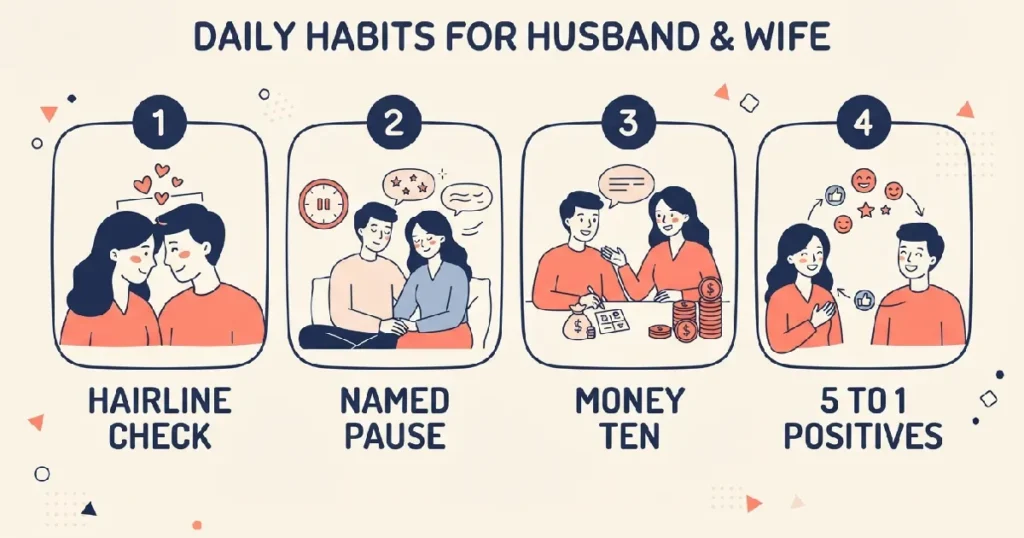
Ten minutes. Same day. Same two questions. What is coming in and going out this week? Is there one decision we need to make together before Friday? No history lectures. No “you always.” If a feeling spikes, name it and park the numbers for twenty minutes. Then come back.
This is marriage advice that works for couples who are not broke. Wealthy couples still split over secrecy and contempt. The check-in is prevention, not punishment.
The stonewalling problem: what it really means when one of you goes silent
Why he shuts down and she pushes harder (the biology behind it)
Stonewalling is more common in men in Gottman’s lab, not because men care less, but because many men’s bodies flood faster in conflict. Flooding means your heart rate climbs, usually past about 100 beats a minute, and your thinking brain goes offline. You cannot problem-solve. You can only escape. The other partner, often the wife, reads the escape as indifference and pursues harder. That pursuit raises the first partner’s heart rate again.
Once flooding hits, most people need at least twenty minutes to return to baseline. Talking through it does not prove love. It pours gasoline on a closed system.
What to say and do instead: scripts for both partners
The named pause for the person who is shutting down: “I want to stay in this with you. My body is flooded. I am taking twenty minutes, and I will come back at 8:40.” Then actually come back.
The patience protocol for the pursuing partner: “I hear you. I will not follow you. I will be here at 8:40.” Do not send a paragraph of text during the break. Do not stack the case. Sit with your own pulse.
Both of you are trying to survive. One by leaving. One by chasing. Neither is the villain.
The 5:1 rule: the daily habit that protects everything
What five positives actually look like in a real marriage
Stable marriages, even during conflict, tend to keep at least five positive moves for every negative one. A positive is not a vacation. It is a genuine compliment. A shared laugh. A hand on the shoulder that is not a request for sex. A “how was your day” that includes a second question. A text that says you remembered something they mentioned yesterday.
Grand gestures cannot replace daily deposits. A weekend away on top of a contemptuous week is a bandage on a drip.
The repair attempt, and why it matters more than never fighting
All couples show the Four Horsemen sometimes. What separates lasting pairs is repair: how fast you come back. A repair attempt is any bid to stop the slide. Humor. A touch. “That came out harsh. Let me try again.” The skill is not perfection. It is reliability.
When to stop going it alone: getting help before the crisis

The stigma trap
Only a minority of couples who hit serious conflict seek professional help, even though many who do report it helped. The old story says therapy is for people who have already failed. That story keeps you in the two-year fog.
Think of a couples therapist the way you think of a dentist. You do not wait for the tooth to fall out. Telehealth and structured programs make early help easier than it used to be. Going early is not drama. It is maintenance.
Signs it is time to bring in a third party before you are in the red zone
You have the same fight three times with no new information. One of you is afraid to raise money, sex, or family. Contempt has started to feel normal. You cannot remember the last unforced laugh. Those are not “later” signals. Those are now signals.
What to do this week: four named tools
One place to start is the Hairline Check. Once this week, name one small thing you have been swallowing. Use a complaint, not a character attack: “I felt alone when you were on your phone while I was talking.”
Consider the Named Pause the next time your chest tightens. Say the script. Take twenty minutes. Return on time.
Try a Sunday Money Ten. Ten minutes. Two questions. No courtroom.
A useful question to ask yourself tonight: If this exact week repeated for two years, would we still recognize each other?
You walked in thinking a quiet house meant you were safe. You can leave knowing quiet can be a drip, and that you now have a way to find the leak. The couples who last are not the ones with no cracks. They are the ones who refuse to call a crack “nothing.”
Fix the drip while the floor still holds.
My Closing Remarks
My closing remarks (70-90 words): I have watched kind people lose a good marriage because they waited for a scene worthy of a movie. There was no scene. There was only Tuesday after Tuesday of almost-connection. If you still care enough to read this, you are not too late. Pick one habit. The greeting. The money ten. The pause. Do it badly if you must. Do it today. Your partner does not need a new speech. They need to feel chosen in a room where the phone is face down.
More Related Stories for You
- If contempt or grandiosity is starting to shape how you fight, read more on narcissistic personality traits and how they block repair.
About The Author