
 Nicole Adkins
She’s not the woman staring into a mirror. She’s the one everyone else is staring at, wondering how she does it all so perfectly, while you’re the only one who knows what happens when the door closes.
Key Points
- The clinical definition of a narcissist woman rarely matches the loud, vain stereotype most people search for online.
- Female narcissism often hides behind kindness, victimhood, and community praise, which is exactly why it goes unnoticed for years.
- Recognizing the real behavioral patterns, not the myth, is the first step toward protecting your peace and your sense of reality.
Contents
Table of Contents
We have been trained to hunt for narcissism in loud rooms. We look for the person who interrupts, who name-drops, who cannot walk past a mirror without checking. You have been scanning for swagger and selfies. That is why her version never matched the picture, and why you spent years wondering if the problem was you.
Someone might think she is just highly sensitive. But what they don’t see is how her tears arrive right on time, the moment anyone asks her to take responsibility.
Someone might think she is the glue of the school, the church, or the office. But what they don’t see is how that same reputation becomes a shield no one is allowed to question.
Someone might think she was your perfect match because she mirrored your music, your politics, your private jokes. But what they don’t see is that the matching stopped the day she felt secure enough to stop performing.
A narcissist woman is not defined by mirrors. She is defined by a stable pattern of using charm, fragility, and praised femininity to harvest admiration, dodge accountability, and keep you emotionally unsteady. The mask is the method.
According to Harvard Health’s guide to narcissistic personality disorder, the core features are a lasting need for admiration, a sense of specialness, and a limited ability to treat other people’s feelings as equally real. The textbook still sounds male. The version in your house often does not.
Left unnamed, this pattern does not just hurt your feelings. It can quietly become the reason you no longer trust your own mind.
Why the Clinical Definition of a Narcissist Woman Gets Missed
If you have ever tried to explain her to a friend and watched their face go blank, you already know the problem. The clinical definition of a narcissist woman is easy to miss because the tools we use to spot narcissism were built around a louder, more male-coded performance.
Most people in this situation don’t realize they are dealing with a personality pattern. They think they are dealing with a mood, a hard childhood, or a woman who “just feels things deeply.”
The Grandiose Bias in Female Narcissism
Narcissistic personality disorder, or NPD, is a long-term pattern of grandiosity, a hungry need for admiration, and weak empathy. Grandiosity means an inflated sense of being special or owed. Empathy means the ability to feel with another person, not just read them.
Standard checklists still favor grandiose narcissism. That is the overt type: boastful, entitled, status-chasing, hard to miss in a meeting. Men are more often caught in that net because the behaviors match old diagnostic pictures.
Women are far more likely to show vulnerable narcissism, also called covert narcissism. This is the quiet type. It runs on shame, defensiveness, and a chronic sense of being wronged. The ego is just as hungry. The costume is different.
You will not catch her through mirror-gazing. You catch her through what happens after you stop feeding the hunger.
Weaponized Femininity in a Narcissist Woman
Western culture still hands women a default pass for being nurturing, fragile, and communal. A narcissist woman knows this. She uses it.
Tears become a firewall. Softness becomes a strategy. “I was only trying to help” becomes cover for a cut that was aimed with care. Anxious sensitivity gets read as depth. People protect her because she looks like someone who needs protecting.
This is weaponized femininity: using the social script of womanhood as camouflage for control. She does not have to shout to dominate a room. She only has to look wounded enough that you become the problem for noticing.
You are not imagining the double standard. A man doing the same thing would be called arrogant by lunchtime. She gets casseroles and sympathy.
Narcissist Woman or Borderline? The Misdiagnosis Trap
Here is another reason the definition stays foggy. When a woman is emotionally intense, many clinicians reach for borderline personality disorder before they consider NPD.
Borderline personality disorder, or BPD, is a pattern of unstable relationships, a shaky sense of self, and a raw fear of abandonment. NPD is more about protecting status and self-image. Both can involve anger, tears, and chaos. They are not the same engine.
A 2023 paper in Frontiers in Psychology has added weight to a problem many partners already feel in their bones. Female narcissism is often read as volatility and then filed under BPD. The exploitation gets missed. The lack of real remorse gets missed. You get a label that explains her pain and skips your injury.
That does not mean every intense woman is a narcissist. It means tears are not a diagnosis. Watch what she does with power, blame, and other people’s needs when no audience is watching.
Covert Narcissism and the Real Mask of a Narcissist Woman
If you came here looking for a woman obsessed with her looks, you can set that picture down. The modern definition of a narcissist woman is closer to an emotional predator in a well-made mask. Forums call her a chameleon or a spider. Both images are trying to say the same thing.
She builds a pristine public self. At home she runs a zero-sum climate. Someone must be the hero, the victim, or the center. That someone is her.
Think of her as a dimmer switch, not a floodlight. She never plunges the room into darkness all at once. She lowers the light so slowly that you start believing this is just how rooms are supposed to feel.
The Prosocial Narcissist Woman and the Saint Facade
One of the least discussed pieces of female narcissism is the altruistic trap. She is the perfect PTO lead, the charity organizer, the neighbor who “does so much.” That work is not a contradiction of her narcissism. It is the factory.
Narcissistic supply is the admiration, attention, and emotional fuel a narcissistic person needs to stabilize their self-image. Community leadership is a clean, socially bulletproof source of that fuel. Who is going to accuse the woman who ran the fundraiser?
If you challenge her at home, she can point to the casserole, the volunteer hours, the public thank-yous. Your private reality never stands a chance against her résumé of goodness. That is the trap. The halo is the strategy.
Vulnerable Narcissism and the Professional Victim
Covert female narcissism often protects the ego through a victim complex rather than open superiority. A slight becomes persecution. A boundary becomes cruelty. A fair question becomes an attack on her character.
This is reverse victim and offender, often called DARVO: Deny, Attack, Reverse Victim and Offender. You bring up a real hurt. She denies it. She attacks your tone. By the end, she is the injured party and you are the bully.
HelpGuide’s work on covert narcissism describes high neuroticism in this type. Neuroticism here means a tendency to process ordinary friction as catastrophe. She does not just feel slighted. She feels hunted. Then she recruits you, the kids, and the group chat into that story.
That is not empathy. That is a smoke alarm that only goes off for her.
Marcus and the Woman Everyone Loved
Marcus met Lena at a community clean-up. She remembered his coffee order, laughed at his driest jokes, and told him she had “never felt this safe with anyone.” Friends called her a catch. She ran the school fair and sent handwritten notes to new families.
At home the air changed. If Marcus got a promotion, Lena developed a migraine and a story about how unsupported she felt. If he asked why she had mocked his mother at dinner, she cried until he was comforting her. Their daughter learned to glance at Lena before answering a simple question, as if the wrong preference could collapse the room.
Marcus spent two years trying to become a more patient man. The patience never produced closeness. It produced a quieter version of him. The night he finally named the pattern, Lena told mutual friends he was “emotionally unsafe.” The dimmer had done its work. The house still looked fine from the street.
10 Traits That Shape the Definition of a Narcissist Woman
Abstract terms will not help you at 11 p.m. during another rewritten argument. These are the behaviors that show up in daily life. One incident proves little. A cluster over time is the definition.
- Reverse victim order (DARVO). If you name a hurt, she denies it, attacks your delivery, and walks away as the wronged party.
- Chameleon mirroring. Early on she copies your hobbies, values, and taste so fast that you feel you have met your match rather than a skilled imitator.
- Emotional regression. She can sound like an adult in public and then use silent treatments or passive-aggressive tantrums when she loses control.
- Pathological competition. Other women, and even you, get treated as rivals. Your win is a cue for her to downplay it or one-up it.
- Surgical public shaming. She points out your breath, clothes, or manners in front of people, framed as “just trying to help,” and leaves you smaller.
- The “all exes are crazy” history. Every former partner or friend was toxic, abusive, or unhinged, which keeps her biography strangely blameless.
- Triangulation and family cleaving. Triangulation means dragging a third person into a two-person bond to create jealousy, doubt, or alliances. She drops hints, shares secrets, and splits rooms that used to be stable.
- Hyper-sensitivity sold as empathy. She calls herself an empath, meaning a person who feels others deeply, yet goes cold when you or the children are actually sick or scared.
- Hijacking therapeutic language. She uses words like “boundaries,” “gaslighting,” and “self-care” to dodge accountability and to recast you as the abuser.
- The discard and hoovering cycle. When you are no longer useful she goes ice-cold. Hoovering, named after a vacuum, is the later suck-back: sudden sweetness, apology-shaped messages, and a pull toward the old bond.
Most people in this situation don’t realize the honeymoon was research. She was not only falling for you. She was mapping your insecurities for later use.
Watch the gap between her public warmth and her private scorekeeping. That gap is the diagnosis you will not get from a selfie.
How a Narcissist Woman Damages Intimacy and Family

Selfishness is ordinary. This is not ordinary. Pathological harm shows up when another person is treated as a tool, a mirror, or a threat to the self, not as a separate human being.
When a Narcissist Woman Weaponizes the Family
Children are often handled as extensions of her identity rather than as people with their own inner lives. A child’s success is her trophy. A child’s difference is betrayal. A child’s closeness to the other parent can be treated as a crime.
Research by Green and colleagues on female narcissism points to real compromises in empathic processing and a pull toward interpersonal exploitation. In plain language, she can read a child’s feelings well enough to steer them, and still fail to care for those feelings as real.
This is how alienation starts. Not always with a courtroom speech. Often with sighs, rewritten history, and a child who learns that loving you costs them her approval. The goal is lifelong control dressed as mothering.
Psychological Destabilization in Close Relationships
Partners describe a slow erosion that is hard to photograph. You walk on eggshells. You replay conversations to find the moment you became the villain. You start asking permission to have a preference.
That is not you being “too much.” That is what happens when your reality is edited daily by someone who needs to win.
The relationship is transactional. Validation goes one way. Repair goes one way. Your needs are negotiable. Her image is not.
If you have been calling this “a rough patch” for years, consider a harder sentence. A rough patch has two people trying. This pattern has one person managing the lighting.
What You Can Do Once You Have the Definition
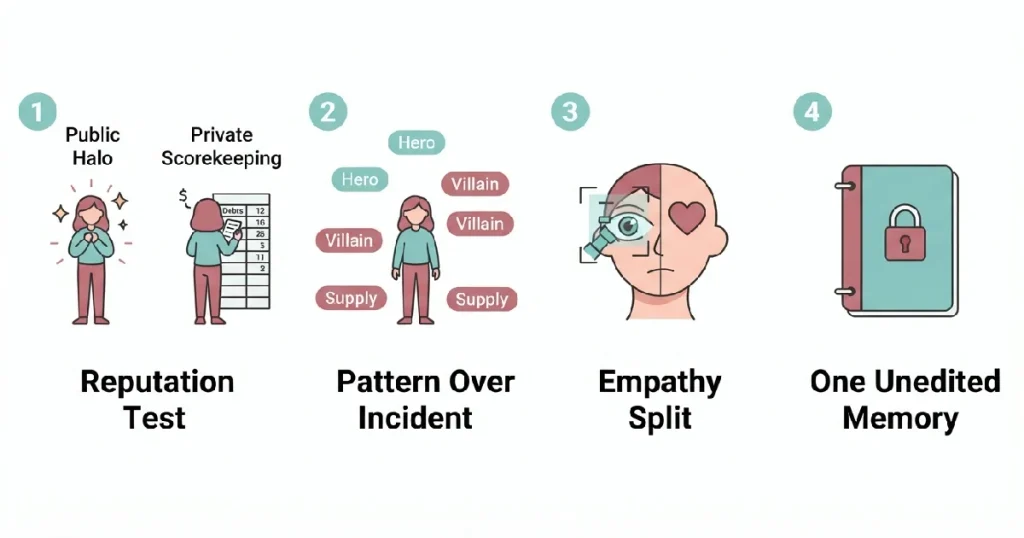
Knowledge is not a personality transplant for her. It is leverage for you. You cannot debate a mask into becoming a face. You can stop arguing with the performance.
The Reputation Test. Write down how she looks to outsiders in one column and how she behaves with you in another. If the two lists could belong to different people, trust the private list. Example: “Beloved team mom” in public, “punishes the child for liking Dad’s weekend” at home.
Pattern Over Incident. Stop litigating the last fight. Ask what role you were assigned. Hero, audience, villain, nurse, supply. If the role repeats, the incident is not the point. The next time she cries at the first sign of accountability, name the pattern to yourself before you start comforting the person who just harmed you.
The Empathy Split. Learn the difference between cognitive empathy and affective empathy. Cognitive empathy is reading what you feel. Affective empathy is being moved by it. A narcissist woman is often gifted at the first and vacant at the second. That is why the early bond felt so intimate. She studied you. She did not join you.
One Unedited Memory. Keep a private record of what was said, not what she later claimed was said. You are not building a court file. You are giving your nervous system a witness. A useful question: “If a friend described this week to me, would I tell her she was overreacting?”
You do not have to decide your whole future tonight. You only have to stop dimming your own eyesight to keep her comfortable.
You Were Looking in the Wrong Place
You came in looking for vanity. The real definition of a narcissist woman is calculation, hidden control, and vulnerability used as a tool. She can be pretty or plain, career-driven or homey, tearful or icy. The tell is what she does with your doubt.
The dimmer switch only works if you keep sitting in the dark, waiting for her to turn the light back up. You can stand. You can walk toward a clearer room. You can love people without agreeing to be their fuel.
You were never too sensitive. You were being trained to stop seeing.
My Closing Remarks
In my practice I have sat with people who spent years trying to become a gentler partner for someone who was never going to meet them in the middle. They did not need a crueler story about her. They needed a cleaner definition. Once they could see the dimmer switch, they stopped arguing with the lighting. They started looking for a door. If that is where you are, you are not late. You are oriented. That is enough for today.
More Related Stories for You
- If the louder, more classic presentation is what you are trying to name in a father, husband, or boss, read this guide to the characteristics of a narcissist man.
About The Author