
 Sara Carmen
Most advice about narcissistic spouses stops at symptoms. This guide walks you through the real steps to protect your money, your mind, and your legal standing, whether you stay or go.
Key Points
- If you’re married to a narcissist, your confusion isn’t weakness. It’s a control system working exactly as designed.
- You can take concrete action this week: gather financial records, document what’s happening, and choose communication tools that won’t hurt you later.
- Staying and leaving are both legitimate choices, and both begin with the same first move: reclaiming your information.
Contents
Table of Contents
You’ve Tried Everything. Here’s the Honest Answer
You’ve tried. You’ve really tried. You’ve read the books, softened your tone, explained yourself more clearly, and walked on eggshells so long that normal flooring feels foreign. And yet the same scenes keep playing: the criticism that lands like a paper cut, the talk that somehow ends with you apologizing, the version of events that never matches what you lived. If you’re married to a narcissist, you’ve lived this paragraph a hundred times. You’re starting to wonder if something is wrong with you. There isn’t.
Someone might think you married a sensitive person with a fragile ego. What they don’t see is the private catalog of your mistakes, reopened the moment you feel safe.
Someone might think the problem is communication. What they don’t see is that every real conversation ends with your reality edited and reissued as theirs.
Someone might think you should simply be grateful. What they don’t see is that gratitude is the admission price here, not a reward.
Here is the honest answer: being married to a narcissist is not a character flaw you can fix by loving harder. It is a one-sided system built on control. Your first job is not to decide whether to stay or leave. It is to reclaim your footing: your finances, your health, your legal options. That is where this guide begins.
What “Married to a Narcissist” Actually Looks Like (It’s Not Always Obvious)
If you picture a narcissist, you probably picture the loud one: the person who dominates the room. That’s the grandiose presentation, and it’s easy to spot. Many spouses live with the other kind, and that’s why so much of what you read online doesn’t sound like your life.
Overt vs. Covert Narcissism: Why Your Partner Doesn’t Match the Stereotype
The quiet narcissist doesn’t demand the spotlight. They demand the soundtrack. They are the victim in every story, the misunderstood genius, the person whose suffering is always slightly more important than yours. Psychologists call this covert narcissism, and it hides behind false humility and gentle sighs of disappointment. The manipulation is still there: gaslighting, silent treatment, subtle sabotage. It just happens in a lower register.
Gaslighting is the steady drip of denials and “you’re remembering that wrong” that makes you trust their version over your own. Covert narcissists are sensitive to criticism, use guilt as a remote control, and cast themselves as the wounded party so your needs keep getting postponed. That’s why you second-guess yourself: the person you live with is skilled at making their inner world feel like your responsibility.
Why Narcissistic Traits Get Worse After the Wedding and After Kids
Here’s a fact that can release you from years of “why didn’t I see it”: the traits were always there, but marriage turned up the volume. As Dr. Ramani Durvasula, author of Should I Stay or Should I Go, puts it, with marriage and parenthood come more interdependence and more demands, “and that often doesn’t play well with an egocentric narcissist.”
During dating you were a source of admiration, and they were on their best behavior. Marriage adds bills, in-laws, sick children, and a partner who needs support instead of applause. The fantasy collapses, and what surfaces is the narcissistic personality disorder pattern underneath: entitlement, shallow empathy, and a fragile self that blames you for every wobble. Clinical estimates put the divorce rate for marriages involving a covert narcissist at 50 to 55 percent, above the national average, and the non-narcissistic spouse initiates most of them.
None of this makes you foolish for staying. It makes you human. And the pattern has already started doing its work on your body.
What a Narcissistic Marriage Does to Your Body and Brain
You may have noticed you’re not quite yourself. You forget appointments. You read the same paragraph three times. You jump when the phone buzzes. Most of us file this under “stress.” There’s a biological story underneath, and it changes how you should read your own exhaustion.
Why You Feel Foggy and Forgetful: The Brain Science of Chronic Stress
Your brain treats chronic emotional danger the way it treats any threat: it mobilizes. The amygdala, your alarm center, stays on high alert. The hippocampus, which handles learning and memory, gets flooded with cortisol, the stress hormone, and prolonged exposure to that hormone has been shown to shrink the tissue over time. In one study by University of New Orleans and Stanford University researchers, people with the highest stress-hormone levels and the most trauma symptoms showed the greatest loss of hippocampal volume.
You are not losing your mind. You are being trained to.
Post-traumatic stress disorder is the clinical name for what happens when a system stays switched on long after the threat passes. You don’t need a diagnosis to recognize the shape of it: hypervigilance, intrusive replays, avoidance, sleep that never restores.
When a Narcissistic Marriage Leads to C-PTSD Symptoms
When the stress is repeated and relational, stretching across years, researchers describe a deeper pattern called complex PTSD, or C-PTSD. Where PTSD follows a single event, C-PTSD follows prolonged entrapment: ongoing emotional abuse, blame, control, and the silent treatment. Along with the classic PTSD symptoms, it carries extra weight: deep shame, a sense of being permanently damaged, and trouble trusting anyone.
Think of yourself as a gardener who was handed a field of stones and told the soil was fine. You watered it. You weeded it. You apologized to it. For years nothing grew, and you concluded the problem was your hands. It never was.
Here is the reframe: naming this changes your relationship to your own symptoms. The fog, the memory gaps, the startle response. They’re not proof that you’re broken. They’re proof that you’ve been under a sustained attack on your sense of reality, and your body responded the way any body would.
Financial Abuse: The Money Trap That Keeps You Stuck
Here’s the part most guides skip, and the part that quietly decides whether anyone can leave: money. In most narcissistic marriages, the financial power is uneven, and that’s not an accident. Financial abuse is the use of money to control someone, and the National Domestic Violence Hotline reports it occurs in 99 percent of domestic violence cases, making it one of the most common and least recognized forms of abuse.
How Narcissists Use Money as a Weapon of Control
It can look like an allowance you have to justify. It can look like debt opened in your name. It can look like a spouse who sabotages your career, hides accounts, or turns every purchase into an interrogation. When I work with clients, the financial discovery is often the moment the fog lifts: you realize you’ve been voting in a system where you were never handed a ballot.
Your Financial Inventory: What to Gather Before Any Decision
You don’t need to know what you’ll do yet. You need to know what exists. Start quietly, and start now.
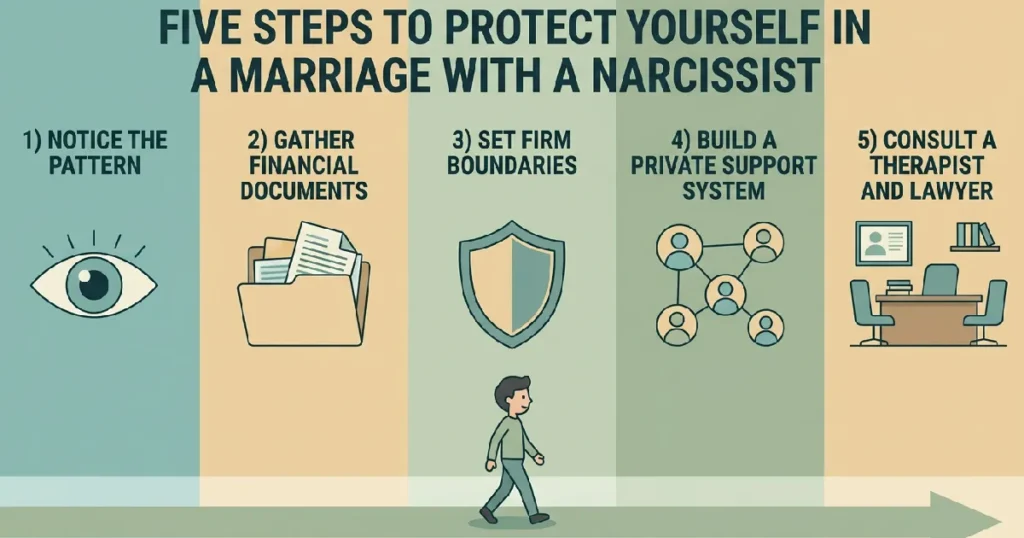
- Every account: bank, retirement, investment, credit card, and loan, in your name, their name, or joint.
- The last two years of tax returns, pay stubs, and mortgage or lease documents.
- Your free annual credit report from each bureau, plus all three credit scores.
- Titles for cars, property, and any business ownership papers.
- Statements showing debts: what’s owed, in whose name, and who opened it.
- Digital access you can quietly copy: bills, insurance, retirement portals.
The goal isn’t spycraft. It’s education. Information is the one thing a controlling spouse cannot argue away, and it’s the foundation for every choice that follows.
Before you do anything else, do this: gather one month of statements and one credit report. That single act moves you from not knowing to knowing. It costs nothing, and it alerts no one.
Married to a Narcissist? What to Do Right Now, Whether You Stay or Leave

You may have heard that people stay because they’re afraid. It’s more complicated. In one survey of people who have lived with narcissistic partners, only about 12 percent said fear was a major reason they hadn’t left, and another 16 percent said it was a partial reason. Many stayed for love, for hope, for the children, for the mortgage. Those are not weak reasons. They are human ones.
You can decide to stay, decide to leave, or stay while you prepare to leave. All three paths share the same starting line, and it’s not the exit door.
Why Couples Therapy Can Backfire With a Narcissistic Spouse
This one surprises people, so let’s be direct. Individual therapy is generally the right call. Couples therapy with a narcissistic spouse often becomes a new arena for the old game. Sessions get mined for your vulnerable moments, and your words get repackaged later as evidence against you. The therapist’s neutrality can make your reality negotiable again. You don’t need a referee for a game only one of you is playing. You need a witness who is entirely on your side.
The Gray Rock Method: Where It Works and Where It Fails You
You’ve probably seen the gray rock method recommended everywhere: become so boring and unreactive that the narcissist loses interest. It works beautifully in daily life, in any moment when a reaction would cost you. Gray rock deprives them of the emotional fuel they’re after, and that’s real protection.
But here’s the catch almost no one mentions. In a courtroom, a stone looks like a stone. If you’re in divorce or custody proceedings, judges and mediators can read flat, unemotional responses as disinterest or noncompliance, especially where your children are concerned. Used carelessly, it can be turned against you.
The better tool for legal settings is what some therapists call the yellow rock method: calm, brief, and courteous, with a “please” and a “thank you,” while still giving away nothing personal. Warm on the surface, sealed underneath. Gray rock for daily survival. Yellow rock for anything that might reach a judge.
Build a Support System Without Tipping Off Your Spouse
Isolation is a feature of narcissistic marriages, not a side effect. Rebuild in small, private steps. One friend who knows the full story. One therapist. One call to a domestic violence hotline, not because you’re in physical danger, but because advocates know the legal and financial playbook in your state. Say less than you think you need to say. You are allowed to protect this process.
Divorcing a Narcissist? The Realistic Roadmap
If you’re leaning toward leaving, you deserve the truth about what comes next, because the divorce phase is where narcissists escalate. Losing control over you threatens their self-image, and they respond with tactics that feel like a different species of war. Forewarned is forearmed.
Maya, 41, was married to Daniel for eleven years before she could say the word out loud. He never yelled; he corrected. Her cooking, her driving, her memory. After their second child, she began keeping a private list of her own failures, convinced she was the problem. When a friend suggested her husband might be narcissistic, she laughed, and then she cried. Over the next three months she did the quiet work: copied the tax returns, screenshotted the texts, found a therapist who had treated other survivors. A year later she still hadn’t decided whether to leave. But for the first time in a decade she could name what was happening, and that changed everything.
Before You File: What to Document and How
Begin a documentation habit now. Date-stamped notes after every significant exchange. Screenshots of texts and emails, saved somewhere your spouse can’t reach. Records of missed payments, empty promises, and parental alienation if it’s happening. Use the BIFF method for communication: keep messages Brief, Informative, Friendly, and Firm. No essays. No emotion. Every message you send is a document you’re both filing.
What to Expect: Hoovering, Legal Warfare, and Escalation
Expect the hoover: the sudden sweetness, the apology that never quite apologizes, the attempt to vacuum you back in the moment you pull away. Expect smear campaigns with friends and family. Expect discovery abuse: demands for years of records designed to exhaust you. None of this means you were wrong to leave. It means the control system is fighting for its life, and your calm documentation is your armor.
Co-Parenting With a Narcissist? Try Parallel Parenting Instead
Shared custody with a high-conflict ex rarely works as co-parenting, because that model assumes two adults who can coordinate. Parallel parenting is the alternative: each parent runs their own household, communicates only through a structured channel about logistics, and keeps contact to short, factual exchanges. The children move between two separate worlds instead of being caught in a crossfire. It’s not ideal. It’s survival, and it’s kinder to the kids than weekly combat.
Narcissistic Abuse Recovery: Rebuilding Yourself After a Narcissistic Marriage

Whether you stay with new boundaries or leave, the deepest work is the same: coming back online in your own body.
Finding a Therapist Who Understands Narcissistic Abuse
Not every therapist is trained for this, so interview them like you’re hiring for the most important job you have. Ask: have you worked with survivors of narcissistic abuse? How do you feel about clients who stay with their partners? What’s your training in trauma? You want someone who validates the pattern without pushing an agenda, and who understands treatments like trauma-informed therapy and EMDR, eye movement desensitization and reprocessing, a technique that helps the brain reprocess stuck memories.
What Healing Actually Looks Like (It’s Not Linear)
Healing is not a straight line, and it’s not a race. It looks like sleep that actually restores. It looks like a memory you can tell without your hands shaking. It looks like a small boundary you hold without apologizing for it. Your nervous system has been in survival mode for years. Recovery means teaching it, gently and repeatedly, that the danger has passed. That happens in the body before it happens in the story.
Consider one useful question to ask yourself each morning: what do I need today, and what is one small way I can give it to myself? You’re not asking permission anymore. You’re the adult in charge of your own thermostat now.
The Close: Where Every Real Change Begins
Come back to that kitchen table from the beginning, if you will. You’re still sitting there, but something has shifted. The eggshells are still there, maybe. The catalog of your imagined failures is thinner. And in your hand there’s a piece of paper with names of accounts on it, or a phone number for a therapist, or a sentence you finally said out loud to someone safe. That’s not a small thing. That’s the first seed of a new garden, planted in soil that was never yours to fix.
You were never a failed gardener. You were handed a field of stones and told your love would grow something there. Now you know the difference between stones and soil. And that difference is where every real change begins.
You are not crazy. You are not weak. You are simply the only one who was ever tending anything at all.
My Closing Remarks
I’ll tell you something I don’t usually put in writing. I stayed longer than I should have in a relationship that ran on the same machinery, and I remember the exact moment I stopped feeling crazy: the day I wrote down what actually happened instead of what I was told happened. That piece of paper did more than any apology ever did. So if you take one thing from all of this, take this. Your memory is a witness. Start writing. Your future self is reading.
More Related Stories for You
- If you want to understand the underlying narcissistic personality traits that make a marriage feel this way, start with our complete guide.
About The Author