
How to Be a Better Partner: 7 Secrets to a Stronger Bond


Love rarely breaks in big fights. It wears thin in tiny moments we never notice. Want to start noticing?
Key Takeaways
- How to be a better partner starts with noticing one small reach you missed today, not with becoming a different person.
- Seven secrets, each one countable, replace vague advice like “just communicate more.”
- That invisible scorecard in your head is a request in disguise, and you can learn to decode it.
Quick Answer: How to be a better partner means noticing and responding to your partner’s small bids for connection, repairing ruptures with a specific next-time behavior, asking for needs instead of keeping score, and protecting a life of your own. Practice one measurable behavior at a time, for seven days, before adding another.
Contents
Table of Contents
It’s 11:48 p.m., and we’re typing how to be a better partner into a search bar. Nothing dramatic happened. Something quiet just went flat.
Here is what we see again and again. You didn’t forget a communication technique. You stopped noticing the small moments where connection is either deposited or withdrawn, like a sigh, a “look at this,” or a question about the day.
Psychologist John Gottman called those moments bids, and how partners answer them tells us a lot about where a relationship is headed. Insight alone rarely changes anything, though. The gap is behavior.
So here are seven secrets, each with one thing you can count, schedule, or ask for, plus a way to audit yourself without shame.
Secret 1: How to Be a Better Partner in a Relationship by Turning Toward Missed Bids
A bid is any small reach for attention, warmth, or help. Your partner sighs at the sink, says “Did you see this?”, or asks how your meeting went. Each one is a tiny question: are you there?
In Gottman’s research, couples who turn toward bids 86% of the time were still together six years later. Couples who divorced had turned toward only about 33%. Trust is built less from grand gestures than from thousands of small answers, and every ignored bid teaches a partner to stop asking.
A common pitfall we frequently see is people insisting they’re responsive, then tallying a single day and finding the blanks cluster at arrival, departure, and bedtime. Those are the moments we’re most tired and most on autopilot.
One caveat. Turning toward doesn’t mean dropping everything. Looking up and saying “give me two minutes, then I want to hear it” still counts, and it beats silence.
Secret 2: How to Become a Better Partner by Decoding the Invisible Scorecard

“I always apologize first.” “I do more around here.” If those lines live in your head, you’re not petty. Scorekeeping is usually a signal that a specific need for recognition went unmet and had nowhere to go.
Standard advice says stop keeping score, which is true and useless without a replacement. Unspoken tallies harden into resentment, and Gottman named contempt as one of the strongest predictors of divorce. APA guidance on healthy communication and daily check-ins points the same way, which is to say what you need while it’s still small.
So treat every tally as an unmade request. “I do more” often means “I want my invisible labor seen.” “I always apologize first” may mean “I want us to meet in the middle.”
One edge case matters. If clear, kind requests get refused again and again, that’s no longer a scorecard problem. It’s information worth bringing to a counselor.
Secret 3: How to Be Better for Your Partner with a Micro-Repair
“Apologize without a but” is solid advice, and it’s incomplete. The missing piece is repairing the moment after the rupture, not just polishing the apology.
Gottman’s work on repair attempts shows that stable couples aren’t conflict-free. Their small de-escalations simply land.
The classic complaint is “they say sorry and then do the same thing.” That’s an apology with no next-time behavior, and without one it’s just a mood.
Timing matters too. If either of you is flooded (racing heart, tight jaw), a repair in the heat can sound like a speech. Take a break of at least 20 minutes first, then use the 90-second version below.
Secret 4: How Can I Be a Better Partner Without Disappearing?
Two opposite complaints keep surfacing: “I don’t have a life outside of them,” and “I keep bending over backwards until I’m bitter.” Both describe the same problem. The self has gone missing.
Attachment research since Bowlby describes a secure base, the place we leave from and return to. We explore more freely when home feels reliable. A partner feels safest with someone choosing them from a full life, not clinging from an empty one.
So skip the vague goal of “being more independent.” Choose one identity anchor, an activity, friendship, or practice you’d keep even if your partner were away for a month. Schedule it with the seriousness of a date night.
Watch one trade-off. If your anchor becomes a hiding place from hard conversations, it has stopped being an anchor.
Secret 5: Replace Fixing with Witnessing
The fixing reflex feels generous. To the person talking, it often lands as “your feelings are a task I’d like to close.”
Before offering a solution, try one of two questions. “Do you want me to help solve this, or just listen?” or “What would feel supportive right now?”
Then practice witnessing in one conversation a day. Reflect the feeling, not the facts: “That sounds exhausting,” instead of “Here’s what I’d do.”
This isn’t passive. Some days the honest answer is “please fix it,” and asking first lets you do that wholeheartedly.
Secret 6: Hold a 20-Minute State of the Union
“We never fight, and that’s the problem.” That’s the roommate pipeline. Nothing is wrong enough to discuss, so nothing gets discussed, and effort slips a little each month.
Most couples only talk about the relationship when something breaks, which makes every talk feel like a verdict. A recurring, low-stakes check-in removes that weight. It also gives your scorecard a safe place to be spoken before it becomes a fight.
The goal is maintenance, not resolution. The exact format is in the practices below.
Secret 7: How to Be a Good Relationship Partner Starts with Self-Love
You can’t consistently turn toward your partner’s bids while constantly turning against your own needs. A partner running on empty has no attention left to notice anything.
Low self-love often traces to early environments where love felt conditional. Those experiences become scripts like “I’m only valuable if I’m useful.” In adulthood they look like saying yes when you mean no, apologizing for existing, or hiding a preference.
Research on partner support for self-improvement and relationship quality found that couples who support each other’s growth tend to report better relationships. Autonomy and closeness work together.
Pick one place you routinely abandon yourself and practice one small boundary a week, like “I’d rather not tonight, can we do Saturday?” That’s capacity-building, not selfishness.
Four Practices to Start This Week
1. The 24-Hour Bid Audit
One place to begin is a pocket-sized tally. For one day, note each reach your partner makes, verbal or not, and mark whether you noticed it and whether you turned toward it. No grading.
Star the ones at arrival, departure, and bedtime. Tomorrow, consider aiming for one more turn-toward than today. Useful phrases include “Oh yeah? Tell me more,” or simply setting down your phone and looking up.
2. The Tally-to-Request Swap
Write down the last three things you silently counted. Beside each, name the request underneath.
Then convert one using this shape: situation, need, specific ask. “I’ve done bedtime all week and I’m running low. Can you take Thursday so I can have an hour?” Clean requests have a day and a size, while vague ones like “help more” tend to bring the tally back.
3. The 90-Second Repair
Consider testing this on something small first. Three sentences, then stop talking.
- Name what happened: “I got defensive when you said you were overwhelmed.”
- Name the impact: “That probably left you feeling alone.”
- Name the next time: “Next time I’ll take a breath and ask a question before answering.”
4. The 20-Minute State of the Union
Pick a weekly slot, like Sunday after dinner, and set a timer for 10 minutes each. Each person answers three questions: What felt good this week? What felt hard? What is one small thing I can do next week?
The listener only listens and says thank you. Anything needing a solution gets parked for another day.
Frequently Asked Questions
How can I improve myself as a partner?
Start with one observable behavior, not a personality change. Turn toward one more of your partner’s small reaches today than you did yesterday. Improvement is attention made repeatable.
What are red flags in a relationship?
Look for patterns, not bad days: contempt, defensiveness as a default, refusing accountability, controlling time or money, and withdrawal used as punishment. One argument isn’t a red flag. A repeated pattern that makes you smaller is.
What causes a lack of self-love?
Usually early environments where love felt conditional, such as neglect, constant criticism, or having to earn belonging. These become scripts like “I’m only valuable if I’m useful,” which show up as people-pleasing or difficulty receiving care.
Back to 11:48 p.m.
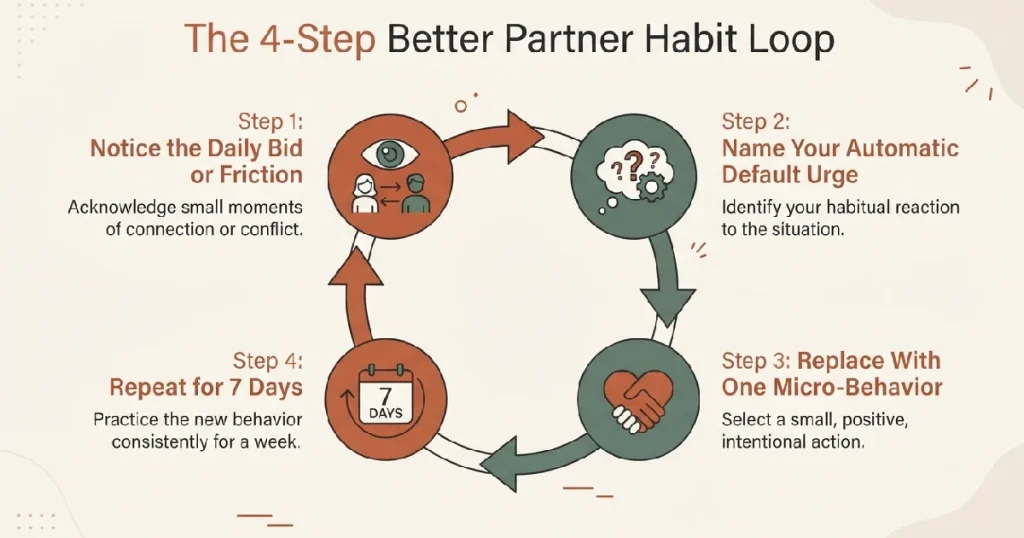
That search bar question has a smaller answer than it seemed. How to be a better partner isn’t about becoming someone new. It’s about noticing the moment you’re already in, naming what it needs, replacing one response, and repeating.
Choose one secret and run it for seven days before adding another. If you miss a day, restart the count without commentary.
Love isn’t lost in one big moment, so it won’t be rebuilt in one either. It comes back one answered bid at a time.
My Closing Remarks
I’ve sat with couples convinced they’d run out of love, when what they’d actually run out of was attention. I’ve also been the partner keeping a silent tally, and I know how righteous it feels and how lonely. Start with the least dramatic secret on the list. Your partner doesn’t need a new you, just a slightly more present one, and you deserve a relationship that feels like that too.
More Related Stories for You
If you want a playful way to stay curious about each other, try these fun questions to ask a new partner. They work surprisingly well for long-term couples too.
About The Author

Related Articles