
Forming New Habits: 8 Secrets to Make Them Stick


Why does motivation fade by week three, and what actually keeps a routine alive?
Key Takeaways
- Forming new habits typically takes two to five months, so the week-three slump is normal, not a flaw.
- Forming new habits gets easier when you design a tiny “Floor” version that survives your worst day.
- Forming new habits sticks faster when your surroundings, not your willpower, do the heavy lifting.
Quick Answer: Forming new habits means repeating a specific action in a stable context until it runs on autopilot. Research suggests this takes roughly 59 to 154 days, depending on complexity. The most reliable method is to attach a tiny version of the behavior to an existing routine, then repeat it daily with minimal friction.
Contents
Table of Contents
We all know the feeling. Monday arrives with a fresh notebook and big plans, and by week three the notebook is under a pile of mail and we’re quietly annoyed at ourselves.
That annoyance is misplaced. Forming new habits is a design problem, not a character test. The famous 21-day rule traces back to plastic surgeon Maxwell Maltz, who wrote in 1960 that patients needed about three weeks to adjust to a new face or an amputated limb. It was an observation about adjustment, never a measured rule for behavior.
The real timeline is longer, and the dip you feel around week three is predictable. Novelty has faded, but automaticity hasn’t arrived yet. Below are eight evidence-backed secrets and four tools to carry you across that gap.
The Neuroscience of Creating New Habits: Why Willpower Runs Out
Two brain systems share the workload. The prefrontal cortex handles deliberate choices and burns a lot of energy doing it. The basal ganglia store procedural routines, which is why you can tie your shoes while thinking about dinner.
A new behavior starts entirely in the prefrontal cortex, so every repetition costs real effort. Pure discipline at this stage is like pushing a car uphill daily, and the fatigue gets worse under stress or poor sleep. (The classic ego depletion experiments have had mixed replication, so treat “willpower as a battery” as a useful metaphor, not a law.)
The foundational 2009 study on automaticity followed 96 adults for 12 weeks. Automaticity rose in a curve, with quick early gains that gradually flattened, and it built fastest when the action happened in the same setting. Repeat in a stable context and the basal ganglia slowly take over the job.
8 Proven Secrets for Forming New Habits That Outlast Your Motivation
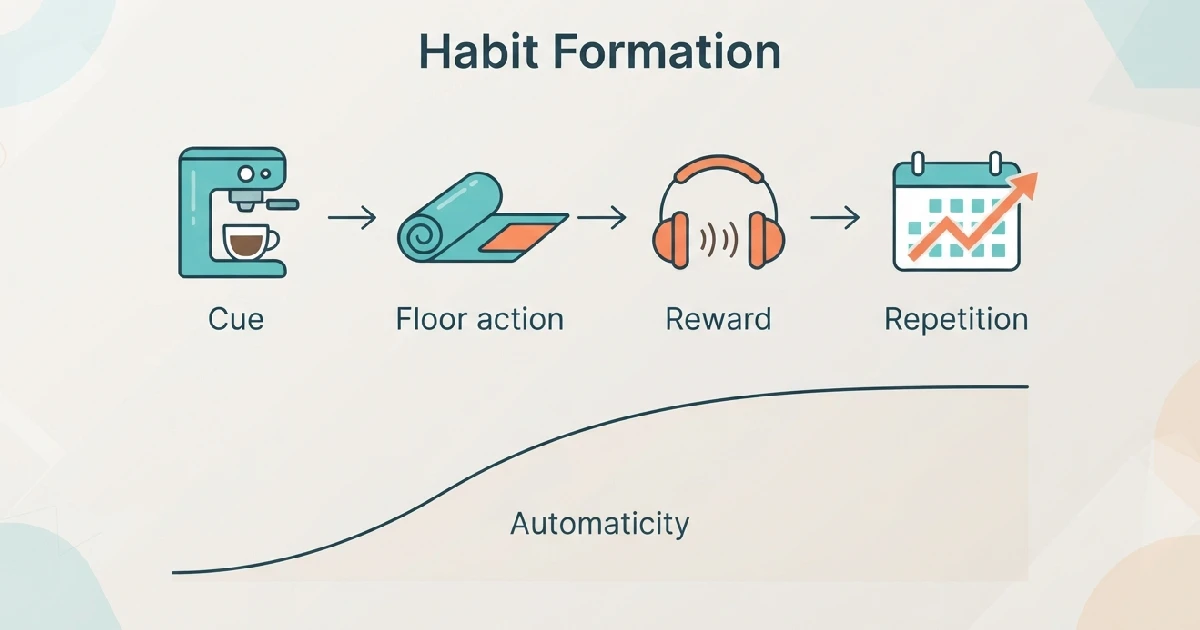
1. Calibrate Your Timeline: The 60-to-150-Day Reality Check
This systematic review on habit formation timelines pooled the evidence and landed on roughly 59 to 154 days, with simple behaviors at the short end. In Lally’s study the median was 66 days, but individuals ranged from 18 to 254.
Drinking water settles quickly. A regular gym routine takes months. So friction on day 30 is biologically normal, not a verdict on you. One place to begin is a review date 90 days out on your calendar, with no judgment before then.
2. Build a Ceiling and an Unbreakable Floor
To form a habit that survives chaos, give it two versions. The Ceiling is the ambitious one, like 40 minutes of cardio. The Floor is almost embarrassingly small, like two minutes of bodyweight squats.
On zero-energy days the Floor keeps the cue-and-action loop firing without spending willpower, and it dismantles the all-or-nothing trap. A common pitfall we frequently see is people deciding their Floor mid-crisis, when negotiation is hardest. Write it down while you feel fine.
3. Stack the Habit onto an Existing Anchor
Clock times (“at 6:30 AM”) break the moment a schedule shifts. Anchor the new action to something you already do on autopilot: After I [current trigger], I will immediately [Floor version].
After I set down my toothbrush, I will floss one tooth. After I press brew on the coffee maker, I will meditate for two minutes. If your days are irregular or you have ADHD, a sensory anchor like the kettle clicking off works well, since a sound shows up even when the schedule doesn’t.
4. Rig Your Environment Physics
Make the good action doable in under 20 seconds. Put gym clothes on your desk chair and keep the guitar on a stand instead of in its case. Then add at least 20 seconds of resistance to habits you want less of, such as logging out of social apps after each use or moving the remote to another room.
The 20-second figure, popularized by Shawn Achor, is a rule of thumb rather than a lab threshold. What matters is that small friction changes the default, and defaults win on tired days.
5. Attach an Immediate Reward
A reward at the end of the month teaches the brain very little. The reward circuit links a cue to an action when gratification arrives during the action, which is how dopamine prediction errors tag a behavior as worth repeating.
Temptation bundling, tested by Katy Milkman’s team in 2014, tied audiobooks to gym visits and raised attendance early on, though the boost faded. Reserve your most gripping podcast or playlist for the new behavior only, and rotate in fresh content when it flattens.
6. Track Percentages, Not Streaks
Streaks feel great until day 41, when you miss. Then the “what-the-hell effect,” first documented in dieting research by Polivy and Herman, kicks in. One slip convinces us the whole attempt is ruined.
Track a rolling consistency percentage instead, days completed out of the last 30, and aim for around 80. Slips are data points, not identity failures. Lally’s team found that a single missed opportunity did not meaningfully derail habit formation.
7. Stabilize Contextual Cues Over Clock Times
The American Psychological Association’s research on contextual habits, much of it from Wendy Wood, shows that habits latch onto places, sequences, and surroundings more than intentions. Your brain encodes the room itself as a trigger.
Keep the same location, lighting, and order of steps. Identical surroundings cut the number of decisions you make, which saves mental effort. If you work rotating shifts, hold the sequence constant and let the clock float.
8. Write Your If-Then Plans in Advance
Implementation intentions, studied by Peter Gollwitzer, are if-then plans written before trouble arrives. A 2006 meta-analysis of 94 tests found a medium-to-large effect on goal attainment.
For example: If I have to work past 8:00 PM, then I will do my 5-minute Floor routine instead of skipping. The decision is already made, so there’s no emotional bargaining when you’re tired. Consider writing three, one for each of your most predictable obstacles.
Practical Daily Rules: How to Form a Habit When Life Disrupts Your Routine

Forming new habits in messy weeks is where most plans quietly die. Three rules help.
- Never Miss Twice. One missed day barely dents automaticity. Two in a row is where avoidance starts to feel normal, so treat day two as the one that counts. This is a practical rule of thumb, not a lab finding.
- The Weekend Bridge. Keep the anchor but shrink the action to a micro version, like one minute of stretching after coffee. Routines stop collapsing every fifth day.
- Travel or Illness Mode. Drop to the Floor and write a re-entry date. Maintenance keeps the loop alive, while abandoning it means starting from scratch.
What to Do Next: Four Tools for Forming New Habits
- The Worst-Day Test. Ask yourself: “Could I do this on my sickest, most exhausted day in under two minutes?” If the answer is no, shrink the habit until it’s yes.
- The Day-14 Check-In. Set a reminder for day 14, right before the week-three dip, when novelty fades and rewards feel smaller. Write three answers: “What got harder? What did I expect to feel by now? What’s the smallest version I’d still count?”
- The Two-Minute Friction Walkthrough. Walk through your home once and find one 20-second barrier to remove and one to add. Consider starting with the spot where the habit happens.
- The Reset Sentence. After a miss, try saying: “That’s one data point. Today I do the Floor.” It replaces the shame spiral with an instruction.
Frequently Asked Questions About Forming Habits
How do you form new habits?
To form new habits, tie a tiny, frictionless action to an existing daily trigger, repeat it in a stable environment, and reward yourself immediately. Start with a behavior so small it needs negligible willpower, like two pushups after brushing your teeth. Consistency matters far more than intensity while the neural pathways solidify.
What are the 7 life-changing habits?
Seven foundational habits are seven to nine hours of quality sleep, thirty minutes of daily movement, water upon waking, ten pages of reading, mindfulness or journaling, whole-food meals, and digital boundaries before bed. Practiced together, these compound over time and support cognitive performance and physical resilience.
What are 10 good habits?
Ten good habits include drinking water first thing each morning, walking twenty minutes daily, planning tomorrow’s priorities each evening, making your bed, eating green vegetables, saving a set percentage of income monthly, taking micro-breaks during screen work, flossing, practicing deep breathing under stress, and unplugging an hour before sleep. Pick one and start with its Floor version.
Transforming Daily Actions into Permanent Identity
Back to that notebook under the mail pile. It was never proof that you lack discipline. It was a plan built for a motivated Monday, not a drained Thursday.
Now you hold the map: a realistic timeline, a Floor, an anchor, friction you control, and a reward that arrives on time. Forming new habits works when the plan forgives you before you ask.
Willpower starts a habit, but a forgiving design is what keeps it alive.
My Closing Remarks
I’ve restarted more habits than I can count, and the ones that finally held were never the heroic ones. They were the two-minute versions I felt almost embarrassed to admit to. If you slip this week, please be as kind to yourself as you’d be to a friend in your spot. Pick one anchor, write one Floor, and let the boring repetition do its quiet work. I’m rooting for you.
David Wall
More Related Stories for You
Curious what else shapes lasting progress? Read the key principles behind lasting success.
About The Author

Related Articles