
 Sara Carmen
When leaving is not possible today, you can still stop organizing your entire emotional life around a man who refuses to change.
Key Points
- When you say, “I hate my husband,” the feeling may be accumulated resentment and nervous system exhaustion rather than a random loss of love.
- Emotional divorce is a temporary boundary strategy that helps you stop waiting for his transformation and begin rebuilding your own life.
- You can create emotional distance without cruelty while also making a safe, practical plan for your future.
Contents
Table of Contents
The third option when you hate your husband but cannot leave is not pretending to love him. It is also not forcing a divorce before you are emotionally, financially, or physically ready.
It is stopping his change from being the condition of your peace.
You may have typed, “I hate my husband but cannot leave,” into a search bar after another evening of silence. Someone might think you are simply angry because you complain about him, avoid his touch, or sleep with your back turned. What they do not see is the years of promises that were made and forgotten.
Someone might think you are staying because the marriage is not truly that bad. What they do not see is financial dependence, childcare, health concerns, immigration issues, family pressure, or the fear of starting over.
Someone might think you are cold because you no longer argue. What they do not see is that you have argued so many times that your body now expects disappointment before the conversation begins.
Research by John Gottman and Robert Levenson found that repeated conflict patterns and high physical arousal were linked with later marital dissolution. Their findings do not mean every unhappy marriage will end in divorce. They show that unregulated conflict and emotional withdrawal are not harmless when they continue for years.
The first step is to understand what may be happening beneath the word hate.
Why I Hate My Husband Can Feel Like a Body Reaction
Hate is sometimes anger that has been denied a boundary for too long. It can also be grief, helplessness, disgust, and disappointment compressed into one powerful word.
Your logical mind may say, “He is not hurting me right now.” Your body may still tighten when you hear his key in the door. This is because the autonomic nervous system, which manages automatic body functions such as heart rate and breathing, learns through repetition.
If your marriage has involved criticism, neglect, broken promises, sexual pressure, contempt, or constant unpredictability, your body may begin to treat ordinary moments as warnings. Your shoulders rise. Your stomach contracts. Your voice becomes sharp before you have chosen to be sharp.
This is a form of threat conditioning. It means your brain has connected a person or setting with emotional danger. The threat may not be physical. It can be the expectation of being dismissed, blamed, interrupted, or disappointed again.
The American Psychological Association explains that chronic stress can affect sleep, mood, concentration, and physical health. That matters because your resentment may not live only in your thoughts. It may be present in your headaches, exhaustion, muscle tension, and inability to relax beside your husband.
Most women in this situation are not proud of their hatred. They often feel ashamed of it. Your reaction may be understandable even if some of the words or behaviors that come from it need to change.
That distinction gives you somewhere to begin.
When I Hate My Husband Means Relational Debt Has Accumulated
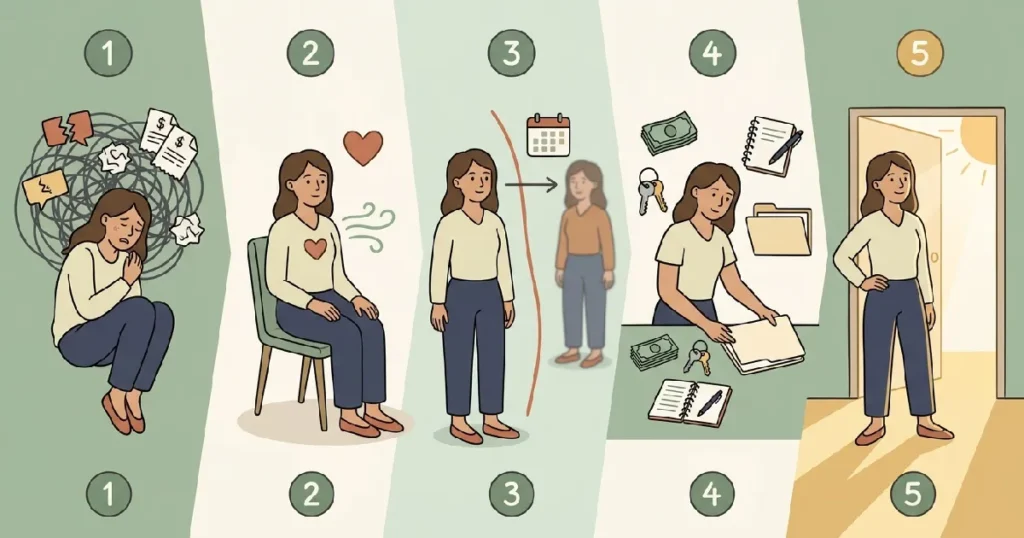
“Relational debt” is not a formal diagnosis. It is a useful term for the emotional cost of needs that have been ignored, agreements that have been broken, and truths that have been swallowed to keep the household functioning.
Every time you stay silent to avoid another fight, the unpaid emotional bill grows. Every time you carry the children, the money, the appointments, and the emotional labor while telling yourself not to complain, the balance increases.
A marriage can become like a bill hidden in a drawer. The longer you avoid opening it, the more frightening the total becomes.
You may have tried gratitude lists. You may have told yourself that good wives forgive faster. You may have prayed for patience while your husband continued to benefit from your silence.
Forgiveness cannot be used to erase information. If a pattern continues, your anger may be telling you that the problem requires a boundary, not another attempt to feel grateful.
Maya’s story. Maya was 38 with two children, a part-time job, and a husband who called her “too sensitive” whenever she mentioned unpaid bills or broken promises. She searched “I hate my husband but cannot leave” after he forgot their son’s medical appointment and laughed when she cried. She did not want a dramatic exit that night. She wanted the knot in her chest to stop controlling every hour. In therapy, she separated facts from fantasy and admitted that she had built her life around waiting for him to finally understand. She stopped bringing him every feeling and began making practical agreements, seeing a friend on Saturdays, and tracking her money. Over time, her hate softened into anger she could name and decisions she could make. She later chose a trial separation, but her real change began before she moved out.
Her story does not prove that emotional divorce leads to one specific outcome. It shows that your future can begin before your living arrangement changes.
How Waiting for Change Keeps You Trapped in Marriage
Hope can keep you alive during a painful season. It can also keep you suspended when it becomes a demand that your husband change before you permit yourself to live.
You may be waiting for him to apologize without being prompted. You may be waiting for him to notice your exhaustion, become more affectionate, stop drinking, participate in parenting, or admit that his behavior has damaged the marriage.
That waiting creates a painful loop. You monitor him for signs of change. He senses your disappointment. You raise the issue again. He becomes defensive. You feel confirmed in your belief that he does not care.
The loop is not evidence that you are irrational. It is a predictable result of placing your emotional future in another person’s hands.
Acceptance does not mean approval. It means seeing the current facts without building your daily peace around a fantasy version of your husband.
But here is the part that may feel both frightening and freeing.
Emotional Divorce Is the Third Option When I Hate My Husband

Emotional divorce is not a legal status. It is a personal boundary strategy that helps you stop trying to obtain safety, validation, or tenderness through repeated arguments with someone who is not offering them.
You may also hear this called radical emotional detachment. Healthy detachment does not mean becoming cruel or numb. It means reducing the amount of mental energy you spend monitoring his mood, seeking his approval, defending your worth, or waiting for him to become emotionally available.
You still communicate about children, housing, schedules, health, and money. You remain civil where possible. You stop treating every interaction as a test of whether he finally loves you correctly.
This is different from the silent treatment. Silent treatment is often used to punish or control. Emotional detachment is used to recover your ability to think.
In practical terms, you begin treating the relationship as a shared household rather than the main source of emotional nourishment. You stop asking your husband to be the person who repairs the damage he keeps causing.
That does not mean your needs disappear. It means you stop handing him the power to decide whether those needs will ever be met.
In clinical work, I have seen women become calmer once they stop making every conversation a final appeal. Their calm is not proof that the marriage is healed. It is proof that their nervous system is no longer being forced to argue for recognition every day.
The most useful question is not, “How do I make him understand?”
It is, “What can I build even if he never does?”
Reclaiming Your Identity When You Hate Your Husband
The goal is not to spend the rest of your life silently tolerating an unhappy marriage. The goal is to stop wasting your whole life waiting for permission to have one.
You need what can be called proof of work. This means repeated evidence that you can care for your mind, body, finances, friendships, career, and future even while the marriage remains unresolved.
Proof of work may look small at first. You update your résumé. You open a private email account for job searches. You learn what money enters the household and where it goes. You reconnect with one friend who does not require you to pretend everything is fine.
If financial dependence is part of why you cannot leave, gather information slowly and safely. The Consumer Financial Protection Bureau provides guidance about financial abuse and control. Financial abuse can include blocking access to money, damaging credit, hiding accounts, or preventing employment.
If your husband uses threats, stalking, physical violence, sexual coercion, intimidation, or financial control, emotional divorce under the same roof may not be safe. The National Domestic Violence Hotline offers safety planning guidance. Couples counseling is not the first step when one person is afraid of the other.
A safe plan may involve a trusted person, legal advice, secure documents, emergency funds, or a protected place to stay. You do not need to announce every step before you have support.
Your anger may be asking for a life that is larger than this marriage. Listen to that message without allowing anger to make every decision.
What to Do When I Hate My Husband But Cannot Leave

1. Use the Debt List. Write three columns: what happened, what you felt, and what boundary or decision the fact points toward. For example, “He canceled childcare again” becomes “I feel abandoned” and then “I will stop accepting work shifts that depend only on his promise.” This turns a cloud of resentment into information.
2. Regulate before you decide. When your chest is tight or your voice is rising, pause before sending a message or starting a confrontation. Try a longer exhale, place both feet on the floor, and name five things you can see. This helps your prefrontal cortex, the part of the brain involved in planning and judgment, come back online before you act.
3. Create roommate-level agreements. Keep difficult conversations specific and time-limited. You might say, “I will discuss the school schedule and electricity bill at 7 p.m. I will not continue a conversation that includes insults.” This is not emotional punishment. It is a clear limit around access to your attention.
4. Build a weekly proof-of-work plan. Choose one action for your health, one for connection, one for money, and one for competence. A walk, a friend’s phone call, a budget review, and a job-training lesson may seem ordinary. Repeated ordinary actions are how a trapped life begins to develop exits.
A useful question for the next 24 hours is this: “What is one decision I can make without waiting for my husband to agree?”
When Emotional Divorce Is Not the Right Move
Emotional detachment is not a universal answer. If the main problem is untreated depression, addiction, trauma, or a temporary crisis and your husband shows consistent accountability, structured marriage counseling may help.
If both of you want repair, a licensed couples therapist can help you identify destructive patterns and practice safer communication. If only one person wants repair and the other continues to mock, threaten, betray, or control, individual therapy and safety planning may be more appropriate.
You are also allowed to discover that you no longer want the marriage. Emotional divorce is not a promise to stay. It is a way to stop making a permanent decision from a state of panic, exhaustion, or dependence.
Your life does not have to wait for a courtroom, a signed agreement, or a dramatic moment of courage.
You may have typed, “I hate my husband,” because you believed hatred meant you were trapped inside a dead end. Now you can see it as a signal that your emotional account has been overdrawn for too long.
You do not have to keep hiding the bill. You can begin paying yourself back.
Your life can begin before your marriage ends.
My Closing Remarks
Here is my blunt conclusion: staying in the same house does not require you to keep abandoning yourself. I have watched women spend years trying to prove that their pain is real to the person causing it. The turning point often comes when they stop presenting evidence and start building a life. That choice may lead to repair, separation, or divorce. The outcome matters, but the first victory is simpler: your peace no longer waits for his permission.
More Related Stories for You
- Learn more about successful marriage tips that support healthier communication and clearer boundaries.
About The Author