
 Sara Carmen
The strongest predictor of survival after an affair is not a skilled therapist. It is whether one person can sit still inside their own shame.
KEY POINTS
- Couple therapy after cheating often stalls because it treats betrayal like a communication breakdown, when the betrayed partner’s nervous system is actually running a full trauma response.
- What rebuilds a marriage is the unfaithful partner’s capacity to absorb rage, repetition, and suspicion without defending, minimizing, or going silent.
- Genuine reconciliation takes 18 months to three years of consistent behavior, and no weekend intensive shortens that clock.
Contents
Table of Contents
Everything you have been told about repairing a marriage after an affair may be quietly making things worse.
You booked the appointment. You sat on the couch across from a kind, credentialed stranger. You practiced reflective listening and used “I” statements and agreed to a weekly date night. And somehow you left feeling emptier than when you walked in.
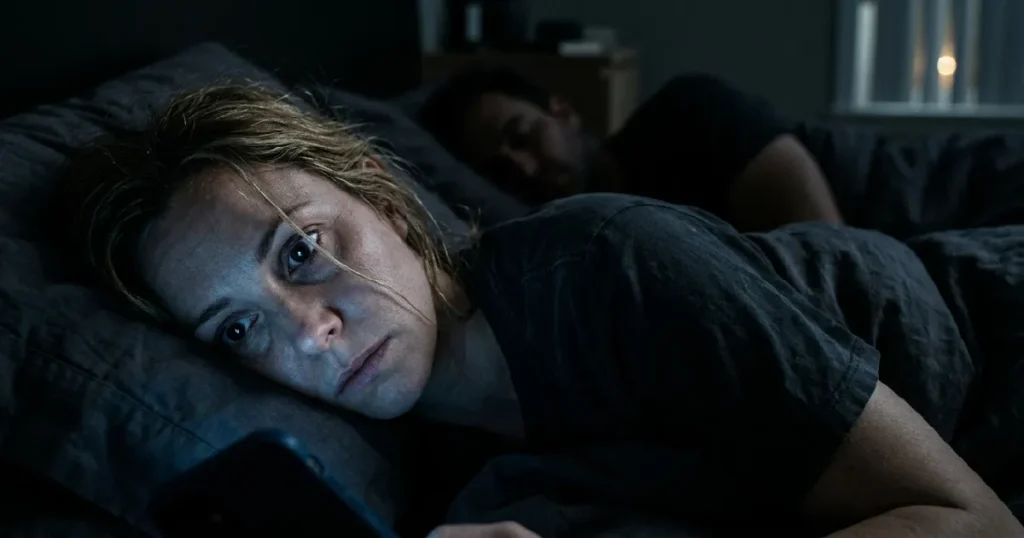
Someone looking at your calendar might think you are doing all the right things. What they do not see is the betrayed partner lying awake at 3 a.m., scrolling through old bank statements. What they do not see is the unfaithful partner sighing, “We already talked about this,” and the way that sigh lands like a second betrayal.
Someone might think that a therapist who stays neutral is being fair. What they do not see is that neutrality, in the weeks after discovery, can feel exactly like being told your pain is negotiable.
There is a reason so many couples walk out of that office more disconnected than when they walked in. It has almost nothing to do with the therapist’s skill.
Couple Therapy After Cheating Fails Because Infidelity Is Not a Communication Problem
Most couple therapy models were built for chronic conflict. Two people who love each other, arguing about money, in-laws, chores, sex. Those models assume something important: a level playing field. Two partners, two perspectives, one shared reality.
Infidelity destroys that assumption.
When you discover an affair, you are not dealing with a disagreement. You are dealing with what researchers call betrayal trauma, a term developed by psychologist Jennifer Freyd at the University of Oregon to describe the specific injury that happens when the person you depend on for safety is the same person who harms you. Your brain cannot file that experience neatly. The alarm system and the attachment system fire at the same time, and they point in opposite directions.
That is why so many betrayed partners describe symptoms that look almost identical to post-traumatic stress: intrusive mental images, sleep disruption, nausea, difficulty concentrating, and hypervigilance, which simply means your nervous system is scanning for danger around the clock even when nothing is happening. A 2019 study by Roos and colleagues in the Journal of Loss and Trauma found that a striking proportion of people who discovered a partner’s infidelity reported symptom clusters consistent with clinical PTSD.
So picture what happens when you take a traumatized nervous system and place it in a room where a well-meaning professional asks, “What do you think was missing in the marriage before this happened?”
That question is not neutral. To a person in acute betrayal trauma, it is an invitation to audit their own worthiness while they are bleeding.
Cheating does not break the conversation. It breaks the floor you were both standing on. And no amount of better listening will hold you up when the floor is gone.
What Actually Saves a Marriage After Betrayal: The Shame Endurance Test
Here is the part almost nobody says out loud.
In my clinical experience, the single most reliable predictor of whether a couple makes it through infidelity is not love, not history, not children, and not the quality of their therapist. It is the unfaithful partner’s ability to tolerate intense, sustained shame without collapsing into defensiveness or self-pity.
I call it the shame endurance test.
Shame is a physically unbearable emotion. It is not guilt. Guilt says, “I did something bad.” Shame says, “I am bad.” And the human brain will do almost anything to escape it. It will minimize (“It was only messages”). It will deflect (“You were checked out too”). It will negotiate (“How long am I going to pay for this?”). It will go silent and call the silence keeping the peace.
Every one of those moves is a shame-escape hatch. And every time the unfaithful partner takes one, the betrayed partner learns the same lesson again: I am still alone in this.
The repair does not live in the apology. It lives in the ability to stay in the room while the apology is rejected.
The Questions Are Not an Interrogation. They Are an Attachment Test.
This is the part that changes everything, and it is the piece most infidelity advice misses completely.
When a betrayed partner asks the same question for the fortieth time, they are not gathering facts. They already have the facts. They are running a nervous-system experiment. Unconsciously, they are testing whether the person who broke their safety can now be a source of it.
Each question is a probe: If I bring you my worst pain, will you stay present, or will you flinch?
Answer with warmth and detail, and the attachment system logs a small deposit of safety. Answer with a sigh, an eye roll, or “we’ve been over this,” and the system logs a fresh injury. This is why recovery feels non-linear. You are not making progress on a topic. You are re-coding an attachment bond, one exchange at a time.
Which means the unfaithful partner has to make one specific psychological shift: stop being the defendant and start being the witness.
A defendant manages their exposure. A witness testifies to the harm, even when the testimony makes them look terrible. Defendants want the trial to end. Witnesses stay until the story is fully told.
Marcus and Dana: What the Shift Looked Like
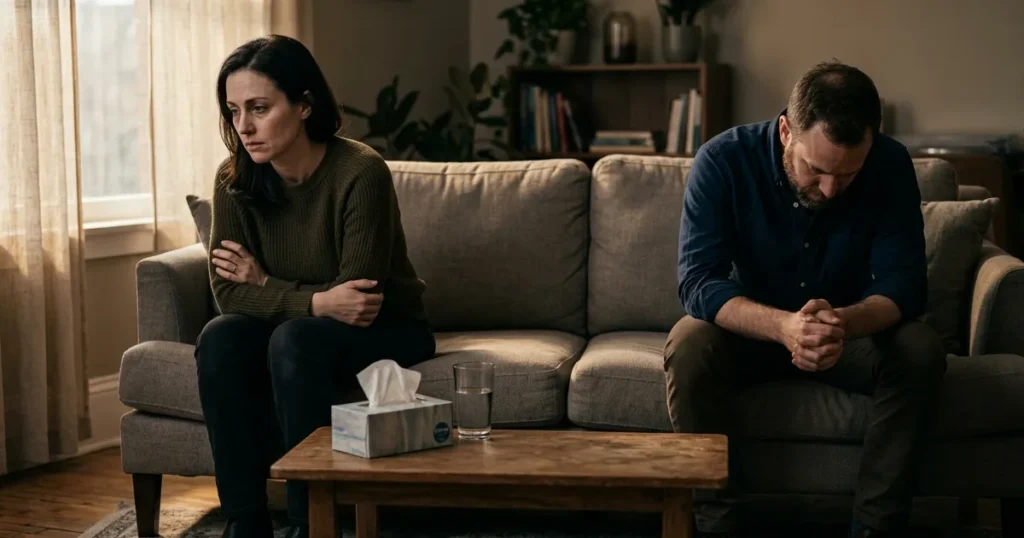
Marcus and Dana came to counseling four months after Dana found a second phone in his gym bag. Marcus had already apologized, ended the affair, and switched jobs. He genuinely believed he had done the work.
But every time Dana brought it up, he would say, “I’ve told you everything. I don’t know what else you want from me.” Dana would escalate. Marcus would go quiet for two days. They called it “communication trouble.”
The turning point came when Marcus stopped trying to end her pain and started letting it exist in front of him. He learned to say, “Ask me again. I’ll answer as many times as you need.” He answered questions at midnight. He answered questions on a Tuesday morning when he was already late. He answered the same question about a hotel in Denver eleven separate times.
Around month fourteen, Dana told me something I have never forgotten. She said, “I stopped needing the answers when I finally believed he wasn’t going to run from the question.”
That is the entire mechanism, in one sentence from a woman who lived it.
Why Digital Affairs Cause the Same Trauma as Physical Ones
There is a common defense worth naming directly, because it derails more recoveries than almost anything else: nothing physical happened.
The gender gap in infidelity has narrowed considerably in recent decades, and a large share of modern betrayal now happens entirely on a screen. Micro-cheating, meaning small, deniable behaviors like secret messaging, hidden apps, or an emotional intimacy kept deliberately out of your partner’s view, produces the same attachment injury as a physical affair.
The reason is straightforward. Attachment trauma is not caused by skin contact. It is caused by the discovery that your partner built a private world and locked you out of it. The late Shirley Glass, whose research on affair recovery remains a cornerstone of the field, described this as a wall of secrecy built toward the spouse and a window of intimacy opened toward someone else. The wall does the damage, not the geography.
If your partner has told you that emotional affairs “don’t really count,” you are not being dramatic. Your nervous system is reading the situation accurately.
Individual Stabilization Comes Before Couple Therapy After Cheating
This is the sequencing error I see most often. Couples rush into joint sessions while both people are still in freefall.
Joint work requires two regulated nervous systems. If the betrayed partner is in fight-or-flight, and the unfaithful partner is drowning in shame, the session becomes a re-injury machine.
So stabilize separately first.
The betrayed partner usually needs trauma-informed care, which may include EMDR, a therapy that helps the brain reprocess distressing memories so they stop firing like they are happening right now. The unfaithful partner needs individual work on a harder question than “how do I fix this?” The real question is why deception felt like a viable option in the first place. Entitlement, avoidance, conflict phobia, unprocessed loneliness, sexual shame, the answers are rarely flattering and always instructive.
Left unexamined, that pattern does not disappear because someone got caught. It simply waits for the next unbearable feeling.
The 18-Month Rule: Rebuilding Trust After Cheating Takes Real Time
Say this part plainly. Meaningful recovery from infidelity typically takes 18 months to three years of consistent, verifiable behavior.
Not 18 months of good intentions. 18 months of showing up.
John Gottman’s research-based model of trust repair describes three stages that unfold in sequence: atonement, attunement, and attachment. You cannot skip to attachment. A couple that tries to fast-forward to “let’s just move on” at month four will usually find themselves back at month one by the following spring.
Most people in your position do not realize this, and the not-knowing makes them panic. If you are ten months in and still having hard nights, you are not failing. You are on schedule.
What to Do This Week: Three Practices That Actually Move the Needle
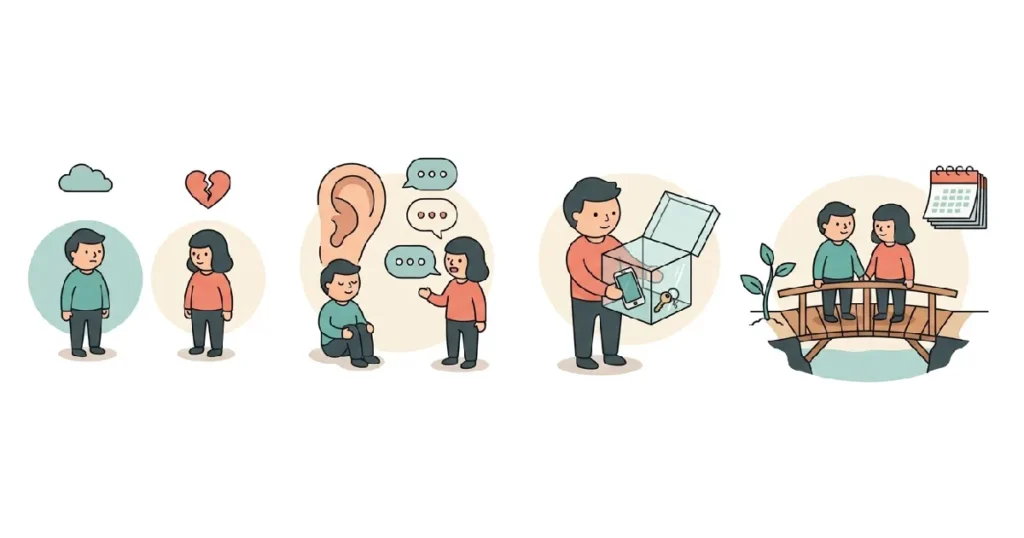
1. The A.A.A. Response. When your partner asks a painful question, use three steps in order: Answer the question directly and completely. Acknowledge the pain behind it. Add something they did not ask for. It sounds like: “Yes, I texted her that day. I know hearing that makes your stomach drop. There’s one more detail I should tell you about that afternoon.” The third step is what separates a defendant from a witness.
2. The Ten-Minute Witness Window. Set a daily appointment, same time, same place, ten minutes. The betrayed partner speaks or asks anything. The unfaithful partner does not explain, correct, or contextualize. Predictability calms a hypervigilant nervous system faster than reassurance does, because reassurance can be faked and consistency cannot.
3. Transparency by Default. Not transparency on request. Passwords open, location shared, plans announced before they happen, with no one having to ask. Consider this useful test: if your partner learned about it later, would they feel informed or ambushed? If the answer is ambushed, say it now.
A question worth sitting with, for the person who cheated: Can I let my partner be unhealed today without treating that as a verdict on me?
And for the person who was betrayed: What would I need to see, specifically and observably, over the next thirty days, to feel one percent safer?
The Floor Gets Rebuilt One Board at a Time
Come back to that therapy office for a moment. The kind stranger, the tissues, the feeling of leaving emptier than you arrived.
You now know why that happened. Nobody heals in a room where their reality is up for debate. Skills training assumes a floor. You do not have a floor yet. You have two people standing in a hole, and the only way out is one of them agreeing to stay down there, in the dark, in the shame, for as long as it takes to hand up the boards.
Good therapy can help enormously, but only when it stops mediating and starts doing what it should have done from the first session: naming the injury, protecting the injured, and holding the person who caused it accountable to the slow work of being trustworthy again.
Your marriage will not be saved by better arguing.
It will be saved by someone who refuses to leave the room.
My Closing Remarks:
I will be blunt with you, because I think you have had enough polite advice. In fifteen years of this work, I have never once seen a marriage survive an affair because someone became a better communicator. Not once. I have seen them survive because one person chose to bleed shame quietly for two years without asking for credit. That is the whole thing. It is unglamorous and unfair and almost nobody has the stomach for it. But if you do, you should know it works. I have watched it work.
More Related Stories for You:
- Successful marriage tips that hold up long after the honeymoon phase ends
About The Author