
 Sara Carmen
They broke your trust, your sleep, and your smile. But here is the part of the story they don’t get to write: the ending is yours.
Key Points
- How to be happy again starts with a hard truth: your brain filed the betrayal as a physical injury, so your healing must begin in your body, not in your pep talks.
- Real happiness after betrayal never comes from restoring the woman you were. It comes from building the woman you are becoming.
- Forgiveness is optional. Post-traumatic growth is not. Choose the growth.
Contents
Table of Contents
Betrayal Trauma Is a Body Injury, Not a Bad Mood
You’ve tried. You’ve really tried. The affirmations on your bathroom mirror. The long walks. The “good riddance” speeches your friends keep handing you like tissues. And still, at 2 a.m., your brain runs the discovery moment on a loop. The text. The phone call. The look on their face. Your chest tightens and your stomach drops like you are living it all over again. You start to wonder if something is wrong with you.
There isn’t. That’s not weakness. That’s wiring.
Everything you’ve been told about getting over someone who broke you might be making it worse. The problem was never that you aren’t trying hard enough. The problem is that you’re trying to think your way out of a wound your body is still carrying.
Psychologist Jennifer Freyd spent decades studying what she calls high betrayal trauma: harm caused by someone you love and depend on. Her research shows that the closer the betrayer, the deeper the injury. When the person who was supposed to be your safest place becomes the source of danger, your brain does something remarkable. It files the event as a survival threat, not just a heartbreak.
That’s why your body still acts like the danger is present. Your amygdala, the brain’s alarm center, keeps signaling threat. Cortisol, the stress hormone, keeps flowing. You stay hypervigilant, scanning for danger in a life where the danger has already left. A 2026 review in the International Journal of Psychiatry in Medicine found that serial infidelity paired with gaslighting produces trauma responses that mirror complex PTSD, the layered wound that comes from repeated betrayal rather than a single event. The authors call these diagnostic blind spots, because too many women are told they’re having a hard breakup when their nervous system is actually in survival mode.
Most women don’t realize the exhaustion is biological. You’re not lazy. You’re not dramatic. Your body is spending enormous energy keeping an alarm system running that nobody has taught it to turn off.
Think of your nervous system as a smoke alarm. The fire is out. The liar is gone. But the alarm still screams at every wisp of smoke. A song on the radio. A tone of voice. A car that looks like theirs. You can’t argue with an alarm. You have to reset the wiring. That’s what healing actually is, and that’s what this roadmap is for.
The Neurobiology of Betrayal: Why You Can’t Just “Snap Out of It”
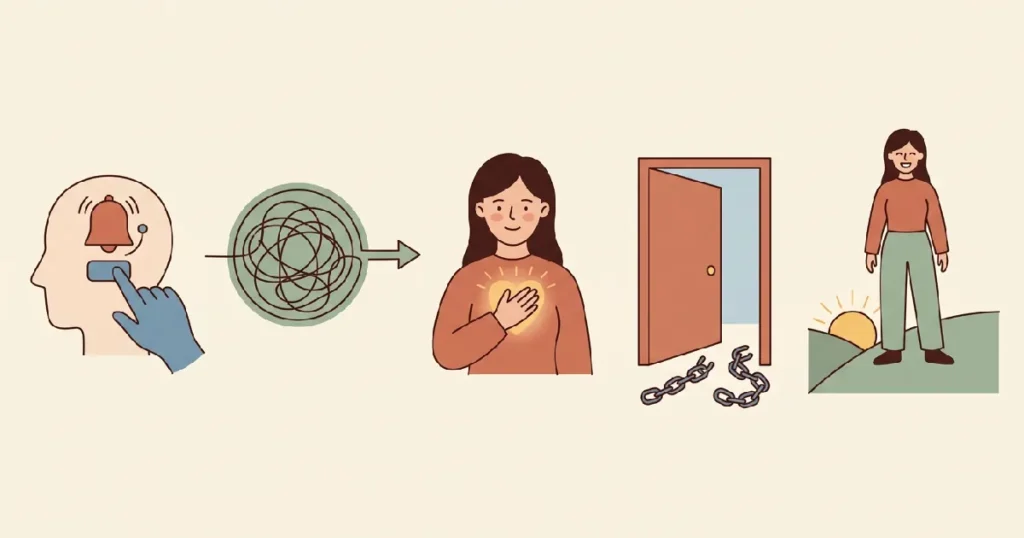
Here’s what “snap out of it” gets wrong: your brain cannot tell the difference between remembering a threat and experiencing it. Trauma memories are stored in fragments. The sight. The sound. The sick feeling in your stomach. Because those pieces were never fully processed, your brain treats them as live events happening right now. The memory hits your body before your thoughts catch up. That is not a choice. It is neurobiology.
Someone might think you’re stuck in the past. What they don’t see is that your nervous system still believes the past is happening now.
When you understand this, your self-judgment starts to dissolve. You stop calling yourself weak for crying in the grocery store. You stop measuring your healing against people who never lived what you lived. Your timeline is not a personality flaw. It is a nervous system timeline, and it deserves the same patience you would give a broken bone.
If this continues untreated, your body will keep making decisions your mind never agreed to. It will pick safety over love and distance over depth, and you will wonder why connection suddenly feels impossible. That is not who you are. That is an alarm that still thinks the fire is burning.
The most effective treatments do not ask you to think harder about the betrayal. They work directly with how the brain stores the memory. Eye movement desensitization and reprocessing (EMDR) uses guided bilateral stimulation, a back-and-forth rhythm of attention, to help the brain file a trauma memory as past instead of present. The research on intensive formats is striking. In one study of a compressed treatment program combining EMDR with exposure therapy for severe PTSD, 82.9% of participants showed a clinically meaningful response with very low dropout, all within a condensed timeframe. Healing can move faster than you think, and it does not require years of retelling the story.
Breaking the Loop: How to Stop Reliving the Moment They Broke You
Rumination, the compulsive replaying of the same painful scene, is not a moral failure. It is your brain’s clumsy attempt to make sense of something senseless. Somewhere inside you, a voice believes that if you find the detail you missed, you will be safe next time. So the loop spins. The 2 a.m. replay. The obsessive scanning of old messages. The mental courtroom where the case never closes.
Forcing the thoughts away rarely works, because what you resist tends to return louder. The fix is to change where the memory lives. That’s where the newer wave of trauma treatment comes in. Instead of fifty-minute weekly sessions that reopen the wound and then send you back into your week, therapy intensives compress treatment into focused multi-day blocks. Telling the story week after week without body-based processing can keep the loop spinning. The story gets rehearsed. The alarm never gets reset.
One question to ask any therapist you interview: “How will we work with my body, not just my story?” A therapist who treats trauma well will have a real answer. If they look confused, keep interviewing. You are not hiring someone to hear the story. You are hiring someone to help your nervous system file it away.
Somatic Sovereignty: Reclaiming Your Body from Someone Else’s Lies

But here’s what almost no one tells you: the person who lied to you did not just steal your trust. They trained your body to distrust itself.
Every time they denied your reality and you overrode your own perception to survive the relationship, you practiced self-doubt. Months and years of that practice rewire your interoception, the body’s ability to sense and trust its own signals. Your gut feeling. Your fatigue. Your quiet “something is off.” You learned to silence all of it to keep the peace. Now the peace is gone and the silence remains.
That is why healing must be physical before it can be mental. This is the truth that separates real recovery from the endless self-help loop. Happiness after betrayal is not found in a better explanation of what happened. It is found in re-earning your own testimony: learning to believe your own body again.
Maya found the messages nineteen months before she walked into my practice. She had talked the betrayal to death. She could explain his psychology better than he could. But she still woke at 3 a.m. with her heart pounding, and she still flinched when her own phone buzzed. We did not start with the story. We started with her body. Where did the tightness live? How did her breath shorten? What did her shoulders do when she said his name? Six weeks of grounding and paced breathing, then EMDR. The first morning she woke without the 3 a.m. alarm, she cried from relief, not grief. Six months later she said something worth repeating: “I don’t think about him daily anymore. I think about the garden I’m planting.”
Your body is the one witness that never lied to you. When it says yes again, you will believe it. When it says no, you will leave. That is sovereignty, and it is the foundation of every genuine smile you will ever have again.
Forgiveness is Optional: Choosing Post-Traumatic Growth Over Forced Healing
Society hands you a script: forgive, move on, be the bigger person. But the science tells a different story. The American Psychological Association describes forgiveness as a voluntary shift in feelings and attitudes, something you choose, not a debt you owe. And forgiveness is not reconciliation. You can forgive and never speak to someone again. You can also decline to forgive and still be completely at peace. Both are legitimate paths. What matters is that the choice is yours.
What is not optional is growth. Psychologists Richard Tedeschi and Lawrence Calhoun found that many people who survive profound adversity do not just recover. They transform. Their research names five domains of post-traumatic growth: personal strength, new possibilities, deeper relationships, greater appreciation of life, and spiritual change. Notice what is absent from that list. Reconciliation with the person who hurt you. Growth does not require them.
Here is a reframe that changes everything. Your anger is not bitterness. When someone you trusted shatters your values, the damage is called moral injury, the wound that forms when your sense of right and wrong is violated by the person who was supposed to honor it. Your rage is the sound of your moral compass defending itself. It is not an emotion to suppress. It is a boundary signal. Let it draw the line your old self was never allowed to draw.
Most women in your position feel guilty about not forgiving. That guilt is borrowed too. It came from the same people who told you to smile so you wouldn’t make anyone uncomfortable. You don’t owe anyone your forgiveness. You owe yourself your growth.
From Shattered to Sovereign: A Practical Roadmap to Rebuild Your Smile

Happiness after devastation is not a feeling you wait for. It is a structure you build. Here are four moves you can start today.
- Move 1: The 60-Second Reset. When the loop starts, do this: name five things you can see, four you can touch, three you can hear, two you can smell, and one you can taste. This is grounding. It pulls your attention out of the trauma memory and into the present moment, where you are actually safe. Do it even when it feels silly. Especially when it feels silly.
- Move 2: The Body Date. Give yourself five quiet minutes a day. Eyes closed. Scan from your scalp to your toes and simply name three sensations without judging them. You are not fixing anything. You are rebuilding interoception, your body’s inner voice, one small conversation at a time. A useful question to ask: “What is my body telling me today that I used to ignore?”
- Move 3: The New-Self Blueprint. Write a goodbye letter to the woman you were before the betrayal. Thank her for surviving. Then write three qualities you want in the woman you are becoming. Not the woman he wanted. The woman you want. Every morning, take one tiny action that version of you would take. Make your coffee exactly how you like it. Wear the color he hated. Small actions are how a new self is built, one brick at a time.
- Move 4: The Non-Negotiable List. Write one boundary you will never bend again. “I will never stay in a relationship where I have to shrink my reality to keep the peace.” Post it where you will see it daily. Boundaries are not walls. They are the architecture of your next chapter.
None of these moves require you to feel happy first. That is the order most people get wrong. Action comes first. Feeling follows. The smile comes later, and it comes from the inside out.
The Ending Is Yours
Tonight, at 2 a.m., the loop may still start. That’s okay. It is quieter than it was, and it will keep getting quieter, because you finally know what is happening: an alarm, not a verdict. A body learning to reset.
And you don’t get the old you back. Hear that as the gift it is. She was blindsided. She trusted without checking. The woman you are building now checks, and then chooses anyway. She is not restored. She is evolved.
This is how to be happy again. Not by forgetting. Not by forgiving on command. By rebuilding a self that cannot be shattered again.
The smile they stole was borrowed anyway. The one you’re building now is yours.
My Closing Remarks
I’m going to say something bold, and I hope you’ll let it land: I’m not sorry you’re not her anymore. The woman who trusted without checking, who laughed without scanning the room, she was lovely. But she was also standing in a storm without an umbrella. I’ve watched women spend years trying to resurrect her, and I’ve watched them spend months becoming someone better. Grieve her, yes. Then outgrow her. The version of you that can’t be broken again is not behind you. She’s ahead, and she’s already smiling.
More Related Stories for You
If you are still in the raw first days after the discovery moment, our guide on surviving a cheating husband walks you through what comes next.
About The Author