
 Sara Carmen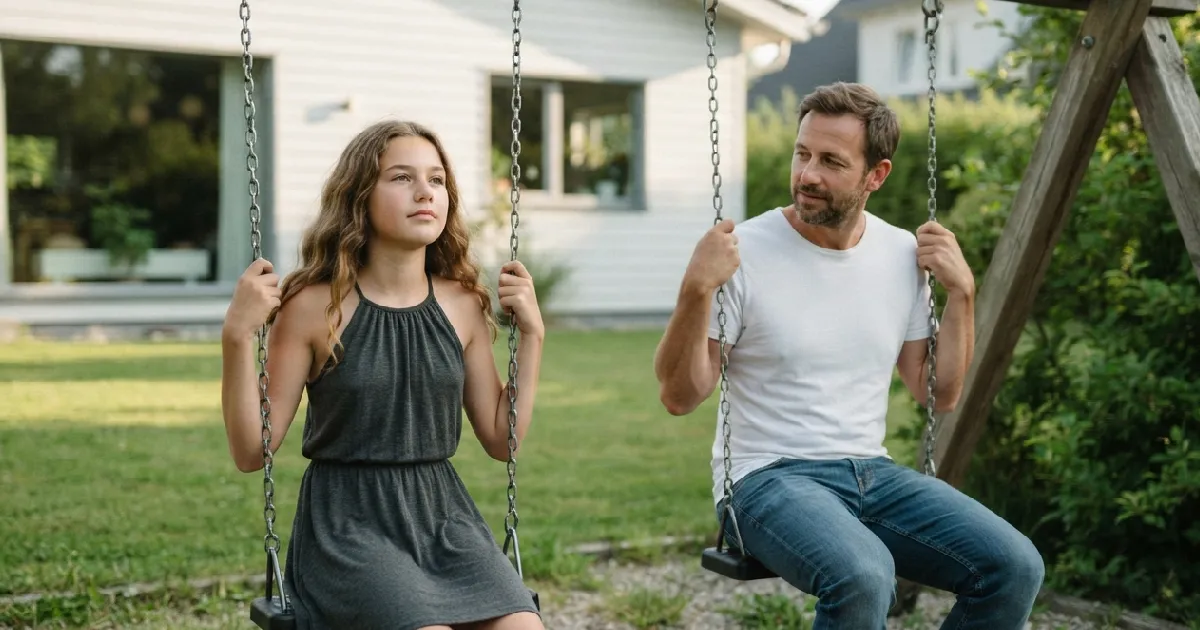
The wound isn’t always about what your father did. Sometimes it’s about what he never learned to give.
Key Points
- Daddy issues can take root even when your father showed up to every game, paid every bill, and never once raised his voice.
- The real driver is usually a gap psychologists call childhood emotional neglect, not a lack of love but a lack of emotional response.
- You can name and heal daddy issues without turning your father into a villain he never was.
Contents
Table of Contents
You’ve scanned your childhood for evidence. No hitting. No leaving. No slammed doors or broken promises you can point to on a timeline. And still, something in you flinches when a partner gets too close, or braces when things start going well. You’ve told yourself you’re being dramatic, that you have no right to feel this way when other people had it so much worse. You’re not making it up.
In short: daddy issues can form when a father is physically present but emotionally absent, when love was never in question but attunement was. The wound isn’t about what he did to you. It’s about what quietly never happened between you.
What Daddy Issues Actually Means (And Why It Isn’t a Diagnosis)
Let’s clear something up first. You won’t find “daddy issues” in any diagnostic manual, and no therapist will ever write it on an insurance claim. What the phrase actually points to is an attachment injury, a disruption in the bond a child forms with a parent that later shapes how safe, worthy, or lovable they feel in relationships.
This idea traces back to attachment theory, first developed by psychiatrist John Bowlby. According to Bowlby’s framework, positive developmental outcomes with lower levels of depressive symptoms occur when adolescents have close relationships with their parents. Closeness, in this model, isn’t measured by hours logged together. It’s measured by whether a child’s emotional signals got a response.
That distinction is where most explanations of daddy issues quietly fall apart.
The Real Reason Daddy Issues Show Up Without Abuse or Abandonment
Here’s the part almost nobody tells you clearly: presence and attunement are two entirely different things. A father can be in the room, at the dinner table, at every soccer game, and still be functionally unreachable when it comes to your inner world.
Attunement simply means a parent noticing your emotional state and responding to it in a way that makes you feel seen. It’s not about grand gestures. It’s about a father catching that you’re upset and asking about it instead of changing the subject.
Psychologist Jonice Webb, who first named this pattern, defines the resulting gap as a parent’s failure to respond enough to the child’s emotional needs, a failure to notice, attend to, or respond appropriately to a child’s feelings. This is childhood emotional neglect, or CEN, and it is, in her words, “the white space in the family picture; the background rather than the foreground.”
That’s exactly why you can’t point to a memory. There isn’t one. The wound lives in what never occurred.
Childhood Emotional Neglect Is the Quiet Root of Many Daddy Issues
Most people assume emotional damage requires a moment: a scream, a slap, a slammed door. But CEN doesn’t work that way. It builds through a thousand small non-events, a hundred times your father was in the house but not in the conversation.
You didn’t lack a father. You lacked a witness.
Most people in this situation don’t realize that emotional neglect can happen inside genuinely loving homes, which is precisely why it’s so easy to dismiss and so hard to name.
Five Hidden Patterns That Create Daddy Issues in Otherwise Good Homes
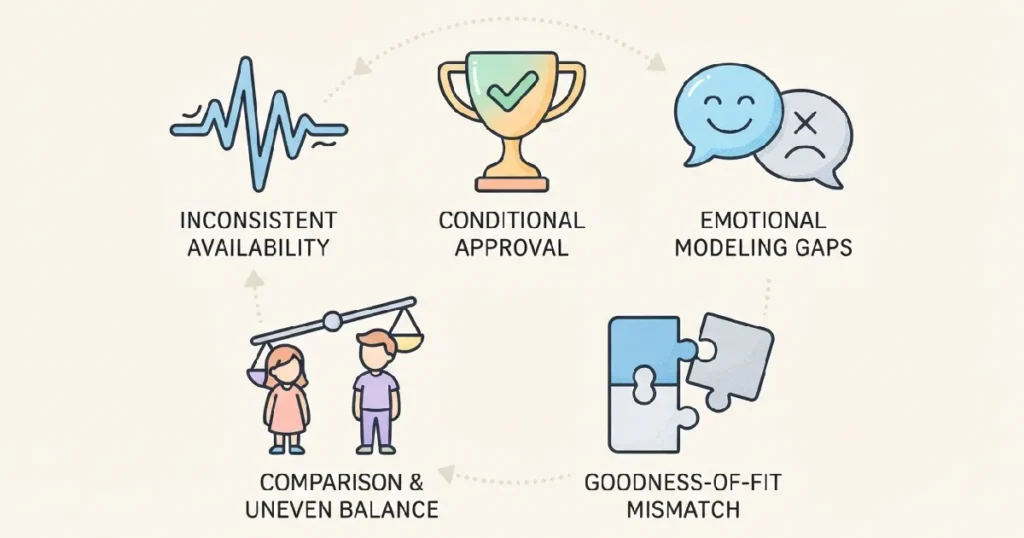
1. Inconsistent Emotional Availability
The claim: A father doesn’t need to be absent to feel unreliable. He just needs to be emotionally present on some days and checked out on others, with no predictable pattern you could learn to trust.
The evidence: This inconsistency often stems from something ordinary, like undiagnosed anxiety, work stress, or a mood that shifted with exhaustion rather than intention. Research consistently links unstable parent-child closeness, not just its absence, to higher depressive symptoms in kids as they move through adolescence.
So what: If you grew up scanning your father’s mood before deciding whether to bring him a problem, you likely developed a hyper-vigilant attachment style. That habit of reading a room before trusting it doesn’t disappear at eighteen. It follows you into every relationship where you wait for the other shoe to drop.
2. Conditional Approval
The claim: Some fathers, without ever meaning to, tie affection to performance. Good grades earned warmth. A messy room earned distance. Love felt like something you had to keep re-earning.
The evidence: A slower decline in warmth and closeness during a child’s development has a measurable protective effect; one analysis found that a slower decline in father-daughter closeness in mid-childhood significantly alleviated depressive symptoms in girls. When that closeness is conditional instead of steady, the protection disappears even if the father never withdraws love outright.
So what: If you’re still chasing achievement to feel worthy of rest or affection, that’s not ambition. That’s a coping strategy built at age seven.
3. Emotional Modeling Gaps
The claim: A father can’t teach a language he was never taught. Many men raised in earlier generations learned that showing emotion signaled weakness, so they simply never developed the vocabulary to talk about feelings, theirs or yours.
The evidence: This is where the story deepens in a way most explanations skip entirely. Your father’s emotional unavailability likely isn’t a personal failure. It’s an inherited script, passed down the same way his father passed it to him, one generation of men taught that stoicism equals strength.
So what (the differentiator): This reframes the whole problem. You’re not dealing with a father who chose distance. You’re dealing with a transmission line of emotional silence that started long before you were born, and that changes how you can approach healing without resentment. Once you see it as inherited rather than intentional, blame starts to lose its grip.
4. Goodness-of-Fit Mismatch
The claim: Sometimes the issue isn’t neglect at all. It’s a mismatch between a sensitive child and a practical, action-oriented father who genuinely loves his kid but speaks an entirely different emotional dialect.
The evidence: A father who solves problems by fixing things rather than sitting with feelings isn’t withholding love. He’s expressing it in the only currency he has. But if you were a child who needed words, his tools didn’t translate.
So what: Naming this mismatch stops you from concluding “he didn’t love me enough” when the more accurate read is “we spoke different emotional languages, and no one taught either of us how to translate.”
5. Quiet Comparison or Favoritism
The claim: Even in loving homes, subtle comparison between siblings, or between you and an idealized version of who your father wished you were, can quietly teach you that you’re loved but not quite chosen.
The evidence: This pattern rarely announces itself. It shows up as a slight difference in tone, in attention, in whose achievements got mentioned at dinner.
So what: If you’ve spent years performing for approval you can’t quite locate, this pattern is worth examining honestly, without assuming it means you were unloved outright.
Why Daddy Issues Without Obvious Trauma Are Harder to Heal

Here’s the trap. Obvious trauma gives you a villain and a clear timeline. Invisible neglect gives you neither.
That absence of a clear story creates what feels like a betrayal loop: he did nothing wrong, so you must be the problem. This guilt is exactly why so many people with daddy issues stay stuck far longer than people with more visible histories of harm.
Think of emotional attunement like a home Wi-Fi signal. The router works perfectly in the living room, the kitchen, even the garage. But in your specific room, the signal never quite reaches. Nothing is technically broken. You’re just consistently disconnected in the one place it mattered most.
Left unexamined, this pattern doesn’t just shape how you date. It can quietly decide who you choose, how much closeness you allow, and how long you stay in relationships that repeat the exact disconnection you grew up inside.
The research backs up why fathers specifically carry this weight. One study following adolescents across ages twelve through nineteen found that the association between father-adolescent closeness and depressive symptoms was stronger for girls than for boys during mid-adolescence, while separate longitudinal work found that relationship quality to fathers predicted depressive symptoms only for boys. Fathers matter differently for different children, but they matter.
A Composite Story: Elena and the Father Who Did Nothing Wrong
Elena grew up with a father who never missed a birthday and never raised his voice. Robert worked long hours in construction, came home tired, and loved his daughter in the only way he knew: providing, fixing, showing up physically. When Elena cried, he’d say “it’s going to be fine” and change the subject, not out of coldness, but because no one had ever taught him what to do with tears.
By thirty-one, Elena couldn’t understand why she felt anxious every time a partner got close, or why she apologized for having needs at all. In therapy, she kept saying, “but he was a good dad.” Once she learned about childhood emotional neglect, something shifted. She wasn’t looking for a villain anymore. She was looking for a language her father never had, and once she stopped waiting for him to hand her that language, she started building it herself.
How to Heal Daddy Issues Without Blaming a Father Who Tried His Best
Name the gap, not the person. Instead of asking “what’s wrong with me,” try asking “what emotional skill did I not get modeled?” One place to start is writing down three moments you wished your father had responded differently, then naming the specific need underneath each one (comfort, praise, curiosity about your inner life).
Reparent the unmet need directly. Consider identifying who in your current life, a partner, a friend, a therapist, can offer the specific response you missed. If you needed someone to ask “how did that make you feel” and never got it, practice asking yourself that question out loud once a day this week.
Decide consciously about the conversation. A useful question to ask yourself: would naming this to my father help either of us, or would it just create defensiveness neither of us can hold? Sometimes healing happens entirely inside you, without your father ever knowing the conversation took place.
Practice secure behavior on purpose. The next time you feel the urge to test a partner’s loyalty or pull away right when things get close, try pausing and naming the pattern out loud, even just to yourself: “this is the old wiring, not the current relationship.”
Daddy Issues in Men Versus Women With Present Fathers

This pattern doesn’t only affect women, though the research and cultural conversation lean that direction. Men with emotionally unavailable but otherwise good fathers often show the wound differently, through over-independence, difficulty asking for help, or discomfort with any form of vulnerability, rather than through relationship anxiety. The mechanism is the same. The expression just wears a different outfit.
What You Now Know That You Didn’t Before
That’s not weakness. That’s wiring, and wiring can change.
You now have a name for something that used to feel like an unspoken accusation against yourself. The disconnect you felt was never proof that you were too sensitive, too needy, or ungrateful for a father who genuinely tried. It was a real, nameable gap between presence and attunement, and gaps like that can be closed with awareness, practice, and the right support.
Your father may have given you almost everything he had to give. That can be true, and it can still be true that a piece went missing. Both things can sit in the same sentence without canceling each other out.
My Closing Remarks
Here’s what I’ve seen over years of sitting across from people with “no reason” to feel this way: the good-father wound is often the hardest to heal precisely because it comes with permission to dismiss itself. I want you to stop asking whether your pain is valid enough to deserve attention. It is. Not because your father failed you, but because a need went unmet, and unmet needs don’t require villains to matter. You get to heal this even if the story has no bad guy in it.
More Related Stories for You
- If patterns of conditional approval or comparison feel familiar, it’s worth understanding the difference between emotional neglect and more overt narcissistic personality traits that can show up in a parent.
About The Author