
 Sara Carmen
The four-year timeline isn’t a law of nature. It’s a scheduling default, and once you understand the difference, you can legally build your own faster path to a diploma.
Key Points
- Learning how to graduate high school early starts with one mental shift: stop counting semesters and start counting credits.
- Most academically ready students already have the mastery to finish in two and a half to three years; what they’re missing is the paperwork strategy.
- Competency-based portfolios, CLEP exams, dual enrollment, and CTE credits let you legally bypass the traditional seat-time model in most states.
Contents
Table of Contents
We’ve all sat in a classroom watching a teacher explain something we understood back in September. Most students shrug it off as the cost of doing time. You don’t shrug it off. You feel it low in your chest, a kind of restless static, like you’re standing still on a moving walkway while everyone tells you to relax and enjoy the ride.
That feeling is not impatience. It’s information.
Someone might look at you and think you’re trying to skip your childhood, rushing toward adulthood because something is wrong at home or in your head. But what they don’t see is the stack of finished assignments sitting untouched for three weeks because the class schedule says you can’t move on yet.
Someone else might assume you’re falling behind, that early graduation is a euphemism for dropping out with extra steps. What they don’t see is a student who already passed the state competency exam for algebra, sitting through algebra class anyway because no one told her she had another option.
And someone might think a working teenager juggling a part-time job and a full course load is simply overextended. What they don’t see is a young person who has already found their industry, already has a mentor, and is being asked to spend four more years on electives that have nothing to do with where they’re headed.
The Four-Year Fallacy: Why Traditional High School Scheduling Feels Outdated
Here’s the direct answer, before we go further: graduating early is not about rushing your life. It’s about trading seat time for credit mastery. You audit your state’s required credits, stack CLEP exams and dual enrollment courses, and use competency-based portfolios so your diploma reflects what you actually know, not how many months you occupied a chair.
That last part matters more than most students realize.
The Fixed-Speed Trap vs. Competency-Based Learning
The American high school schedule was built around something called the Carnegie unit, a measurement invented in 1906 to standardize how long a student sits in a class before earning credit. It was never designed to measure learning. It was designed to measure time.
Modern competency-based education flips that entirely. Instead of asking “did you attend 180 days of class,” it asks “can you demonstrate mastery of this subject right now.” According to the Aurora Institute, a nonprofit focused on education policy, at least 23 states now legally require districts to offer some form of competency-based or mastery-based pathway to a diploma.
That’s not a loophole. That’s policy.
Seat Time vs. Credit Accumulation: Understanding the System
Here’s the mechanism worth understanding. Your diploma isn’t actually tied to your age or your grade level. It’s tied to a specific number of academic credits, usually somewhere between 22 and 24, spread across math, English, science, social studies, and electives.
The four-year calendar is just one way to accumulate those credits. It happens to be the slowest one available to a motivated, capable student.
Step 1: Auditing Your State’s Minimum Graduation Requirements
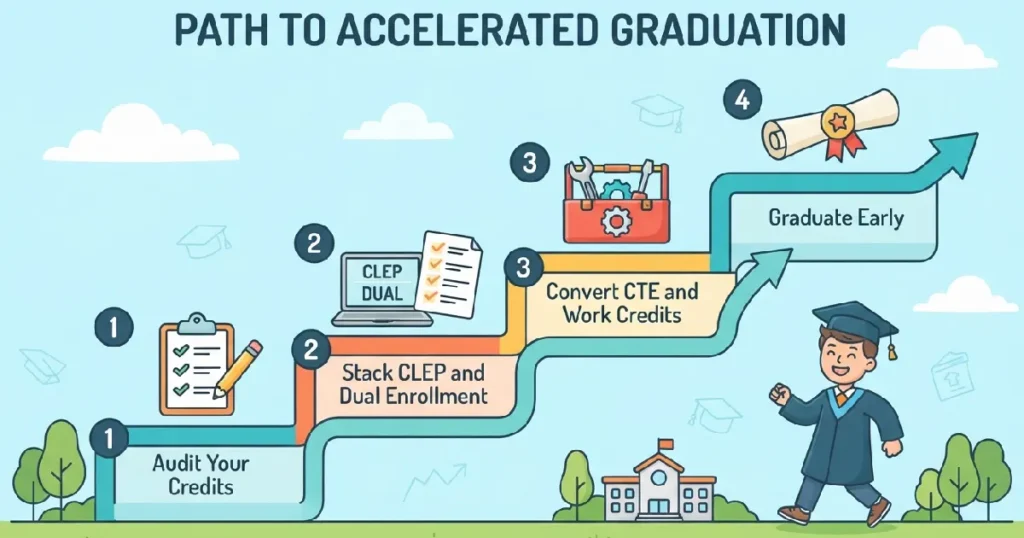
Before you accelerate anything, you need to know exactly what you’re accelerating toward. This is the step most eager students skip, and it’s the one that causes the most delays later.
Decoding the Core Credit Blueprint
Pull your state’s Department of Education graduation requirement sheet. Every state publishes one, and the National Center for Education Statistics maintains comparison data across states if your district’s version is hard to find.
You’re looking for the exact credit breakdown: how many in English, how many in math, how many in science, how many electives. Write it down like a checklist, not a paragraph. This single document becomes your entire roadmap.
Identifying Approved Course Substitutions and Elective Loopholes
Most states allow certain electives to be satisfied through alternative means, things like community service hours, work experience, or technical coursework. These substitutions are often buried in district policy manuals rather than the general handbook parents receive.
Ask your counselor directly: “Which of my elective credits can be satisfied through CTE, work-based learning, or an approved online alternative.” That specific phrasing matters, because a vague question gets a vague answer.
Bypassing Local School Board Roadblocks Legally
Local school boards can add extra requirements on top of the state minimum, but they cannot legally block you from pursuing state-approved alternative pathways. Know the difference between a district preference and a state law.
If a counselor tells you “we don’t do that here,” ask specifically whether that’s a state requirement or a district policy. Nine times out of ten, it’s the second one, and district policy can be challenged with the right documentation.
Step 2: The Acceleration Vehicles That Actually Stack Credits Fast
This is where the real speed comes from. Most advice online stops at “take AP classes,” which is a little like telling someone stuck in traffic to just drive faster in the same lane.
Testing Out: CLEP and Competency Portfolios Over AP Classes
AP classes still require a full nine-month academic calendar. CLEP exams do not. The College-Level Examination Program lets you test directly into college-level credit for subjects you already understand, often satisfying a high school requirement and a college requirement in the same sitting.
One weekend of studying can clear what used to take a semester.
Here’s the differentiator most guides never mention. There’s a concept in gifted education called asynchronous development, meaning a student’s intellectual growth, emotional maturity, and physical age don’t always move at the same speed. A fourteen-year-old can have the reading comprehension of a college sophomore while still needing the social scaffolding of a ninth grader. The traditional seat-time model assumes all three develop at the same rate. They don’t. Competency testing is one of the only tools in the system that actually respects this mismatch instead of ignoring it.
Dual Enrollment: Clearing High School and College Hurdles at Once

Dual enrollment lets you take community college courses that count simultaneously toward your diploma and a future college degree. Unlike AP, there’s no single exam gatekeeping the outcome. You pass the class, and both boxes get checked.
Maya, a junior I consulted with through a family friend, cleared her entire English and history requirements for senior year by taking two dual-enrollment courses over a single summer term. She started her fall semester with only four required credits left. By January, she had her diploma and her first semester of college credit already banked.
Self-Paced Virtual Academies: Accelerating Through Late-Night Learning
Accredited virtual high schools offer the full 21.5 to 22-credit diploma track without a fixed daily schedule. You can work through coursework at 10 p.m. on a Tuesday or in a four-hour sprint on a Saturday.
This is not the same as a GED. A GED replaces your diploma with an equivalency certificate. A state-recognized online academy still awards an actual high school diploma, just on a schedule you control.
Step 3: Trading Electives for Reality Through CTE and Work-Based Credits
Career and Technical Education, commonly called CTE, is one of the most underused acceleration tools available, largely because it still carries an outdated stigma from decades past.
Converting Your Part-Time Job and Apprenticeship Into School Credits
Many states allow structured work experience and registered apprenticeships to satisfy elective credit blocks entirely. The U.S. Department of Education’s Office of Career, Technical, and Adult Education oversees the Perkins V funding that supports these programs nationwide.
If you’re already working 15 hours a week at a job related to your intended field, that time may be convertible into documented academic credit rather than something you’re doing “on top of” school.
Using Technical Certifications to Satisfy Graduation Frameworks
Industry certifications in fields like IT, healthcare, welding, or digital media often satisfy multiple elective requirements at once because they demonstrate applied competency, the same principle behind competency-based portfolios, just built for hands-on trades.
This reframes early graduation as a professional pivot rather than a dropout risk. You’re not quitting school. You’re converting momentum you already have into paperwork the system recognizes.
The Guidance Counselor Conversation Strategy for Early Graduation
Your counselor is not your obstacle. Your counselor is simply unfamiliar with how often students ask for this, because most don’t.
How to Request an Early Graduation Evaluation Portfolio
Ask specifically for a “mastery-based evaluation” or an “early graduation credit audit.” Bring your own printed checklist of state requirements alongside your current transcript, and ask them to map exactly which remaining credits can be satisfied through testing, dual enrollment, or CTE substitution.
Specific requests get specific answers. Vague requests get “let’s revisit this next year.”
Overcoming Institutional Resistance and Pushback
Some resistance comes from genuine concern about social and emotional readiness, and that concern deserves a real answer, not dismissal. Some resistance comes from simple unfamiliarity with policies the counselor rarely uses.
Ask directly which one you’re facing. If it’s the first, address it honestly. If it’s the second, request written documentation of the district’s competency-based policy, since most districts are required to have one on file even if it’s rarely used.
The Reality Check: Managing Your Early Graduation Transition

Here’s what no one tells you at the start of this process.
College Admissions Impact: Presenting an Accelerated Transcript
Admissions officers generally respond well to accelerated transcripts, but only when the story is clear. A transcript that simply looks shorter without context can raise questions. A transcript accompanied by a brief explanation, dual-enrollment grades, CLEP scores, and a clear reason for accelerating, reads as intentional rather than incomplete.
Social Trade-offs: Navigating Milestones and Peer Dynamics
This is the part that surprises even highly motivated students. You will likely graduate before your friend group, and prom, senior trips, and inside jokes tied to a specific timeline may not line up the way they would have.
It’s also worth naming a real nuance here: the adolescent prefrontal cortex, the brain region responsible for judgment and long-term planning, is still developing well into the early twenties. Academic acceleration doesn’t accelerate that timeline. Being ready for college-level coursework and being ready for the full independence of college life are two different kinds of readiness, and it’s worth being honest with yourself about both.
Now What: Turning This Into Your Actual Plan
One place to start is what I’d call the credit audit weekend. Set aside two hours this week, pull your official transcript, and match it line by line against your state’s published requirements. Most students discover they’re closer to done than they think.
Consider the portfolio pitch, a short, specific email to your counselor requesting a mastery-based evaluation, with your credit audit attached. This single email often moves faster than months of hallway conversations.
A useful question to ask yourself: is your goal speed for its own sake, or speed toward something specific, a trade certification, a college start date, a job offer? Naming the destination changes how you build the route.
The next time someone questions why you’re moving faster than your peers, try this response: “I’m not skipping steps. I’m skipping repetition.”
You Were Never the Problem
That restless feeling in the classroom, the one that made you feel like something was wrong with you, was never a character flaw.
It was a mismatch between your pace and the system’s default speed. Now you know the system has another gear. You just had to know where to find it.
You are not slow. You were simply waiting for permission to move at the speed you were already capable of.
My Closing Remarks
Here’s the part I actually believe: schools rarely lie to students about acceleration, they just don’t advertise it, because a building full of self-paced learners is harder to schedule than a building full of obedient ones. I’ve watched capable teenagers spend an extra year of their life waiting for permission nobody was required to withhold. Don’t wait for the system to offer you the door. Go find it, knock, and walk through it yourself.
More Related Stories for You
- If you’re thinking about how early skill-building shapes a child’s trajectory long before high school even starts, this piece on early social and emotional development is worth your time.
About The Author