
 Nicole Adkins
Traditional Meditation Asks Your ADHD Brain To Do The One Thing It Cannot. These Seven Unconventional Mindfulness Hacks Work With Your Wiring, Not Against It.
Key Points:
- Mindfulness for ADHD works best when it uses physical sensation, novelty, and gamification rather than stillness and silence.
- Your distracted brain is not broken. It is under-stimulated, and the right kind of mindfulness can trick your overactive default mode network into calming down.
- Science-backed sensory strategies like cold exposure, bilateral audio, and balance challenges can produce instant focus shifts without requiring a single minute of traditional seated meditation.
Contents
Table of Contents
You Have Tried to Meditate. It Made Everything Worse.
You downloaded the app. You sat on the cushion. You closed your eyes, took a deep breath, and within eleven seconds your brain was composing a grocery list, replaying a conversation from 2019, and wondering whether you left the oven on.
Then came the shame. Because everyone says meditation is the answer. And if it is the answer, and you still cannot do it, what does that say about you?
Here is what it says: nothing. Absolutely nothing about your character, your discipline, or your potential. It says something about the advice.
That’s not weakness. That’s wiring.
Traditional mindfulness was designed for neurotypical brains. It asks you to reduce stimulation. But an ADHD brain is already under-stimulated. Asking it to sit still in silence is like asking someone who is freezing to turn off the heater. The approach does not match the problem.
Why Conventional Meditation Backfires for ADHD Brains
To understand why sitting still feels like torture, you need to understand one brain network: the default mode network, or DMN. This is the system that activates when your mind wanders. It is the daydreaming brain, the “what if” brain, the brain that pulls you away from the email you are writing and drops you into a fantasy about moving to Portugal.
In neurotypical brains, the DMN quiets down when a person engages in a focused task. In ADHD brains, research shows the DMN stays hyperactive even during tasks that require concentration. A 2012 study published in the Journal of the American Academy of Child & Adolescent Psychiatry by Liddle et al. found that individuals with ADHD show significantly less suppression of the DMN during attention-demanding tasks compared to controls.
This is why “just focus” has never worked for you. Your DMN is essentially shouting over the task at hand like a loud radio you cannot turn off.
Traditional meditation says: sit with the noise. Let it pass.
But what if, instead of sitting with the noise, you could drown it out using your body, your senses, and the ADHD brain’s own hunger for novelty?
That is what these seven hacks do. They are high-stimulation, low-demand mindfulness techniques that hijack your brain’s attention systems through surprise, texture, temperature, sound, and movement. They do not ask you to become calm. They trick you into becoming present.
And the difference matters more than you think.
7 Science-Backed Mindfulness for ADHD Hacks That Actually Work
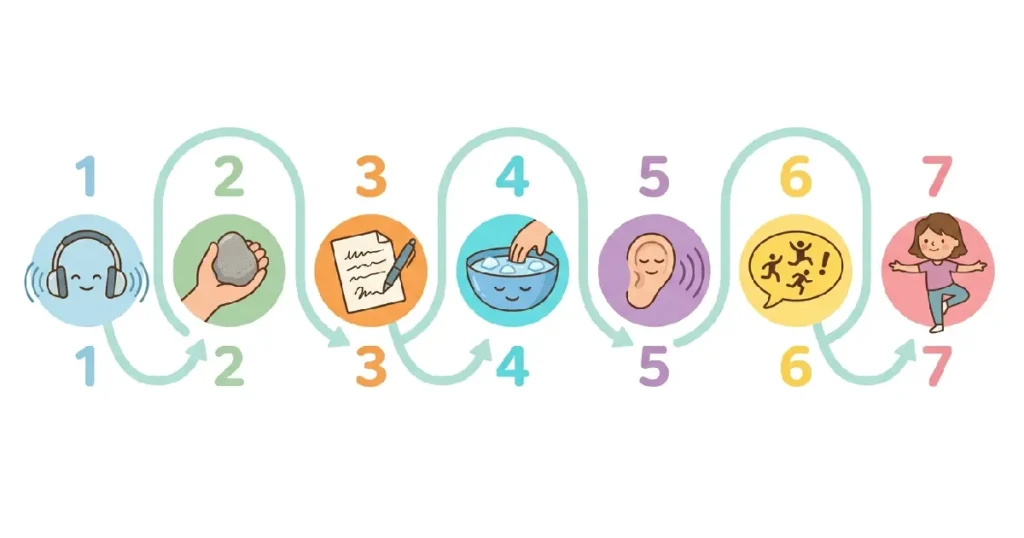
Hack 1: The Bilateral Audio Shifting Reset
What to do: Put on headphones and listen to 8D audio or bilateral stimulation tracks for two to three minutes. These are tracks where the sound physically pans from your left ear to your right ear in a slow, rhythmic pattern.
Why this works for ADHD focus: When sound shifts laterally across your auditory field, your brain has no choice but to orient itself. This is called the orienting response, an automatic survival mechanism that pulls your attention toward novel environmental changes. Your overactive DMN cannot keep daydreaming when your auditory cortex is busy tracking a moving stimulus.
Think of it like this: your wandering mind is a dog chasing squirrels in a yard. Bilateral audio is a tennis ball rolling slowly across the ground. The dog stops chasing squirrels because something more interesting just showed up.
You can find free bilateral stimulation tracks on YouTube or Spotify. Use them before a focus session, during a mid-afternoon slump, or anytime your brain feels like it is spinning in circles.
Hack 2: Kinetic Anchor Transitions for Task Switching
What to do: Keep a small, high-texture object in your pocket. A rough stone. A cold metal coin. A ridged sensory ring. Before you switch from one task to another, squeeze or rub that object for exactly ten seconds.
Why this resets your ADHD brain: Task switching is one of the most taxing executive functions, and ADHD brains struggle with it intensely. You know the experience: you finish one thing, start another, and twenty minutes later you are doing neither because your brain got stuck somewhere in between.
I once worked with a client named Marcus, a 34-year-old software developer, who described his workday as “swimming through peanut butter.” He could hyperfocus on code for hours, but the moment he needed to switch to email or a meeting, his brain would scatter. We introduced a simple brass coin he kept in his front pocket. Every time he transitioned between tasks, he would press it between his thumb and forefinger for ten slow seconds while taking one breath.
Within two weeks, Marcus reported that task transitions felt “like stepping through a doorway instead of falling off a cliff.” The coin created what psychologists call a sensory boundary marker. It gave his brain a physical signal that one task was done and a new context was beginning.
The object itself does not matter. What matters is the texture and the ritual.
Hack 3: Micro-Dosing Chaos with the 60-Second Scribble

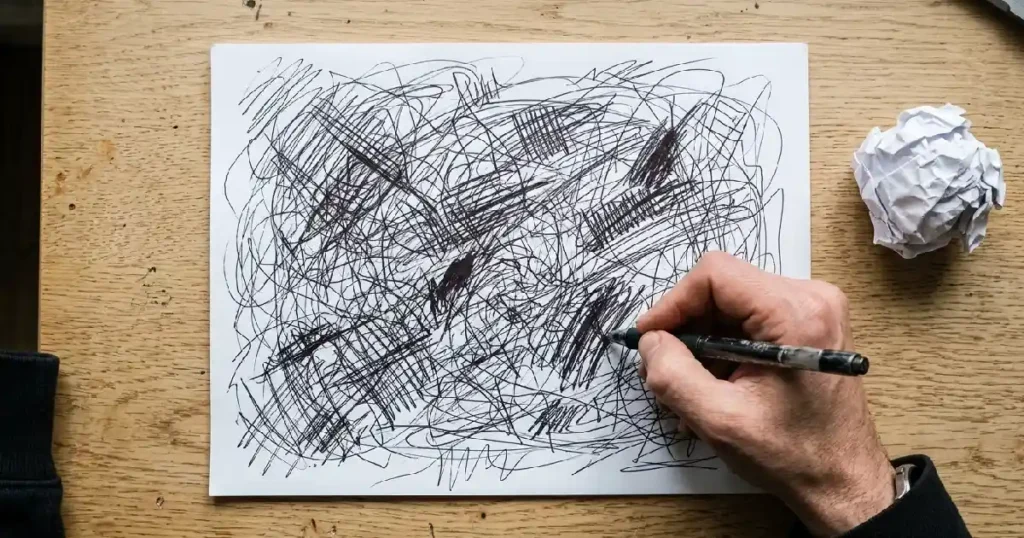
What to do: Before starting any task that requires concentration, grab a blank piece of paper. Scribble as hard, fast, and chaotically as you can for sixty seconds. Press down. Use your whole arm. Fill the page. Then crumple it up and throw it away.
Why this clears mental clutter: The ADHD brain often experiences what I call a mental traffic jam. You have twelve thoughts, four emotions, and six half-formed plans all competing for the same lane at the same time. Traditional ADHD mindfulness advice says to observe these thoughts without judgment. That is fine in theory. In practice, your brain just observes the thoughts and then adds six more.
The 60-second scribble is an outflow technique. Instead of fighting the chaos or observing it passively, you physically discharge it. The hard, fast motion of scribbling activates your motor cortex and releases a small burst of dopamine, the exact neurochemical your ADHD brain is starving for. Crumpling the paper adds a satisfying sensory conclusion.
You are not journaling. You are not creating art. You are purging noise onto paper so your brain can start the next task with a cleaner signal.
Hack 4: Cold-Shock Dopamine Loading
What to do: When you hit a focus wall, submerge your face in a bowl of ice-cold water for fifteen to thirty seconds. Or hold an ice cube tightly in your palm. Or press a cold pack against the back of your neck.
Why this is the fastest ADHD focus reset available: This triggers what physiologists call the mammalian dive reflex, an involuntary response that instantly lowers your heart rate, redirects blood flow to your core, and activates your parasympathetic nervous system, the calming branch of your autonomic nervous system.
But here is what makes this especially powerful for ADHD: cold shock creates a sensory monopoly. Your brain physically cannot keep ruminating about a distracting thought when every nerve ending in your face is screaming about temperature. The cold commandeers your attention. It forces presence.
A 2000 study by Shevchuk, published in Medical Hypotheses, found that brief cold exposure increases norepinephrine production, a neurotransmitter directly involved in attention and alertness. For an ADHD brain that chronically underproduces norepinephrine, this is not just mindfulness. It is neurochemistry you can feel.
Try this one today. Fill a bowl with ice water. Dunk your face. Notice how quiet your mind becomes in the thirty seconds after.
But here’s what no one tells you about this hack.
The silence after the cold is the most focused your ADHD brain will feel all day without medication. Use that window. Start your hardest task immediately.
Hack 5: Sightless Sound Mapping Turns Mindfulness Into a Game
What to do: Close your eyes. Identify the three farthest sounds you can hear. Then identify the three closest. Try to name them and estimate their distance.
Why gamified awareness beats breath-focused meditation: Traditional mindfulness says “focus on your breath.” For an ADHD brain, this is like being told to stare at a blank wall. There is no challenge, no novelty, no reward. Your brain checks out in seconds.
Sightless sound mapping turns present-moment awareness into a detective game. You are scanning, sorting, categorizing, and estimating. Your brain’s attention systems light up because there is a goal: find the sounds, rank them, name them. This satisfies the ADHD need for search-and-find stimulation while anchoring you firmly in the present moment.
You can do this anywhere. In your office. On a park bench. In bed before sleep. Two minutes is enough.
Hack 6: The Vocalized Intent Echo Patches Working Memory Gaps
What to do: Narrate your micro-actions out loud in a slightly exaggerated voice. “I am opening the spreadsheet now. I am looking for the Q2 column. My hands are on the keyboard.”
Why speaking your actions out loud actually fixes a core ADHD deficit: ADHD brains have well-documented deficits in working memory, the mental notepad that holds information for short-term use. This is why you open a browser tab and immediately forget why. This is why you walk into a room and stand there, blank.
When you speak your intention out loud, you create an auditory feedback loop. You are encoding the same information through two channels: thought and sound. This dual-channel encoding gives your working memory a backup system. The spoken words act like a tether, keeping your intention alive long enough to act on it.
It might feel silly at first. Do it anyway. The people who need this hack most are the ones who have seventeen open tabs and cannot remember which one matters. If you work from home, say it out loud. If you are in a shared office, whisper it. The mechanism works either way.
Hack 7: Somatic Pacing with the 2-Minute Balance Challenge
What to do: Stand on one foot while reading an email. Brush your teeth while balancing on a wobble board. Stand on a balance pad during a phone call.
Why physical instability creates mental stability for ADHD: This sounds counterintuitive. Adding a physical challenge while trying to focus should make things harder, right?
Not for your brain. The cerebellum, the brain region responsible for balance and coordination, has extensive connections to the prefrontal cortex, the area responsible for executive function, planning, and sustained attention. When you introduce a mild balance challenge, your cerebellum activates and pulls the prefrontal cortex along with it.
More importantly, the balance challenge absorbs just enough of your brain’s hyperactive surplus energy to quiet the restless noise. Think of it as giving your brain’s excess horsepower something productive to do so the rest of your mental engine can run smoothly.
You do not need a wobble board. Standing on one foot works. So does sitting on an exercise ball. The goal is a low-level physical demand that keeps running in the background while you focus on the real task.
How to Build These ADHD Mindfulness Hacks Into Your Day

You do not need all seven. You need two or three that match your daily rhythm.
The Morning Stack: Start your day with the 60-second scribble (Hack 3) followed by two minutes of bilateral audio (Hack 1). This clears overnight mental clutter and orients your brain toward the present before you open your inbox.
The Transition Ritual: Keep your kinetic anchor (Hack 2) in your pocket and use it between every task switch. Pair it with a vocalized intent echo (Hack 6) as you begin each new task. Together, these two hacks address both the sensory and cognitive sides of task-switching difficulty.
The Focus Emergency Kit: When you hit a wall midday, go straight to cold-shock dopamine loading (Hack 4). Follow it immediately with your hardest task while the neurochemical window is open.
A useful question to ask yourself each morning: “Which transition will be hardest today?” Then place your anchor object in the pocket closest to your dominant hand before you leave the house.
Consider keeping a simple tally for one week. Each time you use a hack, mark it. Each time you notice your focus hold even five seconds longer than usual, mark that too. ADHD brains respond to visible evidence of progress. Give yourself that evidence.
Your Brain Was Never the Problem
Remember the meditation cushion? The app? The shame spiral that followed when your mind wandered for the hundredth time in ninety seconds?
That was never a failure of willpower. It was a mismatch between the tool and the brain it was designed for. Your ADHD brain does not lack the capacity for presence. It lacks the right doorway into it.
These seven hacks are doorways built for your specific wiring. They use sensation, movement, novelty, and challenge because that is what your nervous system responds to. Not silence. Not stillness. Not force.
Mindfulness for ADHD is not about quieting your mind. It is about giving your mind something so interesting that it forgets to wander.
Pick one hack. Try it today. Not tomorrow. Today.
Your focus was never missing. It was just waiting for the right invitation.
My Closing Remarks
I will be honest with you. For years, I watched clients with ADHD sit across from me and describe the guilt they carried for not being able to meditate “properly.” It broke something in me every time. Because the truth is, the wellness industry sold them a tool designed for a completely different brain and then blamed them when it did not work. These hacks are not cute tricks. They are corrections. They are what mindfulness should have looked like for ADHD brains from the beginning. If even one of them gives you thirty seconds of unexpected clarity today, that is not a small thing. That is the beginning of trusting your own mind again.
More Related Stories for You
- If you are looking for more ways to build a sustainable mindfulness practice that fits real life, these stories go deeper into the research and daily application of attention training for restless minds.
About The Author