
 Sara Carmen
The Difference Between A Good Relationship And The Right Relationship Is Not About Fireworks. It Is About Something Far Quieter And More Powerful.
Key Points
- The signs he is the right guy are not found in grand romantic gestures but in the consistent, daily patterns of emotional safety, respect, and mutual growth that research links to lasting relationship satisfaction.
- A healthy partnership functions less like a roller coaster and more like a steady current beneath your feet, giving you freedom to be fully yourself.
- Knowing whether he is the right partner requires looking beyond chemistry and evaluating whether his actions, values, and emotional presence align with who you are becoming.
Contents
Table of Contents
You are lying in bed at 11 p.m., scrolling through your phone, and a thought drifts into your mind like smoke you cannot wave away. Is he really the one? He did something kind today. He also forgot something you mentioned twice. Your best friend says he is great. Your mother is not so sure. And somewhere inside you, two voices argue: one says stay, the other says what if there is someone better?
You are not being dramatic. You are being human.
That question, that quiet, gnawing uncertainty about whether the person beside you is truly right for you, is one of the most common concerns I have heard in over fifteen years of clinical work with couples. And here is what surprises most people: the answer rarely lives in your feelings alone.
It lives in patterns.
Why Your Gut Feeling Is Not Enough to Know He Is Right
Most of us were taught to trust our hearts. And there is wisdom in that. But psychological research tells us something more precise: what we often call “gut feeling” in relationships is actually our attachment system responding to cues of safety or threat. If you grew up in a home where love was unpredictable, your gut might confuse anxiety with passion and calmness with boredom.
Dr. Sue Johnson, the developer of Emotionally Focused Therapy (EFT), has spent decades demonstrating that the quality of emotional bonding between partners is the single strongest predictor of relationship satisfaction and longevity. Not butterflies. Not shared hobbies. Emotional bonding.
This is where the 13 signs below come in. They are not a checklist for perfection. They are markers of the kind of relationship that psychological science consistently links to deep, lasting fulfillment. Think of them as a compass, not a scoreboard.
And the first cluster of signs may be the most important of all.
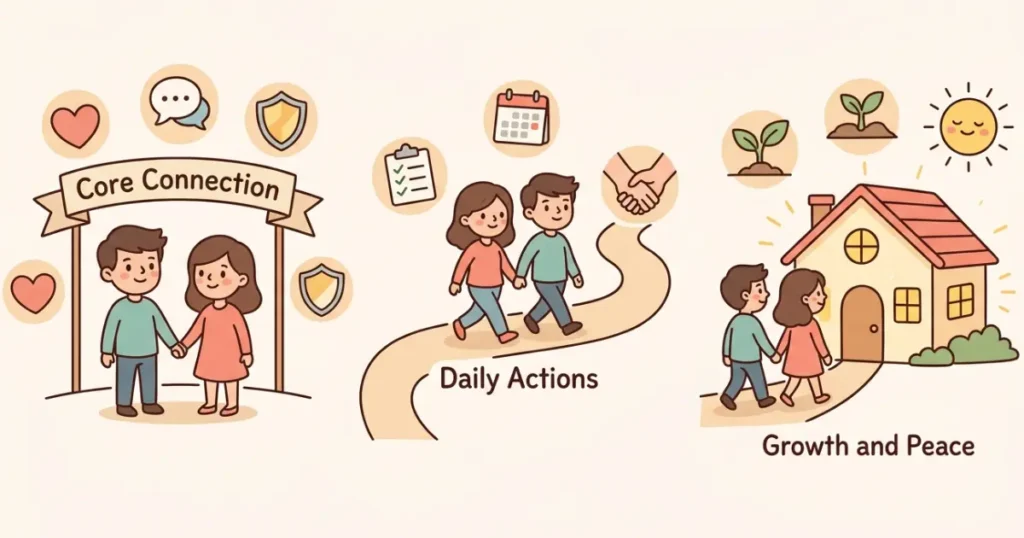
The Core Connection: Signs He Is the Right Guy at the Deepest Level
1. You Feel Genuinely Safe Being Yourself Around Him
Not safe as in “he has never raised his voice.” Safe as in you can say something vulnerable, something unfinished, something you are not proud of, and you do not brace for impact afterward.
Psychologists call this psychological safety, a term originally coined in organizational research by Harvard professor Amy Edmondson, but now widely applied to intimate relationships. In a psychologically safe partnership, you do not edit yourself down to avoid conflict. You expand.
Consider this: a woman I once worked with, let us call her Dana, realized she had spent three years with her ex carefully curating which emotions she showed him. She laughed when she was hurt. She said “I am fine” when she was furious. With her current partner, she noticed something strange. She could cry in front of him without rehearsing an explanation first. “I did not even realize I had been holding my breath for years,” she told me. That is psychological safety in action.
2. Your Core Values Actually Align
Chemistry makes you want to be near someone. Shared values make you want to build with them.
This does not mean you agree on every political opinion or restaurant choice. It means you are aligned on what psychologists call value congruence, the degree to which two people share beliefs about fundamentals like honesty, family, financial priorities, faith, and how you want to raise children.
A 2005 study published in the Journal of Personality and Social Psychology by Luo and Klohnen found that couples with higher value similarity reported significantly greater relationship satisfaction over time, even more so than personality similarity. You do not need to be identical. You need to be headed in the same direction.
3. Your Communication Is Constructive, Not Corrosive
Every couple argues. That is not a red flag. The red flag is how you argue.
The right guy does not shut down, stonewall, or resort to name-calling when disagreements arise. Instead, he engages in what Dr. John Gottman’s research identifies as “repair attempts”, those small verbal and nonverbal gestures that de-escalate tension during conflict. A repair attempt might sound like: “Wait, I think I said that wrong. Let me try again.” Or simply: “I hear you.”
According to Gottman’s extensive research, the success or failure of repair attempts is one of the most reliable predictors of whether a relationship will last. If he can fight with you and still make you feel like you are on the same team, pay attention. That is rare and worth protecting.
4. He Is Emotionally Present When It Matters Most
When you are having a terrible day, he does not say “just relax” or change the subject. He sits with you in the discomfort, even when he cannot fix it.
This is called emotional attunement, the ability to sense and respond to a partner’s emotional state with care and accuracy. It is not about being a mind reader. It is about being willing to ask “What do you need right now?” and actually listening to the answer.
But here is what no one tells you.
Emotional attunement is not something a person either has or does not have. It is a skill that is practiced, refined, and sometimes hard-won. The right guy may not always get it right. What matters is that he keeps trying.
Daily Actions That Reveal the Signs He Is the Right Partner

5. His Actions Consistently Match His Words
Think of trust like a bridge. Every kept promise is a plank. Every broken promise is a plank removed. Over time, you either have a bridge sturdy enough to walk across together, or you have gaps that make you hesitate with every step.
The right guy does not just say “I will be there.” He shows up. Repeatedly. Without needing applause.
Behavioral consistency, in psychological terms, is a cornerstone of what researchers call earned secure attachment, the kind of trust that is built through reliable, predictable caregiving behavior over time.
6. He Respects Your Boundaries Without Resistance
When you say no, he does not pout. He does not pressure you. He does not make you feel guilty for having limits. He simply respects your boundary and moves forward.
This might sound basic. But in my experience, genuine boundary respect is one of the clearest signs of a healthy relationship, and one of the most commonly missing in unhealthy ones. A partner who respects your no is a partner who sees you as a full, autonomous person, not an extension of his own needs.
7. He Notices and Remembers the Small Things
He picks up your favorite tea on his way home. He remembers that your coworker’s name is Priya, and he asks how the project with her is going. He sends you a song because a lyric reminded him of something you said last Tuesday.
These are not just “nice touches.” Gottman’s research calls them “turning toward” behaviors, small moments of attention that build emotional capital in a relationship. Couples who consistently turn toward each other’s bids for connection have dramatically higher rates of staying together.
The small things are not small. They are everything.
8. He Includes You in His Vision of the Future
He says “when we move” instead of “when I move.” He asks your opinion about career decisions. He talks about next summer, next year, the next decade, and you are in every version of the story.
This is not about rushing timelines. This is about intentional partnership, the conscious decision to plan a life with someone rather than simply coexisting in the present. If he naturally weaves you into his future, it reveals something about how he sees you: not as temporary, but as essential.
Growth and Respect: The Signs He Is the Right Guy for Your Future

9. He Celebrates Your Growth Without Feeling Threatened
You got the promotion. You want to go back to school. You started a new hobby that takes up your Saturday mornings. And instead of feeling left behind or competitive, he is genuinely proud of you.
The right partner has what psychologists call a growth mindset within the relationship. He does not see your success as a threat to his significance. He sees it as something that makes the whole partnership richer.
A woman named Tara told me her turning point came when she got accepted into a graduate program across the country. Her partner’s first response was not “What about us?” but “How can I help you make this work?” That single sentence told her more about his character than two years of dating had.
10. He Makes You Feel More Confident, Not Less
After spending time with the right guy, you feel more like yourself, not less. You feel brighter, steadier, more grounded. This is not because he completes you. It is because he does not diminish you.
In relationships marked by emotional safety, partners experience what researchers call the Michelangelo effect, a phenomenon where close partners “sculpt” each other toward their ideal selves. The right partner sees who you are becoming and helps you get there, not by pushing, but by believing.
11. He Accepts Your Quirks Without Trying to Rewrite You
You talk to your plants. You eat cereal for dinner. You cry during commercials about dogs. And he does not roll his eyes. He does not make you feel strange. He might even join you.
Acceptance is not the same as tolerance. Tolerance says “I can live with this.” Acceptance says “This is part of who you are, and I love who you are.” The right guy knows the difference.
12. He Treats You as an Equal Partner
Your opinions carry weight. Your time is respected. Your voice matters in decisions both large and mundane. He does not talk over you. He does not dismiss your ideas. He does not position himself as the authority in the relationship.
True partnership requires what psychologists call mutuality, the sense that both people contribute to and benefit from the relationship in roughly equal measure. If you consistently feel like your perspective is valued, that is not luck. That is a sign of deep relational health.
The Ultimate Metric: The Quiet Sign That Matters Most

13. You Feel a Deep, Quiet Inner Peace
This is the sign most people miss because they are looking for the wrong thing. They are looking for excitement. They are looking for the breathless, heart-pounding sensation of early infatuation.
But here is the insight that changes everything: the right relationship does not feel like a storm. It feels like coming home.
Think of a healthy relationship like an anchor dropped in deep water. The surface may ripple. Waves will come. But underneath, there is a stillness that holds. That quiet peace, the absence of constant anxiety, obsessive overthinking, or emotional whiplash, is not boredom. It is security.
Left unexamined, the confusion between emotional chaos and passion can quietly become the reason good relationships end. Most people in this situation do not realize that calm can coexist with deep love. It can. And when it does, you have found something worth holding onto.
How to Apply These Signs to Your Own Relationship
Recognizing these signs is the first step. Using them wisely is the second. Here are three practical ways to apply what you have learned.
The Reflection Inventory
Set aside 15 quiet minutes this week. Go through each of the 13 signs and rate, on a scale of 1 to 5, how present each one is in your relationship. This is not about reaching a perfect score. It is about identifying where your relationship is strong and where it might need intentional attention. Patterns tell stories that single moments cannot.
The Observation Week
For the next seven days, pay close attention to your partner’s daily behavior without trying to change it or interpret it through a lens of anxiety. Simply notice. Does he turn toward your bids for connection? Does he follow through on what he says? Does he treat your boundaries with respect? Let the data speak before your fears do.
The Honest Conversation
Consider sharing this article with your partner and asking one simple question: “Which of these do you think we do well, and where could we grow?” The willingness to have that conversation is itself a sign. A partner who is open to reflection and growth is a partner who is invested in more than just comfort.
A useful question to ask yourself tonight: Do I feel more like myself because of this relationship, or less?
The Right Guy Does Not Complete You. He Steadies You.
Remember that moment at 11 p.m., lying in bed, wondering if he is the one? You now have something you did not have before: a framework grounded in research, not romance novels, to evaluate what you actually have.
The signs he is the right guy are not dramatic declarations or cinematic moments. They are found in the way he listens when you are not making sense, the way he shows up on ordinary Tuesdays, and the quiet confidence you feel when you picture tomorrow with him in it.
You do not need certainty to move forward. You need evidence. And evidence is built in small, steady, unglamorous moments of trust.
The right love does not ask you to shrink. It gives you room to breathe.
My Closing Remarks
I have sat with hundreds of people who stayed too long with the wrong person and dozens who almost walked away from the right one. The difference was rarely about the partner. It was about whether they trusted what steady, quiet love actually felt like. If you read these 13 signs and something stirred in you, some recognition, some relief, trust that. Not because I told you to. Because the evidence is in front of you every single day, in the way he shows up, the way you breathe easier around him, and the way the future feels possible instead of frightening. Do not let the noise of doubt drown out the signal of something real.
More Related Stories for You
- If you are already seeing these signs and wondering what comes next, you might be noticing the early signals that a proposal could be on the horizon.
About The Author



Great content! Keep up the good work!
Thanks