
 Sara Carmen
What one honest conversation tonight could tell you more than six months of dating ever would.
Key Points
- Asking deep questions to ask a new partner early in a relationship predicts long-term emotional compatibility far more accurately than time alone.
- Surface-level dating conversations create a false sense of knowing someone, while strategic depth questions reveal emotional maturity, real fears, and core values.
- The right question, asked at the right moment, does not push a new partner away. It pulls them closer in ways that small talk simply cannot.
Contents
Table of Contents
You are three dates in. The conversation has been easy, the laughs have been real, and yet something still feels slightly off. Not wrong, exactly. Just… thin. Like you are talking around each other rather than truly to each other. You know their favorite restaurant and where they grew up, but you have no real idea who they are when life gets hard. And quietly, somewhere underneath the good-date excitement, that question is already forming: Is this actually going anywhere real?
That feeling is not paranoia. It is your instincts doing their job.
Why Small Talk Is a Relationship Risk in Disguise
Most people assume that intimacy builds naturally over time. Just keep showing up, the thinking goes, and real closeness will follow. But research tells a more complicated story.
According to psychologist Arthur Aron’s landmark 1997 study on interpersonal closeness, self-disclosure, not time spent together, is the primary driver of genuine connection. Specifically, mutual vulnerability, meaning both people taking turns sharing something real and meaningful, accelerates emotional bonding in ways that casual conversation simply cannot replicate. The study famously produced 36 questions designed to generate closeness between strangers in under an hour.
The problem with most early dating conversations is not that they are boring. It is that they are safe by design. We present the best-curated version of ourselves, avoid anything that might feel like “too much,” and call that getting to know each other. What we are actually doing is building a relationship on top of a performance.
Left unexamined, this pattern does not just keep things shallow. It can quietly become the reason a relationship ends months or even years later, when two people realize they never actually knew each other at all.
What a Good Deep Question Actually Does
Think of a truly deep question the way you might think of a key. Most conversations knock politely on the front door. A good question finds the door that actually leads somewhere.
The goal is not to interrogate your new partner. It is to give both of you permission to be real with each other. That permission, when offered through the right question, creates a particular kind of safety that attraction alone cannot manufacture.
In my experience working with couples in early-stage relationships, the pairs who ask genuinely vulnerable questions early tend to build more resilient bonds faster. Not because vulnerability is a shortcut, but because it signals something critical: I am interested in who you actually are, not just who you want me to think you are.
That signal changes everything.
15 Boldly Deep Questions to Ask a New Partner Tonight
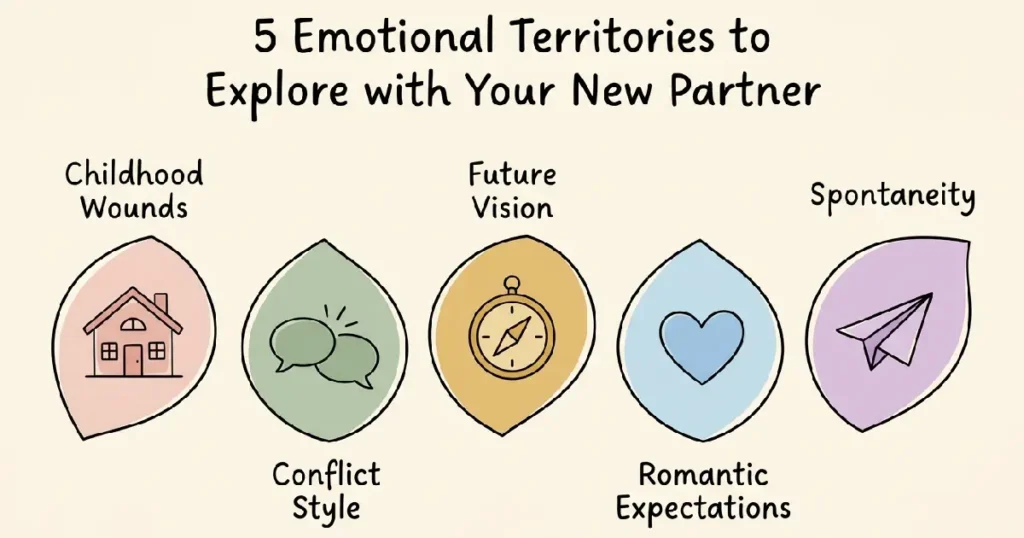
These are not party games or therapy prompts. They are precise psychological keys, organized by the emotional territory they open. Use them one at a time, whenever the moment feels right. You do not need to run through all fifteen in one night.
Section 1: Childhood Wounds and the Self-Awareness That Grows From Them
1. “What is the biggest parenting mistake your parents made that you consciously vow never to repeat?”
This question does two things at once. It reveals where your partner’s deepest wounds live, and it shows you whether they have done any real work to understand those wounds rather than just carry them. Someone who can answer this thoughtfully has moved from victim to narrator of their own story. That is a significant mark of emotional maturity.
2. “If you met the version of yourself from five years ago, what one warning would you give them about relationships?”
This is one of the most revealing questions you can ask because it surfaces hard-won knowledge without asking “what went wrong in your last relationship?” directly. The answer tells you what lessons they have actually absorbed, not just the ones they intellectually know they should have learned.
3. “What is the one thing you fear people will discover about you that would change how they see you?”
This question is bold. It might feel too bold. But consider what happens when someone answers it honestly: they are showing you their deepest point of emotional insecurity and trusting you with it at the same time. The quality of their answer tells you far more than the content.
Section 2: Conflict Style and Emotional Intelligence Under Pressure
4. “When a conversation gets heated, do you prefer space to cool down, or do you need to work through it in real time, even if emotions are running high?”
This is not a trick question, and there is no wrong answer. But knowing this about a partner before your first real argument is genuinely practical. Research on conflict resolution in couples consistently shows that mismatched conflict styles, where one partner needs distance and the other pursues, create far more damage than the original disagreement ever did.
5. “What toxic trait do you secretly acknowledge in yourself that you are actively trying to manage?”
Here is what no one tells you about this question: the people who find it uncomfortable to answer are often the ones who most need to answer it. Someone who can name a shadow side of themselves with honesty and without shame is telling you something about their psychological safety and their willingness to keep growing.
6. “When I am going through something really hard, how can I best support you when you are struggling: practical help, silent presence, or space alone?”
This question is a gift you are giving your future self. It eliminates years of guessing, misreading signals, and accidentally doing the one thing your partner finds smothering rather than comforting.
Section 3: Future Vision and Core Priorities
7. “If you had to choose between a career that makes you genuinely proud but consumes most of your time, or a deeply peaceful and ordinary family life, which would you choose?”
Do not look for the “right” answer. Look for the speed and honesty with which they answer. Hesitation is not weakness; it is nuance. A rehearsed answer with no hesitation can actually signal that they are telling you what they think you want to hear.
8. “What financial behavior do most people consider completely normal that you see as either wasteful or excessively rigid?”
Money is the topic most couples avoid until it is already a problem. Financial incompatibility is one of the leading predictors of relationship breakdown, according to multiple studies on divorce drivers. This question opens that conversation sideways, through values rather than numbers, which makes it far less threatening and far more honest.
9. “What is the one thing someone could do that would make it impossible for you to stay in a relationship, with no second chances?”
Every person has a line. Most people have never said it out loud. Asking this question early is not dramatic; it is deeply respectful of both of your time and emotional investment.
Section 4: Romantic Expectations and Commitment Realism
10. “What romantic expectation did you finally have to let go of after a past relationship?”
Romantic illusions, the belief that love should feel effortless, that the right person will always know what you need without being told, that passion should never require work, are one of the most common quiet destroyers of relationships. A partner who has released one of these expectations is a partner who has grown.
11. “When the early excitement fades and love becomes daily routine, how do you plan to keep the warmth alive?”
This question separates people who are in love with the idea of a relationship from people who are genuinely committed to the practice of one. Both exist. Knowing which you are dealing with early on matters enormously.
12. “When was the last time you felt truly seen and understood by someone, and what specifically did they do that created that feeling?”
This is the question underneath all the other questions. The answer is essentially a blueprint: here is what my deepest emotional need looks like when it is being met. Take note. This is information that most couples spend years trying to figure out through trial, error, and heartbreak.
Section 5: Boldness, Spontaneity, and the Texture of Their Inner Life
13. “What was your very first impression of me that you have since discovered was completely wrong?”
This question does something quietly magical. It invites honesty, creates laughter, and signals that you are secure enough to hear something slightly unflattering. That combination is rare and instantly attractive.
14. “What small, unintentional thing could I do with someone else that would make you feel quietly jealous or insecure, even if you would never say it out loud?”
The key word is quietly. This is not about big, dramatic jealousy. It is about the small, specific emotional triggers that people almost never admit to until they are already hurt. Knowing this in advance is the difference between accidentally wounding someone and simply knowing how to be careful with them.
15. “If we could completely abandon tonight’s plans right now and go anywhere or do anything, where would you go?”
End the night with this one. It is lighter. It is playful. But the answer still tells you something real about how they relate to spontaneity, adventure, and whether they are the kind of person who is fully present in the moment you are in together.
A Night That Might Change Everything: Meet Maya and Daniel

Maya and Daniel were five weeks into what she described as “a very pleasant, very forgettable situation.” She liked him. He liked her. The dates were fine. Nothing felt wrong, but nothing felt particularly alive, either.
She arrived at their sixth date with three of these questions written on her phone and no plan to use all of them. By the end of the night, she had asked five. Daniel had answered in ways that surprised her. He admitted something about his conflict style that he said he had never told anyone on a first year of dating. She told him about the thing she feared people would discover about her. They stayed two hours past when they had planned to leave.
That is not magic. That is what happens when two people give each other permission to be real.
How to Actually Use These Questions Tonight
The Gradual Depth Method. Do not open with question three. Begin with the lighter, more playful questions (like the hidden first impression or the spontaneous plans question) and work your way toward the more vulnerable ones. Think of the conversation as a river: you start in the shallows and move toward deeper water together.
The Reciprocal Offer. For every question you ask, answer it yourself first, or immediately after they answer. Vulnerability is not an interrogation tool. It only works when it flows both ways. Offering your own honest answer first can lower the temperature and make their honesty feel less like exposure.
The “I’m Curious” Frame. If a question feels too direct, preface it with: “I’ve been thinking about something and I’m genuinely curious what your answer would be.” That framing signals safety, not confrontation.
The Permission to Pass. Before you begin, quietly establish that either of you can say “I’m not ready to answer that one yet” without explanation. This preserves psychological safety and, ironically, makes honest answers more likely, not less.
You Already Know That Small Talk Is Not Enough
You picked this article for a reason. Something in you already knows that the surface-level conversation you have been having is not giving you what you actually need. Not because anything is wrong with your new partner, but because neither of you has been given the opening to be real yet.
These questions are that opening.
The right conversation does not push a good partner away. It sorts, gently and honestly, for the ones who are ready to be known from the ones who are not. Either outcome is a gift. One just feels better in the moment.
Ask the question you are most afraid to ask. The answer will tell you everything.
My Closing Remarks
I have sat across from couples in my office who have been together for seven years and still cannot answer half of these questions about each other. Not because they do not care, but because no one ever gave them permission to go there. And here is the part that still gets to me every time: the question they most needed to ask was usually the one they were most afraid would “ruin the mood.” It will not ruin the mood. It will reveal whether there is a real foundation beneath it. Ask boldly. Real love does not flinch at honesty. It leans in.
More Related Stories for You
- Curious about how to deepen the connection even further? These meaningful questions to ask a new partner go hand in hand with what you have been reading and are worth exploring before your next date night.
About The Author