
 David Wall
Your nervousness around girls isn’t a character flaw. It’s a predictable psychological pattern and understanding it is the first step to breaking it.
Key Points
- Getting so shy around girls is rooted in real, measurable psychological and biological mechanisms, not personal weakness.
- The most overlooked reason you get so shy around girls has nothing to do with confidence it’s about how your brain calculates risk.
- Once you understand why shyness happens, you can rewire your response, one small interaction at a time.
Contents
Table of Contents
You Know That Feeling
She walks into the room. Your throat tightens. Your brain, which was working just fine thirty seconds ago, suddenly goes offline. You either say something awkward, say nothing at all, or disappear into your phone like it just sent you a critical message from NASA.
And afterward, you replay it. “Why do I do that?”
You are not alone. And more importantly, you are not broken.
This kind of shyness around girls is one of the most common experiences men quietly carry. But because it feels embarrassing to admit, most guys never examine it closely enough to actually change it. That’s the real problem. Not the nervousness itself, but the fact that it stays in the dark, unnamed and unaddressed.
Let’s bring it into the light.
What’s Actually Happening in Your Brain
Shyness, at its core, is not about being quiet or reserved. It is a fear-based response to social evaluation. According to research from the American Psychological Association, social anxiety and shyness share a common root: the fear that others will judge you negatively and that you won’t be able to handle that judgment.
When that fear gets activated specifically around girls you’re attracted to, your brain does something fascinating and deeply inconvenient. It treats the situation like a threat. Your nervous system fires up the same fight-or-flight circuitry that kept your ancestors alive in dangerous situations. Suddenly, asking a girl for her number feels neurologically similar to being chased by something with teeth.
That’s not weakness. That’s wiring.
The question is not whether this happens. The question is why it keeps happening to you specifically, and what you can do about it before another year passes in the same pattern.
7 Real Reasons You Get So Shy Around Girls
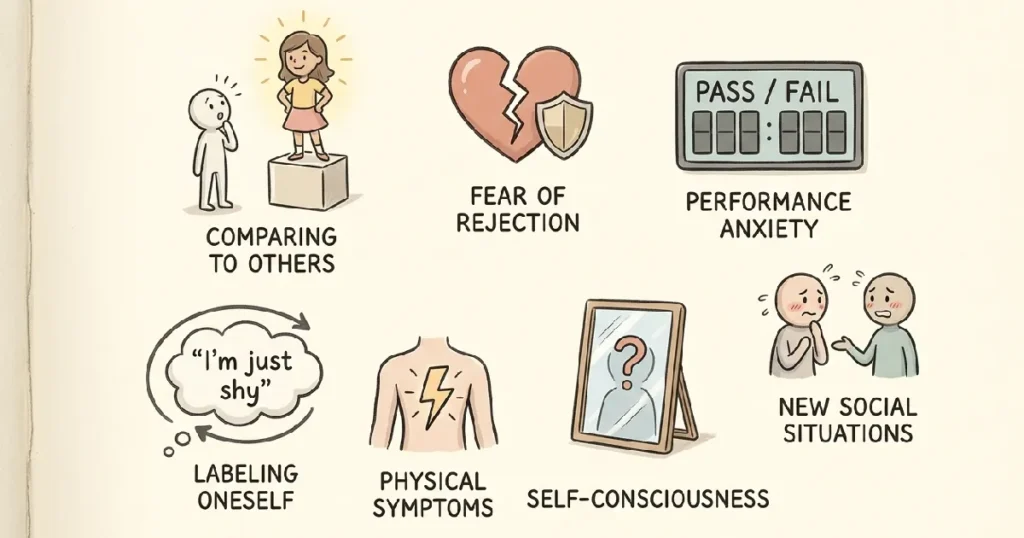
1. You’ve Put Her on a Pedestal (The Halo Effect)
The halo effect is a well-documented cognitive bias in psychology. It describes how we unconsciously assign an overall positive value to someone based on one impressive quality like physical attractiveness. When you find a girl attractive, your brain often inflates her in every other dimension too. Suddenly, she’s not just pretty. She’s perfect, out of your league, and probably judging your every word.
This mental upgrade you give her comes at a direct cost to yourself. The higher the pedestal, the deeper the psychological gap you feel between you and her. And in that gap, shyness grows.
Think of it this way: you would not feel nervous talking to someone you genuinely saw as your equal. The nervousness is a signal that you’ve stopped seeing the interaction as two human beings having a conversation. You’ve turned it into an audition.
Reframe it: She’s a person. Possibly a fascinating one. But still a person with her own insecurities, awkward moments, and bad days. You’re not auditioning. You’re just talking.
2. Your Brain Is Treating Rejection Like Physical Pain
Fear of rejection is not irrational. It’s ancient. Research published in the journal Social Cognitive and Affective Neuroscience has shown that social rejection activates the same neural pathways as physical pain. Your brain genuinely does not distinguish cleanly between being turned down and being hurt.
So when you approach a girl and feel paralyzed, your nervous system is trying to protect you. Shyness, in this context, is a defense mechanism. It says, “If I don’t try, I can’t fail.” The problem is, that same protection also guarantees you miss out entirely.
And here’s the part no one tells you: tying your self-worth to her response is the actual danger zone. When her reaction determines how you feel about yourself, the stakes become impossibly high. Of course you freeze.
Reframe it: Her response tells you about compatibility and timing. It tells you nothing absolute about your worth as a person.
3. Every Conversation Feels Like a Test You Could Fail
Consider Marcus, a 24-year-old I’ll use as a composite example from patterns I’ve seen in clinical settings. Every time Marcus approached a woman he liked, he had a goal already locked in: get her number, make her laugh, leave a perfect impression. The moment the interaction started, his internal scorecard activated. And under that pressure, he went completely blank.
This is outcome pressure, and it is one of the most common reasons men get so shy around girls. When you approach a conversation as a pass-or-fail test, your brain enters performance mode. Performance mode is cognitively expensive. It splits your attention between being present and monitoring how you’re doing, which means you’re never fully in the moment.
Psychology Today notes that shyness intensifies when people become overly focused on how they appear to others rather than on the interaction itself. That self-monitoring is what drains your confidence in real time.
Reframe it: You’re not there to win anything. You’re there to find out if this person is interesting. Curiosity is far lighter than performance.
4. You Simply Haven’t Had Enough Practice
Socializing is a skill. Not a talent you either have or don’t. A skill you build through repetition.
If you grew up in environments with little mixed-gender socialization all-boys schools, heavily male friend groups, or limited opportunities to spend casual time around women then girls may feel unfamiliar to you in a way that reads as intimidating. That unfamiliarity isn’t your fault. But it is your responsibility to address.
The more you interact with women in low-stakes, platonic contexts as coworkers, classmates, or casual acquaintances the more normal those interactions become. The mystery dissolves. The anxiety drops. It’s simple exposure, and it works.
Action step: Start with zero-stakes interactions. Make eye contact with the cashier. Say hello to a female coworker. Build the muscle slowly before you try to lift the heavy weight.
5. You’re Already Convinced Something Is Wrong With You
This one is the hardest to hear, and the most important.
If you carry deep insecurity about your appearance, your social status, your intelligence, or your personality, you will approach every interaction with a hidden assumption: that she’s about to discover the truth about you. And that assumption makes you want to hide.
Self-consciousness is not the same as low confidence. Self-consciousness is the hyperawareness of being observed. When you’re already convinced you’re lacking something, being looked at feels dangerous. So you go quiet. You look away. You disappear before she gets a chance to see “the real you.”
But here’s what that pattern actually costs you: she never gets to see the real you, and you never get the evidence that you’re worth knowing. The self-fulfilling cycle keeps turning.
Reframe it: Vulnerability is not exposure of your flaws. It’s proof that you’re human enough to show up anyway.
6. Your Body Is Reacting to Attraction Before Your Brain Catches Up
This one might be the most surprising reason of all.
Sometimes shyness around girls is not a psychological problem. It’s a physiological event. When you’re genuinely attracted to someone, your brain releases a cocktail of chemicals dopamine, norepinephrine, adrenaline that together produce a state that feels almost identical to anxiety. Racing heart. Dry mouth. Stumbled words. Inability to think clearly.
You are not nervous because something is wrong. You are nervous because something is right. Your brain has identified this person as someone who matters to you, and it’s responding accordingly.
The insight differentiator here is this: most advice about shyness treats nervousness as a problem to eliminate. But attraction-based nervousness can’t be eliminated, only redirected. The goal isn’t to stop feeling it. It’s to stop letting it stop you.
Reframe it: That flutter in your chest is not panic. It’s interest. Let it be both at once.
7. Shyness Has Become Part of How You See Yourself
According to research highlighted by Psychology Today, shyness becomes self-reinforcing when people begin to identify with it. When you say “I’m just shy,” you’ve turned a behavioral pattern into a personality label. And once it’s a label, it feels permanent.
The psychologist Philip Zimbardo, who spent decades studying shyness at Stanford, found that a significant portion of people who considered themselves shy had actually developed the trait through social conditioning and repeated negative self-comparisons not through genetics alone. In other words, many people learn to be shy by watching others who seem more outgoing and concluding that they are fundamentally different.
If you have spent years telling yourself that confident men have something you don’t, you’ve been practicing the wrong belief. Shyness is not destiny.
Reframe it: You’re not a shy person. You’re a person who has been practicing shyness. And practice can change.
What to Actually Do Starting Now

The “Exposure Ladder” Method
Start so small that failure is almost impossible. Make brief eye contact with a stranger. Say good morning to someone in a shop. Comment on something neutral to a female coworker. Each tiny interaction teaches your nervous system that social contact is safe. Over weeks, the ladder gets higher, and the anxiety gets smaller.
The “Curiosity Shift”
Before your next conversation with a girl you like, ask yourself one question: What’s one thing I’d genuinely like to know about her? That question shifts your focus from how you’re performing to what you’re discovering. It’s nearly impossible to be crippled by shyness when you’re genuinely curious.
The “Name It to Tame It” Technique
When you feel the physical symptoms of nervousness the heart rate, the dry mouth say quietly to yourself: “This is excitement. My brain thinks this matters.” Naming the physical state and reframing it as excitement rather than fear is backed by research from Harvard Business School, which found that this simple cognitive shift actually improves performance in high-pressure situations.
The “Two-Week Platonic Practice” Challenge
Commit to two weeks of intentional, platonic interaction with women in your daily life. No agenda. No goals. Just conversation. This is the fastest way to dissolve the unfamiliarity that makes girls feel mysterious and intimidating. By week two, the dynamic shifts in ways that are difficult to explain but impossible to miss.
You Were Never as Broken as You Thought
Remember that moment we started with? The tight throat, the blank brain, the silent replay afterward?
You now know what was actually happening. Your brain was calculating social risk. Your nervous system was protecting you. Your self-concept was running old code that you didn’t even write.
None of that is permanent. All of it is workable.
Shyness around girls is not a wall. It’s a collection of patterns, beliefs, and untested assumptions. And patterns can be interrupted. Beliefs can be updated. Assumptions can be tested and failed and survived.
The next time she walks into the room, you don’t need to be fearless. You just need to be curious enough to say hello.
That’s the only move that has ever actually worked.
My Closing Remarks
I want to be honest with you in a way that most articles won’t be: I’ve sat across from grown men in their thirties who were still paralyzed by this. Brilliant, kind, genuinely remarkable men who let years pass because they never understood why the freeze happened. And every single time, the breakthrough came not from becoming more confident, but from becoming more honest about what was driving the fear. The moment you stop performing and start showing up, something shifts. I’ve seen it too many times to call it a coincidence. You deserve to experience it too.
More Related Stories for You
- Struggling with why you get so shy around girls and want a deeper step-by-step guide? This one was written specifically for you.
About The Author