David Wall

Your brain treats her like a threat. Here is how to retrain it, one low-stakes conversation at a time.
Key Takeaways
- The men who overcome shyness towards girls fastest usually stop rehearsing lines and start retraining attention, because the freeze begins with a spotlight pointed inward.
- Research on the “liking gap” shows that strangers like you more than you think, which makes your harsh post-chat verdict unreliable evidence.
- Ten tiny conversations beat one grand gesture, and a two-second action window beats an hour of pep talk.
Quick answer: To overcome shyness towards girls, point your attention outward, retire the safety habits that feed anxiety, and climb a ladder of small daily conversations. Confidence grows from repeated action, and with daily reps the edge usually softens within two to four weeks.
Contents
Table of Contents
She is at the coffee counter, and you have about four seconds to say something. You know this. You have rehearsed this. Instead, you study the pastry case like it owes you money, and the moment walks out the door with her.
We have all been there. The quiet fear underneath is simple: if she sees the unpolished you, she will flinch. So your mind runs a live video feed of yourself mid-chat, grading your voice, your hands, your word choices. Psychologists call this self-focused attention, the engine of self-consciousness, and it eats the exact mental bandwidth a good conversation needs.
Below are seven field-tested ways to overcome shyness towards girls, with word-for-word scripts, a two-week practice ladder, and simple numbers to track. No pep talks. Just mechanics that hold up on a real Tuesday.
Way 1: Turn the Spotlight Outward
Here is the trap in plain terms: while you talk to her, part of your mind watches you talk to her. You check your posture, replay your last sentence, and scan her face for verdicts. In the cognitive model of social anxiety developed by Clark and Wells (1995), this inward spotlight drives the freeze, because attention spent on yourself is attention stolen from the conversation.
The fix is a direction change. Trying to “calm down” keeps the spotlight parked on you, while curiosity moves it.
One place to begin: before you open your mouth, name three things outside your own head. The book in her hand. The song playing. The absurd length of the line. Then build your first sentence from one of those details, because a shared observation gives you both something real to stand on.
A common pitfall in my practice: men swap self-monitoring for her-monitoring, reading every tiny expression like a lie detector. That reads as scrutiny, and people feel it. Keep the outward focus loose and warm. If your body hits full fight-or-flight before you even speak, start with our companion guide on what to do when you get nervous around girls, then return to the ladder below.
Way 2: Fire Your Inner Critic as the Official Scorekeeper

After any interaction, your brain delivers a verdict: awkward, boring, weird. Treat that verdict like a biased witness. In a series of studies in Psychological Science, Boothby and colleagues (2018) found a consistent liking gap: people’s conversation partners liked them more than they estimated, and the gap persisted for months among college dorm mates.
Read that twice. Your inner critic is also your worst statistician.
So change the scoreboard. Instead of rating how you felt, log what she did:
- Did she ask you a question back?
- Did she angle her body toward you?
- Did the chat run past its natural ending?
Two yes answers out of three means the conversation worked, whatever your nerves claim. Genuine disinterest exists too, so give it a fair test: two one-word replies in a row plus a turned-away posture is your cue to exit warmly (Way 7 hands you the script). One flat chat is a data point. Ten flat chats with ten different women is a pattern worth reviewing with a therapist or coach.
Way 3: Retire the Crutches That Quietly Keep You Shy
Type “how to not be shy around girls” into a search bar at midnight and you get the usual list: be confident, be yourself, just talk to her. None of it mentions the phone you clutch, the lines you rehearse, or the drink you need first. The Clark and Wells model calls these safety behaviors, and here is the sting: when a chat goes well, your brain credits the crutch instead of you, so the fear never gets corrected.
Consider the trade-off most advice skips:
| Safety behavior | What it buys you today | What it costs you later |
|---|---|---|
| Rehearsing every line | A feeling of preparation | You sound scripted and stall when she goes off-script |
| Phone in hand | An escape hatch | You look unavailable, and eye contact never happens |
| Waiting for the perfect moment | Zero risk of awkwardness | The moment never arrives |
| A drink before approaching | Looser body language | Your brain files the win under alcohol |
Retire one crutch per week rather than all at once, because stripping every coping habit in a single day can flood you and send you back to the couch.
One honest distinction: a quiet temperament is fine and needs no cure. The target is avoidance, the unread message and the swallowed hello. If fear regularly reaches panic level, or you skip whole events to dodge it, cognitive behavioral therapy with a trained clinician can compress years of solo struggle into months.
Practical What-To-Do-Next: Ways 4 to 7, With Scripts
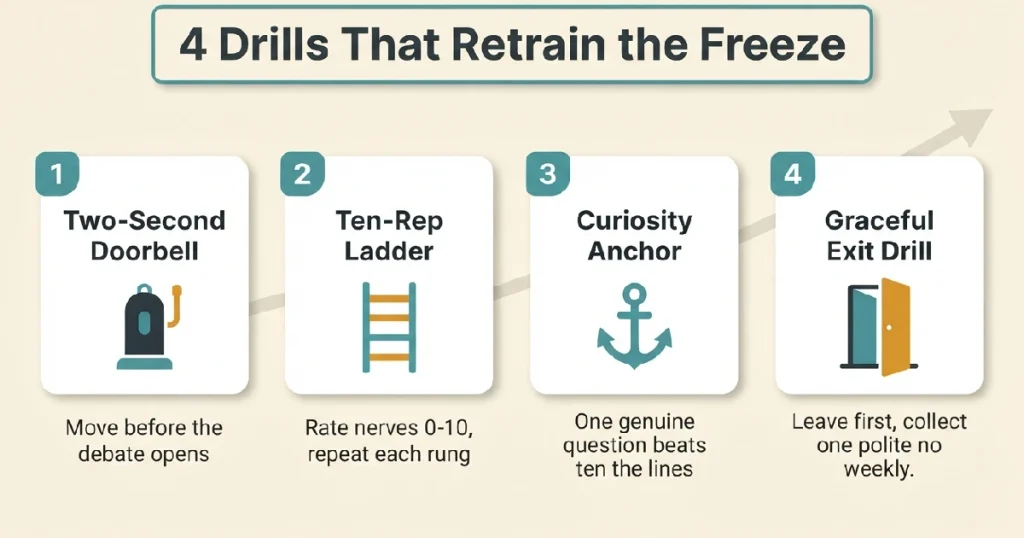
Ways 1 to 3 explain the machinery. These four drills are the daily practice that helps you overcome shyness towards girls on a real schedule. Consider running them in order for two weeks and logging one line after each rep.
Way 4: The Two-Second Doorbell
Notice the gap between spotting her and the start of your internal debate. That stretch is approach anxiety, and in the practice logs I keep with clients, hesitation past roughly two seconds is where excuses multiply (“she’s busy,” “after this song”). Treat two seconds as a doorbell: once it rings, move before the debate opens.
Keep the opener situational and small: “Hey, quick question, is the cold brew here worth it?” A shrug counts as a completed rep too.
Way 5: The Ten-Rep Ladder
Anxiety loosens through graded exposure, the clinical term for small doses repeated in an order your nervous system can digest. Try this exposure ladder, rating nervousness from 0 to 10 before each rep:
| Days | Rep | Done looks like |
|---|---|---|
| 1-3 | Ask two strangers for the time or directions | You asked, you thanked, you left |
| 4-6 | Give one woman a drive-by compliment | “Great jacket.” Then walk on, no agenda |
| 7-9 | Hold a 30-second chat with a cashier or barista | One question past the usual small talk |
| 10-14 | Start a two-minute chat with someone you find attractive | You exit on purpose while it still feels good |
Repeat any rung until its before-number drops about two points. A composite from my notes: a 29-year-old teacher who rehearsed openers every lunch break watched his before-ratings fall from 8 to 5 across ten logged reps. Skip rungs and you risk flooding, so build with low-stakes strangers first; a clumsy approach at work follows you to the next meeting.
Way 6: The Curiosity Anchor
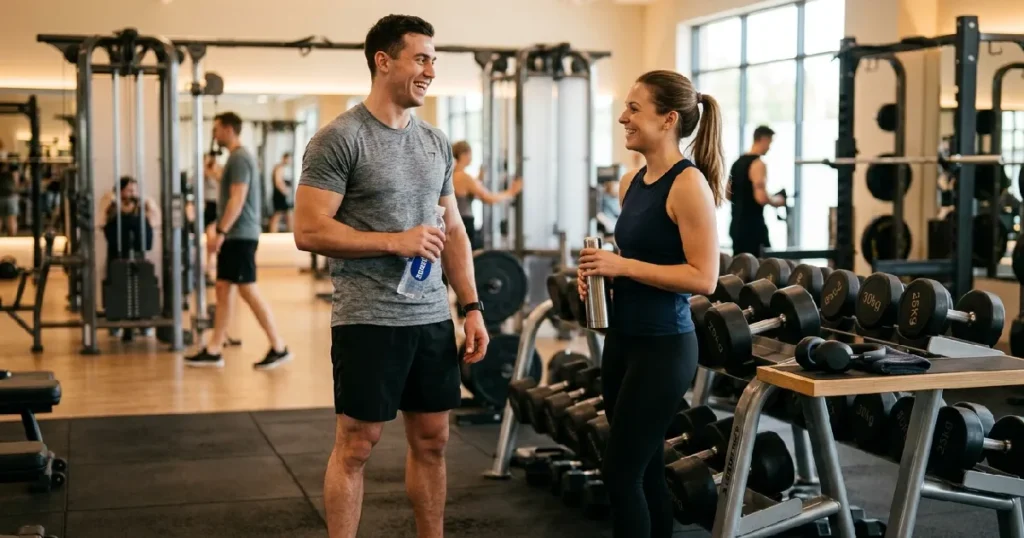
Memorized conversation starters collapse the moment she answers off-script. A genuine question about the shared situation survives any reply. Anchor each chat to one thing you actually want to know: “What are you reading? I need a book that isn’t my phone.” Or: “You seem like a regular here, what’s actually good?”
Then use a statement-plus-question rhythm so it feels like a chat: “I tried sci-fi once and bounced off it. What hooked you?” Notice what shifts when your only job is to learn one real thing about her.
Way 7: The Graceful Exit Drill
Half the fear is feeling trapped, so practice leaving first. Script: “I’ve got to run, but this was fun. Can I grab your number?” If she declines or deflects: “No worries, enjoy your coffee.” Then leave with the same warm tone you arrived with.
Consider collecting one polite no per week on purpose. Clients who schedule these rejection reps stop treating a no as a verdict on their worth, mostly because the predicted catastrophe never shows up. You have survived every no so far. That streak is evidence, and it compounds.
Frequently Asked Questions
How long does it take to overcome shyness towards girls?
In my practice, daily low-stakes reps soften the edge within two to four weeks, and the ladder gives you numbers to confirm it. Deep-rooted social anxiety can take longer, and a therapist trained in CBT shortens that road.
Is being shy the same as social anxiety?
No. Shyness is a temperament trait many people carry comfortably, while social anxiety adds persistent fear and avoidance that disrupts work, school, or friendships. If the second description fits, treat these drills as support for professional care.
What if she thinks I’m weird?
People judge these moments far less harshly than you do; the liking gap research found we consistently underestimate how well our conversations land. A polite no closes one conversation, and your warm exit is what she will actually remember.
The Same Coffee Counter, Thirty Days Later
Picture the opening scene again. She is at the counter, and your heart still knocks a little, because a silent nervous system was never the goal. Now your attention sits on the song playing and the book in her bag, the two-second doorbell has rung, and your feet move while your brain clears its throat.
“Hey, quick question, is the cold brew worth it?” Ten reps from now, that sentence will feel like tying your shoes. You hold the whole map now: spotlight out, a fair scoreboard, one crutch retired at a time, four drills with scripts.
Two seconds of courage, repeated ten times, will change more than a year of waiting.
My Closing Remarks
I spent my early twenties being shy around girls and calling it respect, waiting for a perfect moment that never came. What changed things was boring: small reps, logged honestly, on days I did not feel ready. Take one thing from this and make it a single two-second rep today. You are allowed to be a beginner here; everyone good at this once stood where you stand.
More Related Stories for You
Curious where the freeze actually comes from? Read the seven reasons you get so shy around girls in the first place, then pair that diagnosis with tonight’s first rep.
About The Author