
 Nicole Adkins
The real red flags rarely look like arrogance. They look like exhaustion, confusion, and a marriage that only makes sense from the outside.
Key Points
- The clearest signs of a narcissist husband show up behind closed doors, not at dinner parties, where charm hides a very different private reality.
- Weaponized incompetence, chronic victimhood, and sudden “hoovering” are the covert signs of a narcissistic husband that most checklists never mention.
- Naming the pattern is only step one. Documenting it and building a real plan is what actually protects you and your children.
Contents
Table of Contents
You’ve tried to explain it to your sister, your therapist, even yourself, and the words never quite land right. He’s not cruel, not exactly. He’s not the villain from a movie. But something is wrong, and you can’t name it, and that not-naming is its own kind of tired.
A narcissistic husband rarely announces himself with grandiosity. He announces himself through a pattern: charming in public, cold and blame-shifting in private, allergic to accountability, and strangely reasonable the moment you threaten to leave. That pattern has a name, and a shape you can finally see.
Why This Pattern Has a Clinical Name
Psychologists call the full clinical version of this pattern Narcissistic Personality Disorder, or NPD: a long-term pattern of grandiosity, a deep need for admiration, and a genuine lack of empathy for the people closest to him, according to diagnostic criteria summarized by the Mayo Clinic.
You don’t need a formal diagnosis to be living inside the pattern, though. Full NPD affects roughly 6.2 percent of adults over a lifetime, according to a large national survey led by researcher Frederick Stinson and later reviews summarized by the National Institutes of Health. The real number is likely higher, because narcissists almost never walk into a therapist’s office asking to be assessed.
That’s the mechanism behind why you feel like the unofficial diagnostician in your own marriage. You’re the one googling at midnight. You’re the one building the case in your head, quietly, because he never will.
Most wives in this situation don’t realize how common this exact experience is until they read another woman’s words and think, that’s my marriage exactly.
The Two Faces: Public Charm vs. Private Cruelty in a Narcissistic Husband
Think of him as a lighthouse. From the shore, from coworkers, from his own mother, he looks bright and steady, generous with his light. He remembers birthdays. He’s the funny one at dinner parties. He helps a coworker move apartments on a Saturday.
But you live on the side facing the water, the side the light never reaches. That’s where the sarcasm lives. That’s where you get three days of silence over a disagreement about paint color. That’s where “I was just joking” erases a comment that cut you open.
Why the Nice Guy Mask Fools Everyone Around a Narcissistic Husband
This split isn’t hypocrisy the way you’d normally think about it. Clinicians describe it as impression management, meaning the effort a person spends controlling how others see him gets aimed almost entirely outward, toward people who can supply admiration.
You aren’t an audience anymore.
You’re infrastructure. And infrastructure doesn’t need to be charmed, only managed.
That’s why friends struggle to believe you when you finally say something. They’ve only ever seen the lighthouse. You’re describing the dark side of the water, and it doesn’t match their photo album.
The public mask is only half the story, though. The private signs are far more specific than “he’s just difficult,” and most of them are so quiet you’ve been mistaking them for something else entirely.
Covert Signs of a Narcissistic Husband Beyond Grandiosity
Loud arrogance is actually the least reliable sign. The quiet signs are the ones doing real damage over time, according to clinical descriptions from the Cleveland Clinic.
Weaponized incompetence. He “forgets” how the washing machine works, pays a bill late every month “by accident,” or can’t find the pediatrician’s number, so you end up doing it. This isn’t forgetfulness. It’s a strategy that keeps him free while you manage the household. Financial control shows up in nearly every documented case of coercive control, often disguised as “he just handles the money,” or its mirror image, “he can’t handle anything, so I have to.”
Chronic victimhood. Every conflict somehow ends with him as the wounded party, even the ones he started. You raise a legitimate concern, and within minutes you’re the one comforting him.
The invisible scoreboard. He remembers every favor he’s ever done for you, in detail, and forgets every one you’ve done for him. Gratitude only flows one direction.
None of these look like a diagnosis from a movie. They look like a Tuesday. That’s exactly why they’re so hard to name.
Phrases Narcissistic Husbands Use During Gaslighting
Listen to the lines. They repeat across kitchens and time zones.
“You’re too sensitive.” This is gaslighting, the tactic of making you doubt your own memory, perception, or sanity. You named a real event. He renamed you as the event.
“After all I’ve done for you.” Keeping score dressed as love.
“I guess I’m just a terrible husband then.” A collapse that forces you to rescue him from a consequence he earned.
“If you leave, the kids will never forgive you.” Fear used as a leash.
None of these lines solve the original problem. They move the problem onto your character. That move is the whole game.
He is not confused. He is managing you.
Elena, 41, with two children, told herself she had a good enough marriage because nothing was ever “that bad.” Her husband coached soccer and remembered every neighbor’s dog. At home he called her intense for wanting a budget talk and slept through their son’s night terrors, then described himself as hands-on. She started a dated notebook after he denied a fight her body still remembered. When she met a lawyer, he cried in the driveway and booked a surprise weekend. She almost shredded the notebook. She kept it. That record made the private weather visible in rooms that only believed the sunshine.
The Hoovering Trap: Why a Narcissistic Husband Becomes Perfect Right After You Try to Leave
Clinicians borrow the term hoovering from the vacuum brand, because the behavior sucks you back in right when you’re closest to the door.
But here’s what no one tells you.
Family law practitioners notice this timing isn’t random. Hoovering tends to spike at predictable legal moments: the day divorce papers get filed, the day you tour an apartment, the day a custody evaluator gets assigned. This isn’t romance returning. It’s a threat response to losing control. Recognizing the pattern is the difference between real change and a strategic pause built to buy time.
Living as a Single Parent Inside a Marriage to a Narcissistic Husband

If you’ve noticed your child comforting you after a fight, or your teenager acting as a buffer between you and your husband, that’s not a personality quirk in your kid. That’s parentification, when a child takes on adult emotional responsibilities like managing conflict or reading the room before speaking.
Psychological research on high conflict homes links this pattern to children who grow into over-functioning adults, still scanning every room for tension decades later. Left unexamined, this pattern doesn’t just strain a marriage. It can quietly shape how your children learn to love as adults.
Building Your Case: Documentation Against a Narcissistic Husband
More than 20 U.S. states, along with the UK under the Serious Crime Act 2015, now legally recognize coercive control, meaning a pattern of intimidation, isolation, and financial restriction, as abuse even without a single physical incident. That means emotional and financial control from a narcissistic husband may meet an actual legal threshold now, not just a private complaint.
State-by-State Consent Laws Before Recording a Narcissistic Husband
Before you record a conversation as evidence, check your state’s law. Thirty-eight states allow one-party consent, meaning you can legally record a conversation you’re part of without telling him. Twelve require all-party consent, meaning a recording made without his knowledge could actually hurt your case instead of helping it. WomensLaw keeps an updated, state-specific breakdown worth checking before you press record.
The Grief No One Talks About With a Narcissistic Husband
There’s a specific grief that comes with this realization, and it doesn’t look like grief at first. It looks like flatness, like missing a man who was never fully there to begin with.
You’re not grieving him exactly. You’re grieving the version of him you kept hoping would show up permanently, the one you saw during hoovering, during the wedding, during the good months. That man was real for maybe twenty percent of the marriage. You built a life around the hope that the twenty percent would become the whole thing.
Real Solutions for Coping With a Narcissistic Husband
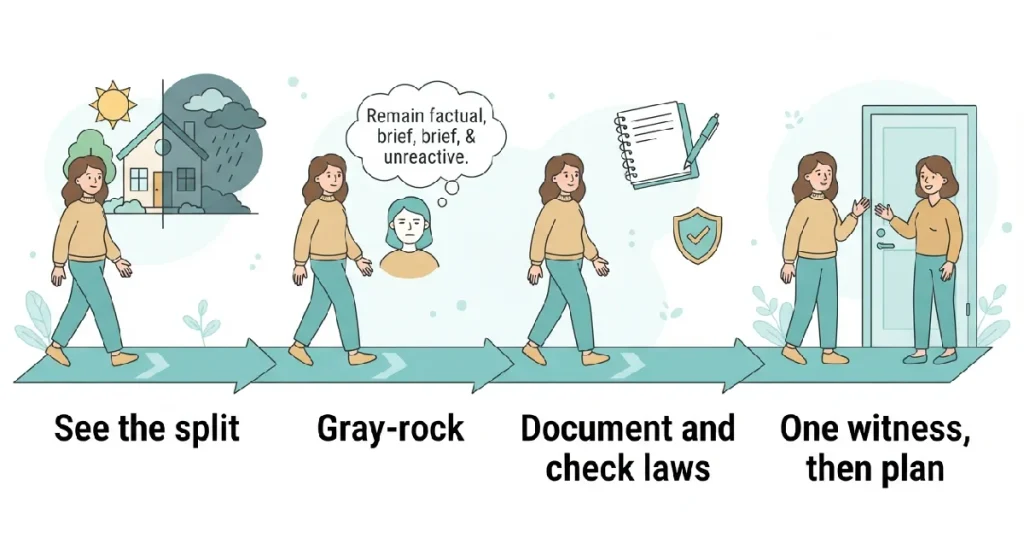
The Gray Rock Method. Keep exchanges about logistics brief, factual, and unemotional, since reaction is the reward he’s fishing for. Instead of defending yourself about being late, try “Noted, I’ll leave earlier,” and end the conversation there.
The Mental Quarantine Technique. Privately label the tactic without engaging it outward. He says “you’re too sensitive,” you think “that’s deflection,” and you don’t take the bait.
The Underground Support Network. Tell one trusted person one true detail today. Isolation is what keeps this pattern invisible, and disclosure is what breaks it.
Documentation Discipline. Keep a dated log of incidents, save texts and emails, and consult a family attorney familiar with coercive control documentation, not just physical abuse cases.
One question worth sitting with this week: if a friend described your marriage to you exactly as it is, what would you tell her to do?
You Are Not the Problem You’ve Been Told You Are
You are not the unreasonable one who can’t get along with a good man. You’ve been reading a lighthouse for warmth while standing on the dark side of the water. Now you know why the light never reached you. It was never meant to.
The light was never meant for you. Once you understand that, you stop waiting for the version of him who visits during a crisis, and you start building the version of your life that doesn’t need him to change at all.
My Closing Remarks
Here’s the part I tell clients that surprises them most: the day you stop trying to prove your reality to him is the day you actually start healing. You don’t need his agreement to trust what you saw and felt. I’ve watched women rebuild entire identities after years of doubting their own memory. It’s slow, and it’s real, and it works.
Therapist Note: If you’re struggling with a narcissistic husband, consider speaking with a licensed therapist who has experience with narcissistic abuse and coercive control.
More Related Stories for You
- Managing the anxiety this kind of marriage creates matters just as much as naming the pattern. These mindfulness exercises for anxiety offer a place to start calming your nervous system while you plan your next steps.
About The Author