
 Nicole Adkins
Your OCEAN score isn’t your ceiling. It’s your starting line, and the science says you can move it.
Key Points
- The 5 main personality traits (OCEAN) predict a meaningful slice of your daily behavior, which means most of your patterns are still within your reach to change.
- What feels like a fixed flaw, like low agreeableness or a short fuse, is often an untrained strength waiting for the right context.
- Small, structured shifts to your environment change trait-driven habits faster and more reliably than willpower alone.
Contents
Table of Contents
We’ve all sat through a personality quiz, felt a flash of recognition, then wondered by Tuesday why the label didn’t hold up. You take the test, you get your four letters or your color or your spirit animal, and for about a week it explains everything. Then life gets messy again, and the label stops fitting the person actually living your week.
That gap between the quiz result and your real behavior isn’t a flaw in you. It’s a flaw in the tool.
Someone might think their short temper is just “who they are.” What they don’t see is that their reactivity has been shaped by ten years of poor sleep and unprocessed stress, not carved into stone at birth.
Someone might think being “too nice” is a personality problem they’re stuck managing forever. What they don’t see is that this trait is a dial, not a sentence, and it can be turned down on purpose.
Someone might think their inability to finish creative projects makes them lazy or undisciplined. What they don’t see is a specific, well-documented collision between two traits, one that has a name and a fix.
You’ve tried to change before. You’ve read the books, made the vision board, promised yourself this would be the year. And yet the same patterns keep showing up, and you start to wonder if something is actually wrong with you. Nothing is wrong with you. You’ve just been using the wrong map.
What the 5 Main Personality Traits (OCEAN) Really Measure
Psychologists refer to the 5 main personality traits using the acronym OCEAN: Openness to experience, Conscientiousness, Extraversion, Agreeableness, and Neuroticism. Unlike MBTI-style tests, which sort you into one of sixteen fixed boxes, the Big Five model treats each trait as a spectrum. You don’t “have” high Openness the way you have brown eyes. You sit somewhere on a sliding scale, and that position can move.
This distinction matters more than it sounds like it should. According to the American Psychological Association, the Big Five has become the dominant scientific model for trait research precisely because it holds up across cultures, languages, and decades of retesting. That’s a big part of why HR departments, dating researchers, and clinicians have quietly shifted away from MBTI over the past several years. You’re not imagining that trend. You’re responding to it.
Here’s the part that gets buried in most explanations: roughly 30 to 40 percent of your trait expression traces back to genetics. That leaves a wide, workable majority shaped by habit, environment, and choice.
Why Personality Isn’t Fixed: The Maturity Principle Explained
Here’s what almost nobody tells you about trait scores.
You are already changing, right now, without doing anything at all. Psychologist Brent Roberts and his colleagues at the University of Illinois ran a cumulative analysis of longitudinal personality studies and found a consistent pattern: Conscientiousness and Agreeableness tend to rise steadily from your twenties through your forties, while Neuroticism (the tendency toward anxiety, moodiness, and emotional reactivity) tends to decline. Researchers call this the maturity principle.
How Age Naturally Reshapes Your Traits
This isn’t motivational filler. It’s a measured pattern found in study after study cataloged through work associated with the University of Illinois psychology department. You get steadier with age partly because your brain does, and partly because life keeps handing you situations that reward patience over reactivity.
That’s the passive version of change. The active version moves much faster. A 2015 study led by researcher Nathan Hudson tracked adults who set specific weekly goals tied to a target trait, like initiating one extra conversation a day to build Extraversion. Within 15 weeks, participants showed statistically real increases in their target traits. Not a mood shift. A measured trait shift.
Fifteen weeks. Not fifteen years.
The “Negative Trait” Myth: Turning Low Scores Into Strengths
Most people who take a Big Five assessment read their low scores like a diagnosis. Low Agreeableness gets read as “I’m difficult.” High Neuroticism gets read as “I’m broken.” That reading is where most guidance stops, and it’s exactly where it should start digging deeper.
Traits aren’t good or bad. They’re tools built for specific jobs, and the job determines whether the tool looks like a strength or a liability.
Why Low Agreeableness Can Make You a Better Negotiator
Agreeableness measures how much you prioritize cooperation and harmony over your own interests. Score low, and you likely push back more, concede less, and feel less guilt asking for what you’re worth.
Organizational psychology research covered extensively by Harvard Business Review has repeatedly linked lower Agreeableness to stronger salary negotiation outcomes and faster movement into leadership roles. The same trait that makes you feel like the difficult one in your friend group might be the exact trait getting you promoted at work.
In my practice, I’ve watched clients spend years trying to “fix” this part of themselves before realizing the trait was never the problem. The problem was using a boardroom tool in a bedroom conversation. Most people in this situation don’t realize their trait profile is fine. It’s their context-matching that needs the work.
How Your Traits Are Secretly Shaping Your Relationships

Your OCEAN profile doesn’t stay quietly in the background of your dating life. It actively steers who you choose, how long you stay, and why things end.
Longitudinal relationship research has connected high Neuroticism paired with low Openness to shorter relationship duration and higher self-reported loneliness in adults between 25 and 45. The mechanism makes sense once you see it laid out. High Neuroticism means you’re quicker to interpret a delayed text as rejection. Low Openness means you’re less likely to sit with the discomfort of that interpretation before reacting to it.
Picture a woman named Elena. She’s smart, funny, and has ended four relationships in six years, always convinced the timing was wrong or the person wasn’t “the one.” What Elena hadn’t connected was her own trait pattern: high Neuroticism made minor conflict feel catastrophic, and low Openness meant she rarely questioned her first read of a situation. Once she saw the pattern named on paper, she stopped blaming the men and started building a 24-hour pause before ending things during conflict. Her next relationship crossed the two-year mark for the first time in her adult life.
That’s not weakness. That’s wiring, and wiring can be rerouted.
The Distraction Trap: When High Openness Meets Low Discipline
If you’ve spent time in personality forums, you’ve seen this complaint over and over: a person bursting with ideas, starting a new project every few weeks, finishing almost none of them. This combination, high Openness paired with low Conscientiousness, has a name among researchers who study it. Call it the Distraction Trap.
High Openness gives you a constant stream of new interests. Low Conscientiousness means you struggle to sit with any single one long enough to see it through. Together, they create a person who looks scattered from the outside but is actually running on a completely logical internal system, one built for novelty instead of completion.
Think of your trait profile less like a cage and more like a thermostat. The room’s temperature isn’t fixed. It just needs a hand on the dial, applied consistently, before the room actually changes.
Consider Maya, a graphic designer with four half-finished side businesses and a drawer full of notebooks with three entries each. Willpower had never worked for her, no matter how many productivity apps she downloaded. What finally worked was removing the choice point entirely: she joined a weekly body-doubling session where she had to show up and work in front of others on one named project, no switching allowed. Six months later, she had shipped her first finished product. Nothing about her Openness had changed. Her ecosystem had.
Practical Ways to Rewire Trait-Driven Behavior (Not Your Genes)

You don’t need to overhaul your personality to change your outcomes. You need to change the conditions your personality operates inside of. Here are places to start, matched to the trait most likely to be running the show.
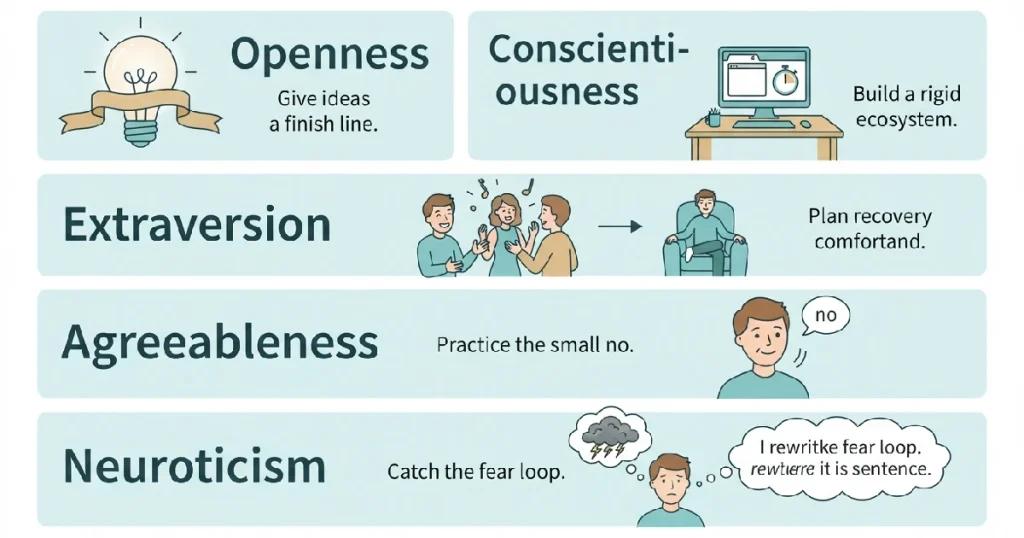
Ecosystem Design works directly against the Distraction Trap. Instead of relying on motivation, you strip your environment of choice. One place to start is picking a single project, telling one accountability partner your deadline, and blocking every competing tab or app during your work window.
The Small No Practice helps if high Agreeableness has you overcommitted and resentful. Consider practicing a low-stakes “no” this week, like declining a minor favor, before you attempt it in a higher-stakes relationship or work request.
Recovery Buffer Scheduling protects low-Extraversion energy without asking you to fake being someone you’re not. If a big meeting or networking event is coming up, try blocking 30 quiet minutes immediately afterward, guilt-free, before your next obligation.
The 60-Second Reframe targets high Neuroticism directly. A short-term cognitive behavioral technique, structured psychotherapy that challenges distorted thought patterns, has been shown in a 2017 review by Roberts and colleagues to produce measurable drops in Neuroticism, not just symptom relief. A useful question to ask yourself the next time anxiety spikes: “What’s the evidence for this thought, and what’s the evidence against it?”
Building Your Personal Growth Plan Around Your 5 Main Personality Traits
Left unexamined, trait-driven patterns don’t just cause daily friction. They quietly become the reason relationships end, promotions get missed, and creative work never leaves the drawer. That’s the real cost of treating your OCEAN score as fixed instead of workable.
You don’t need to score high everywhere. You need one honest read of your current profile (a validated Big Five assessment, like the one referenced through Verywell Mind’s overview, takes about ten minutes) and one trait you’re ready to work on this quarter, not all five at once.
A useful question to sit with tonight: which of these five traits has cost you the most this year, and what’s one context where that same trait would actually serve you well?
You now have something you didn’t have at the start of this piece: a working map instead of a static label. Your Openness, your Conscientiousness, your Extraversion, your Agreeableness, your Neuroticism, none of them are life sentences. They’re settings, and you’re allowed to touch the dial.
The quiz never had the final word on who you are. You do.
My Closing Remarks
Here’s my honest take after years of watching clients chase the “right” personality: nobody needs a better label. They need permission to stop performing a version of themselves that was never accurate in the first place. I’ve watched a low-Agreeableness woman finally stop apologizing for her negotiating instincts and get the raise she’d earned three years earlier. That’s not a personality quiz result. That’s a life changing because someone finally trusted their own wiring.
If you’re struggling with anxiety or reactivity tied to your Neuroticism score, consider speaking with a licensed therapist.
More Related Stories for You
If anxious reactivity is the trait giving you the most trouble, these mindfulness exercises for anxiety offer a practical starting point for calming the nervous system before you work on the deeper trait pattern.
About The Author