
 Sara Carmen
The problem was never that he doesn’t open up. It’s that nobody ever taught either of you how to ask.
KEY POINTS
- Most couples do not run out of love. They run out of questions, and the silence gets misread as distance.
- The right romantic questions to ask your boyfriend work like a key, not a crowbar. Sequence and timing matter more than the wording.
- Deep prompts land best when they are wrapped in praise, spaced out in tiny five-minute rituals, and asked with your phone face-down.
Contents
Table of Contents
We know each other’s coffee orders. We know which side of the bed, which podcast, which mood the Sunday scaries bring. And somewhere inside that comfortable fluency, we stop being curious.
You still love him. That is not in question.
But lately your conversations have a shape you could predict with your eyes closed. Logistics. Dinner. The group chat drama. A show playing while two phones glow in the dark.
Someone looking in might think you have a communication problem. What they do not see is that you talk constantly. You just talk around each other, not into each other.
Someone might think he is closed off. What they do not see is that no one has asked him anything worth putting his phone down for in a very long time.
That is the tension worth naming. Left unexamined, this quiet drift does not announce itself. It just slowly becomes the reason people say “we grew apart” and genuinely mean it.
Beyond Small Talk: Why Structured Emotional Safety Changes Everything
Here is the mechanism most people miss.
Intimacy is not built by feeling close. It is built by a process psychologists call escalating reciprocal self-disclosure, which is a formal way of saying: I tell you something slightly personal, you match it, and we both climb one step higher.
That word escalating is doing heavy lifting. The climb has to be gradual. Jumping to “what’s your deepest fear?” over breakfast is like asking someone to sprint before they’ve stood up.
Psychologist Arthur Aron demonstrated this in his now-famous 1997 study, where strangers who worked through 36 progressively personal questions reported dramatic closeness in under an hour. The magic was never the questions themselves. It was the structure. Easy first. Vulnerable later. Both people answering.
And there’s a neurological piece too. Novelty, meaning new information about someone you already love, activates the brain’s reward circuitry. Research on romantic love and the brain points to dopamine-rich regions lighting up in long-term couples who still experience their partner as interesting. Curiosity is not a soft skill in relationships. It is chemistry.
But here’s what no one tells you.
Men who “shut down” during emotional conversations are often not avoiding intimacy. They are avoiding ambush. A sudden heavy question after a draining day reads as a test with an answer they might fail. So they go flat, and you read the flatness as indifference.
Change the container and you usually change the man.
The “Love-Lore” Method: Deep Questions to Uncover His Untold History
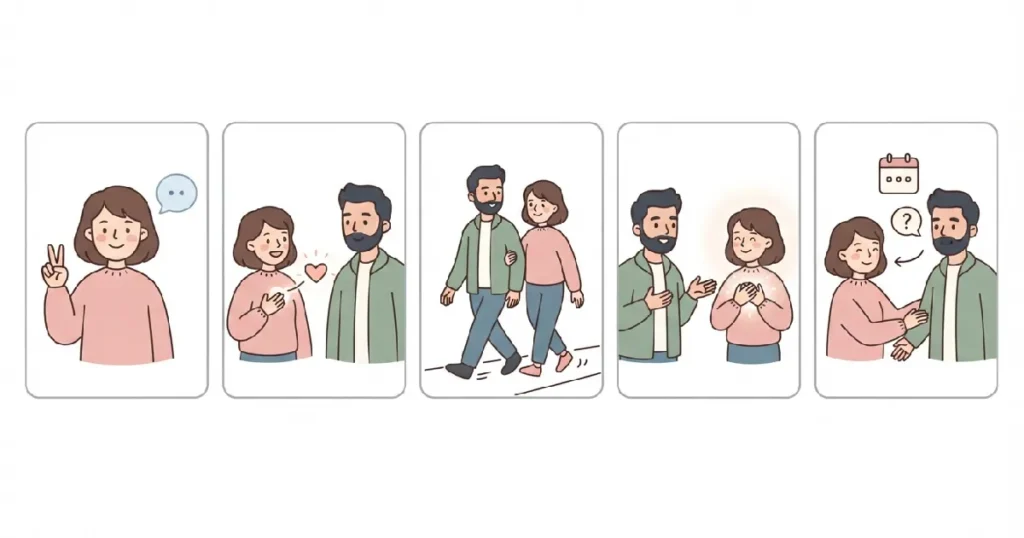
There’s a shift happening in how modern couples connect. Dating researchers have started tracking what’s been nicknamed love-loreing, where partners actively dig into each other’s backstory, formative memories, and personal mythology instead of trading résumé facts. Psychology coverage of emerging dating trends reflects this broader hunger for narrative depth over surface compatibility.
Think of it this way. Most couples know each other like a Wikipedia summary. Love-lore is reading the whole book.
Treat his life as an unfolding story, not a fact sheet.
- What’s a version of yourself you’re glad I never met, and why?
- Which memory from before we met do you wish I could have watched happen?
- Who was the first person who made you feel genuinely understood?
- What’s a compliment you received years ago that you still think about?
- What did you believe about love at seventeen that makes you laugh now?
- Which small moment changed the direction of your life more than anyone realizes?
- What’s something your family taught you about affection without ever saying it out loud?
- When did you first realize you were falling for me, and what tipped it?
- What’s a fear you carried as a kid that still shows up in adult form?
- If your life so far were a film, where would the intermission be?
The “so what”: These do not ask him to perform feelings. They ask him to tell a story, which is a far more comfortable entry point for most men. Emotion arrives on its own once the story starts moving.
Micro-Rituals of Desire: Five-Minute Romantic Questions for Everyday Sparks
You do not need a three-hour talk. You need a micro-ritual, a small repeated moment that becomes emotionally predictable in the best way.
Five minutes. Lights low. Phones charging in another room. That’s it.
- What was the best sixty seconds of your day?
- What’s one thing I did today that you noticed?
- If we could wake up anywhere tomorrow, where would you pick?
- What made you laugh when I wasn’t around?
- What’s something you’ve been wanting to say but haven’t found the right moment for?
- Which part of my face do you look at most?
- What do you want more of from me this week?
- What’s one thing you’re quietly proud of right now?
The “so what”: Consistency beats intensity. Two of these a night, three nights a week, will do more for your bond than one dramatic heart-to-heart every three months.
Navigating Digital Intimacy: Questions to Reconnect Off-Screen

Phone presence is corrosive in a specific way. The American Psychological Association has documented how constant connectivity fragments attention and raises baseline stress, and fragmented attention is the enemy of feeling chosen.
There’s a term for the sting of being ignored in favor of a screen: phubbing, short for phone-snubbing. It rarely causes a fight. It just slowly teaches your nervous system that you are the second most interesting thing in the room.
These questions are designed for the screen-free window.
- What does my full attention feel like to you?
- When do you feel most disconnected from me, honestly?
- If we deleted every app tonight, what would you want us to do instead?
- What’s a conversation you wish we had more often?
- What do you think I’d be surprised to learn about your inner life this year?
- When was the last time you felt completely relaxed around me?
- What’s one boundary of yours I could protect better?
The Insight Nobody Mentions: Your Questions Are Only as Safe as Your Reaction
Here is the differentiator, and it matters more than any list.
The question is not the intervention. Your face is.
Asking your boyfriend a vulnerable question and then flinching, correcting, or getting quiet at his answer teaches him that honesty costs something. He will answer once. He will not answer twice.
Think of emotional safety like a diving board. The question is the board. Your reaction is the water. He is not measuring how high the board is. He is checking whether there’s anything down there to land in.
This is where the Gottman Institute’s well-known 5:1 ratio becomes practical. Their research on stable couples found roughly five positive interactions for every negative one during conflict and hard conversations. Applied to questions, it means every heavy prompt should sit inside a bed of warmth.
Ask something deep. Then ask something that reminds him he’s admired.
The 5:1 Method: Balancing Vulnerability With Romantic Validation
Pair these deliberately. One heavier, one warmer.
- What’s something you carry that you’ve never asked for help with?
- What’s my best quality that most people overlook?
- When did you last feel like you disappointed me, and was I aware?
- What’s a moment with me you’d relive exactly as it happened?
- What part of yourself are you still working on?
- What do I do that makes you feel safest?
- What’s the hardest thing you’ve forgiven yourself for?
Micro-Validation Questions: What Love Languages Left Out
Knowing his love language tells you the category. It does not tell you the behavior.
Micro-validations are the tiny, near-invisible acts that register as love in real time. The hand on the back of his neck. The text at 2 p.m. The way you let him finish a boring story.
- What small habit of mine makes you feel quietly appreciated?
- What’s the most romantic thing I do that I probably think is nothing?
- How do you like to be comforted when you’re stressed, specifically?
- What kind of praise actually lands for you?
- Is there something I say often that you love hearing?
- What do you need in the first ten minutes after you walk through the door?
- How would you like me to respond when you go quiet?
- What makes you feel most respected by me?
Slow-Dating Questions to Rediscover the Man He’s Becoming
Slow dating describes the deliberate choice to let connection build instead of rushing milestones. Long-term couples benefit from borrowing it, because the person you committed to is not the same person sitting across from you tonight.
People change quietly. Then one day you realize you’ve been loving an outdated version.
- Who are you becoming that I haven’t met yet?
- What do you want the next five years to feel like, not look like?
- What’s changed about what you want from love since we started?
- If we met today, would you approach me? What would you say?
- What’s a dream you’ve stopped mentioning?
- What would make you feel more like a team with me?
- What do you hope I never stop doing?
- What’s one thing we could build together that neither of us could build alone?
Maya and the Question She Almost Didn’t Ask
Maya came in convinced her boyfriend of four years had “checked out.” He answered in one-word bursts. He scrolled through dinner. She had started rehearsing breakup speeches in the shower.
I suggested she stop asking about the relationship entirely for two weeks and ask only about him. One question. Bedtime. Phone in the kitchen.
Night three she asked what compliment he still thought about. He told her about a teacher who, when he was twelve, said he noticed things other people missed. He’d never told anyone that.
Night nine he asked her a question first.
By week three they were talking past midnight, not about problems, but about who they were becoming. Nothing structural changed in their lives. What changed was that he stopped being a project to be fixed and started being a person to be known.
How to Ask Without It Feeling Like an Interrogation
1. The Two-Question Cap. Never more than two per sitting. The moment it feels like a quiz, the safety collapses. Leave him wanting the next one.
2. Answer First. Go before he does, and go slightly deeper than you’re comfortable with. Self-disclosure is contagious. Modeling beats requesting.
3. The Sideways Rule. Ask during a walk, a drive, or while washing dishes. Reduced eye contact lowers physiological arousal, meaning his body stays calm and his guard stays down. Face-to-face feels like a confrontation. Shoulder-to-shoulder feels like a team.
4. Receive, Don’t React. Whatever he says, your only job in the first thirty seconds is warmth. “Thank you for telling me that” is a complete sentence.
5. Close the Loop Later. Reference his answer three days on. “I keep thinking about what you said about your dad.” That’s the move that proves you were actually listening.
A useful question to ask yourself before you begin: Am I asking to know him, or asking to be reassured? Both are human. Only one builds intimacy.
The Curiosity You Choose
You do not need a better relationship. You need a better opening line into the one you already have.
The board is there. Every night, in the ordinary quiet before sleep, there’s a five-minute window where you get to decide whether to stay on the shore or step out onto it.
He is still a stranger in a hundred small, beautiful ways. So are you.
Love does not die from lack of feeling. It dies from lack of asking.
My Closing Remarks
I’ll be honest with you. In my own life, I once went nearly a year without asking my partner a single question I didn’t already know the answer to, and I called that stability. It wasn’t. It was sleep. The night I finally asked him something real, he cried, and I realized I had been living beside a locked room I never once knocked on. Do not wait for a crisis to become curious again. Knock tonight.
More Related Stories for You
- Struggling to tell the difference between emotional distance and something more concerning? Learn the warning signs of narcissistic personality traits.
About The Author