David Wall

Some couples wilt under a shared roof. Others build the strongest marriage on the block. What separates them?
Key Takeaways
- Living with family after marriage works when the couple stays the household’s decision-making center, with everyone else joined as support.
- The gains are measurable: real savings, reclaimed hours, and daily practice at the small responsiveness habits that predict marital stability.
- One quiet failure mode sinks most setups: routing couple tension through a parent, which therapists call a triangle.
Quick answer: Living with family after marriage can strengthen a couple’s bond through shared costs, daily support, childcare, and closer grandparent ties. It works when both partners choose it freely, money and chores are agreed in writing, and the couple keeps private time and final say over their own decisions.
Contents
Table of Contents
We tend to picture the hard parts of marriage as money, chores, and sleep. Then you’re in your mother’s kitchen, watching her quietly rewash the pan your husband just cleaned, and his jaw tightens. Nobody warns you about that moment.
Your spouse feels like a guest. Your parents feel like hosts. You have become the full-time translator between two camps you love.
Here is the mechanism underneath: moving into a family home reactivates old roles. You slide back into being the kid. Family systems theory names what often follows: a triangle, where tension between two people detours through a third.
Living with family after marriage can still be one of the smartest setups you will ever choose. Below are seven reasons it genuinely works, the tripwires that sink it, and scripts you can use this week.
Reasons: The Practical Dividend of Living With Parents After Marriage

When family and marriage share one address, the practical math changes first.
1. A financial runway you can measure
Shared housing turns your largest expense into your smallest. Picture a couple paying $2,300 a month for rent and utilities, then moving in with parents on an agreed $600 plus weekend groceries. That gap, roughly $19,000 a year, becomes a down payment fund.
The pattern is national: 59.7 million Americans, 18% of the population, lived in multigenerational homes by 2021, and financial reasons top the list of why (Cohn et al., 2022).
The nuance most lists skip: 53% of adult children say the setup helps them financially, while only 29% of their parents agree. Your runway may be funded by someone’s retirement. Contribute accordingly.
2. Hours back in your week
Cooking rotates. Someone is home for the delivery, the plumber, the childcare handoff. In the setups I have watched work, each partner buys back five to eight hours a week that a solo household would eat.
Spend those hours on purpose. Two protected evenings together beat eight scattered free hours. The dividend only counts if it lands on the marriage.
3. A safety net with a pulse
Flu at 2 a.m. A layoff, a newborn, a surgery. A shared house responds in minutes, and a third of adults in these households tell Pew caregiving is a major reason they live this way.
One edge case deserves naming: support curdles when it turns into debt. If every favor arrives with an opinion attached (“we watched the baby, so we get a say on daycare”), you are paying interest. Agree on what help is free before you need it.
Reasons: How a Marriage With Family Nearby Grows Stronger
The next three reasons work on the bond itself, where marriage and family overlap most.
4. More daily reps at the habit that predicts lasting marriage
John Gottman’s newlywed study followed couples for six years. Those who stayed married turned toward their partner’s small bids for attention 86% of the time, while those who divorced managed 33% (Brittle, 2015).
A shared house floods you with bid moments: a comment over breakfast, a look across the dinner table, a complaint about traffic. More moments, more reps.
One rule protects the dividend: answer your spouse first, then the parent. When your wife cracks a joke and your father asks a question in the same breath, the order of your response teaches everyone where your attention lives.
5. A live model of long marriage
Watching parents disagree, cool off, apologize, and try again gives you something no book offers: conflict repair in real time. You get to see how a thirty-year marriage absorbs a bad week.
Filter what you see. Take the pattern, leave the prescription. Their repair rhythm may be worth copying; their rules about money or gender roles may belong to another era.
6. Culture and continuity your kids can taste
Across South Asia and many other regions, the joint family remains the default start of married life. Daily life with family after marriage passes language, recipes, and festival rhythms to the next generation without anyone scheduling a lesson. Grandparents become attachment figures, and attachment theory has long recognized that children bond securely with more than one caregiver.
If you and your spouse come from different backgrounds, this gets richer and trickier at once. We mapped that territory in our guide to cultural differences in marriage, including whose traditions set the household default.
Reason 7 and the Tripwires: Reading Your Household Honestly
7. Caring for elders together builds a team
There is a version of this arrangement where you are the givers. Managing a parent’s medications, driving to appointments, splitting the mental load of elder care: couples who share a real mission tend to describe a stronger “us.”
Keep it sustainable with arithmetic. If care tasks pass ten hours a week, put a sibling rota in writing. Resentment grows in the gap between what one couple gives and what everyone else assumes.
The three failure patterns to watch
The honest scoreboard first: in Pew’s survey, 54% of adults call multigenerational living rewarding all or most of the time, while 23% call it stressful just as often (Cohn et al., 2022). The difference usually traces to three patterns.
- Triangulation: a parent becomes tiebreaker, referee, or messenger for couple tension. Couples family therapists treat this as the central hazard of shared-household marriage.
- Guest mode: every real disagreement gets postponed to keep the house pleasant, then detonates in private weeks later.
- Role regression: a capable adult gets treated, and starts acting, like a teenager in their childhood bedroom.
Watch these signals across two ordinary weeks:
| Daily signal | Setup that works | Setup that erodes |
|---|---|---|
| Decisions | Couple decides, then informs | Parent consulted before spouse |
| Money | Fixed written contribution | Vague favors, running guilt tab |
| Conflict | Private repair within a day | Polite freeze, delayed blowups |
| Privacy | Knocks and closed doors honored | Surprise entries, open-door audits |
| Future | A named review date | “We’ll see how it goes” forever |
One metric cuts through the noise: keep a triangle log. For two weeks, tally every couple decision that reaches a parent before it reaches your spouse. More than two or three a week means the marriage has lost its seat at the head of the table.
A candid word on fit: this arrangement fails predictably when one partner agreed out of duty rather than desire, when a parent has a pattern of control or addiction, or when the couple is already in crisis. Shared walls amplify the dynamics you bring. They do not heal them.
Four Moves to Make This Work Starting This Week
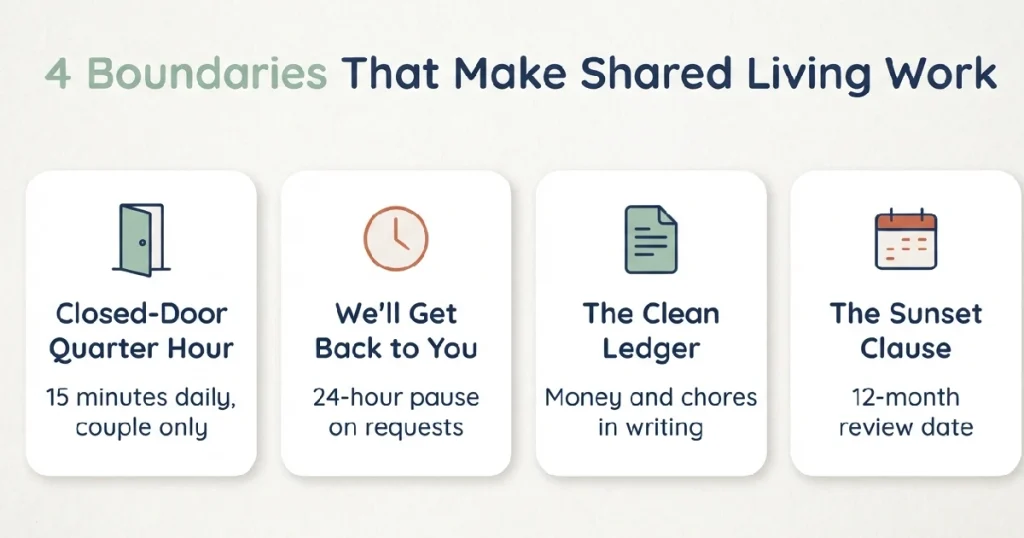
These four moves turn goodwill into working boundaries.
1. The Closed-Door Quarter Hour
Fifteen minutes daily, couple only, phones down, door shut. Decisions get discussed here before anywhere else. One warm announcement covers it: “We do a 15-minute check-in after dinner, then we’re all yours.” Notice what shifts when the household learns the couple has a standing meeting.
2. The “We’ll Get Back to You” Rule
Any parental request that touches your money, time, or plans gets one default reply: “Let me talk it over with Sam, and we’ll come back to you tomorrow.” Twenty-four hours converts pressure into a decision. It also teaches everyone that “we” answers as a unit.
3. The Clean Ledger
One page: monthly contribution, chore ownership, guest rules, quiet hours, and which help is freely given. Try: “We’d like to put $600 a month plus Saturday groceries in writing, so nobody has to guess or keep score.” A quarterly review keeps it current, before resentment does the reviewing for you.
4. The Sunset Clause
Consider setting a review date before you unpack, say twelve months out, plus one measurable goal like $18,000 saved. Script: “Let’s treat year one as a trial. If either of us wants our own place by June, we move, no debate.” A pre-agreed exit turns a potential power struggle into a shared plan.
Frequently Asked Questions
Is it normal to feel like a guest in your own home?
Common, and fixable. It usually means the house still runs on your parents’ rules; ask for one zone, your room and your decisions, to be treated as fully yours.
How do we move out without hurting my parents?
Lead with thanks and a concrete plan: “This year built our savings, and we’re ready for our own place. Sunday dinners stay sacred.” Parents accept exits far more easily when the exit keeps a ritual.
Can living with in-laws save a shaky marriage?
No. Support stabilizes logistics, and it can even mask problems by removing daily friction. If the bond itself is strained, seek couples therapy before sharing walls.
Back to that kitchen, the rewashed pan, the tightened jaw. You now hold a map for that moment: name the triangle, answer your spouse first, take the decision behind the closed door for fifteen minutes.
Couples who thrive treat living with family after marriage as a tool with written terms, a review date, and one clear center of gravity. You get to write those terms.
A strong marriage can share its address. It just never shares its throne.
My Closing Remarks
I’ve watched this arrangement quietly fund a first home and quietly strain a good one. The deciding factor, almost every time, was whether two adults kept choosing each other in small, visible ways. If you take one thing from me, take the quarter hour. Fifteen protected minutes will tell you more about your future than fifteen family opinions ever will.
David Wall
More Related Stories for You
Before you commit to a shared address, it helps to know how you two handle pressure together. See what our marriage compatibility test reveals about your conflict styles and where you naturally click.
About The Author