
 Elena Garcia
The one styling principle that turns nine pieces of clothing into a wardrobe that actually makes sense.
Key Points
- What is the 3-3-3 rule in fashion? It’s a minimalist styling formula 3 tops, 3 bottoms, 3 pairs of shoes that creates up to 27 polished outfit combinations from just nine pieces.
- The reason the 3-3-3 rule in fashion works isn’t just about math; it’s about how your brain responds to intentional, limited choices, reducing daily decision fatigue and building real confidence.
- Applying the 3-3-3 rule in fashion successfully depends not on restricting yourself, but on choosing pieces with the right color logic, silhouette balance, and lifestyle honesty.
Contents
Table of Contents
You’re Standing in Front of Your Closet Again
It’s 7:42 in the morning. You have somewhere to be by 9. And you’re standing in front of a wardrobe that is, by any objective measure, overflowing.
And yet.
Nothing feels right. One top doesn’t go with those pants. Those shoes don’t match this shirt. That blazer is too formal, and the other one is at the dry cleaner. You feel the quiet frustration building not because you have nothing to wear, but because you have too much of the wrong things.
You end up throwing on the same three combinations you always wear. The ones that just work, without thinking.
Here’s the thing: that instinct is telling you something important.
The Wardrobe Paradox Nobody Talks About
Most of us have been sold the idea that more options equal more freedom. Buy more, have more, choose more. But psychology tells a completely different story. We’re drowning in wardrobe options, yet our closets still echo that age-old cry, “Nothing to wear!” Research suggests the average woman wears only 20% of her wardrobe 80% of the time. That means 80% of what you own is, essentially, visual noise.
This is what psychologists call decision fatigue the mental exhaustion that builds up every time your brain is forced to choose between competing options. It’s a real, documented phenomenon. Every morning, your brain makes small decisions about what to wear, what to eat, and how to style your hair. When you have too many options, you waste both time and energy deciding.
The result? By the time you walk out the door, you’ve already spent a chunk of your mental reserves on something that should take less than five minutes. That’s not a personality flaw. That’s cognitive overload.
And that’s exactly the problem the 3-3-3 rule was designed to solve.
So, What Is the 3-3-3 Rule in Fashion, Exactly?
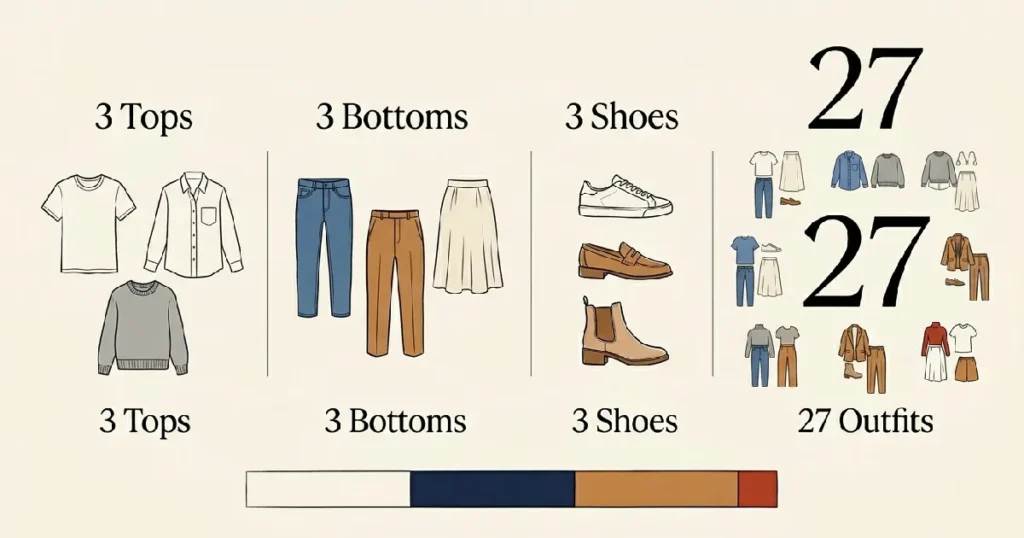
At its core, the 3-3-3 rule is a minimalist fashion formula designed to simplify how you get dressed. It involves selecting 3 tops, 3 bottoms, and 3 pairs of shoes that can be mixed and matched to create a functional, stylish micro-wardrobe.
The math is surprisingly satisfying. Because the combinations quickly add up: 3 tops × 3 bottoms × 3 shoes = 27 unique looks.
Twenty-seven outfits. From nine pieces. Without stress, without guessing, and without staring into the abyss of a stuffed closet every single morning. It’s about clarity, not restriction. When you narrow your options, you concentrate on fit, comfort, and your own style rather than the latest trends or snap decisions.
But here’s what no one tells you about this rule.
The number isn’t the point. The intention behind the number is.
Why the Brain Actually Loves This Rule
A 2014 peer-reviewed study published in PLOS ONE by researchers at Duke University and Carnegie Mellon University found something fascinating. Studies reveal a robust quadratic effect, such that maximum fashionableness is attained when outfits are neither too coordinated nor too different. In other words, fashionable outfits are those that are moderately matched, not “matchy-matchy” or “clashing.” This balance of extremes supports a broader hypothesis regarding aesthetic preferences the Goldilocks principle that seeks to balance simplicity and complexity.
In plain language: your brain is wired to find beauty in intentional, moderate balance. Not chaos. Not uniformity. The 3-3-3 rule creates exactly that sweet spot. Fashion psychologists say people who follow simple wardrobe systems often feel more confident. They don’t worry about their looks every day because they already know everything in their closet fits well and feels good.
This is the part most articles skip over. They treat the 3-3-3 rule as a packing trick or a minimalism challenge. But it’s actually a confidence system dressed up as a styling formula.
The 3 Things That Make or Break Your 3-3-3 System
Here’s where it gets interesting and where most people go wrong.
1. Your Colors Have to Speak the Same Language
You can follow the 3-3-3 formula perfectly and still end up with outfits that look chaotic if your pieces don’t share a color logic. The 3 Color Principle is a styling guideline that says your outfit should stick to no more than three colors at a time. The idea is simple: fewer colors mean a cleaner, more put-together look. Instead of your outfit screaming ten different things at once, three colors keep everything cohesive and visually balanced.
When building your 3-3-3 capsule, think in terms of color roles. Those three colors break down into specific roles: a dominant color the main shade that covers the most surface area, think your trousers, dress, or base layer. And a secondary color a supporting shade that complements the dominant one. Then, your accent: one pop of personality through a shoe, a belt, or a bag.4 Stick to neutrals like mocha, cream, grey, black, and navy for maximum mixing potential. One accent color is fine, but your capsule should flow together without jarring contrasts.
Think of your wardrobe like a sentence. Each word matters. But if every word shouts, nobody can read the sentence.
2. The Cuts Have to Complement Your Body, Not Just Each Other
This is the gap that social media styling content almost always misses. The simplicity of the rule is also its biggest weakness. It often fails when the foundational principles of styling are ignored. Your 27 potential outfits will fall flat if the colors don’t relate a random assortment of colors, even if you like them individually, will clash when combined.
But it goes deeper than color. The cuts have to flatter your body. A trendy pair of low-rise jeans or a boxy jacket might look great on a mannequin but may not work for your unique shape.
The 3-3-3 rule rewards you for knowing yourself. When you know your silhouette, your proportions, and what actually flatters your frame not what’s trending on a 5’11” model the formula stops being a limit and starts being a superpower.
In my work with clients over the years, the single biggest breakthrough isn’t finding the right pieces. It’s learning to stop buying pieces that only look good on hangers.
3. Your Capsule Has to Match Your Real Life, Not Your Dream Life
This is the insight that changes everything. Your capsule should reflect your actual life, not aspirational Pinterest boards. If you work from home most days, prioritize comfortable pieces over formal trousers. Be honest about what you truly need.
Think about Maya. She’s a 34-year-old graphic designer who spent years buying structured blazers she never wore and heels that lived untouched in boxes. When she finally built a 3-3-3 capsule based on her actual week remote work, weekend brunches, occasional client meetings everything changed. Getting dressed became something she looked forward to instead of something she dreaded. She didn’t just save time. She stopped feeling like a stranger in her own closet. Fashion should fit your life, not make your life harder. The 3-3-3 rule is designed to help you do just that.
The “Insight Differentiator”: What the Rule Teaches You About Yourself
Here’s a perspective you won’t find in most styling guides.
The 3-3-3 rule isn’t just a wardrobe strategy. It’s a self-knowledge exercise.
When you force yourself to choose only nine pieces, you have to ask real questions. What do I actually wear? What makes me feel like me? What am I buying for the life I have, versus the life I imagine? Most people discover that the clothes they reach for instinctively the ones that feel like a second skin already number around nine. The rest is just noise you’ve been paying rent to store. The rule is also a form of self-expression. When your wardrobe is small but thoughtful, every piece shows your personal style. Instead of chasing every new trend, you learn what fits your personality best.
That’s not minimalism as deprivation. That’s minimalism as self-respect.
How to Actually Build Your 3-3-3 Capsule: Starting Today

Here are four practical moves you can make right now.
The Honest Edit. Pull out every item in your closet. Now ask: “Would I reach for this in the next two weeks?” If the honest answer is no, it doesn’t earn a spot. This isn’t about being ruthless it’s about being real.
The Color Anchor Method. Choose one neutral that will anchor everything. Black, navy, camel, or cream work for most people. Then select your pieces so that every single one can pair with that anchor color. This alone eliminates 80% of the “it doesn’t go with anything” problem.
The Three-Occasion Test. Before adding a piece to your 3-3-3 capsule, ask: “Can I wear this in at least three different contexts casual, smart-casual, and one step up?” The 3×3 dress-up challenge involves taking your nine wardrobe pieces and intentionally building three distinct dressed-up looks from them: one casual, one smart-casual, one polished. If a piece only works in one setting, it’s a supporting character, not a lead.
The Lifestyle Reality Check. Write down your actual week. Not your ideal week. Your actual week. Choose pieces that share a cohesive color palette, similar levels of formality, and compatible silhouettes. Neutrals and classic pieces work best tailored trousers, straight-leg jeans, structured blazers, and simple tops that layer cleanly. Then build your capsule around what that week actually requires.
A useful question to ask yourself: “Am I dressing for my life, or for a life I haven’t lived yet?”
One place to start is simply laying out the nine pieces you already own and reach for most often. They’re already there. You just haven’t called them your capsule yet.
You Already Know What Works
Here’s the close-up view of what you now have.
You understand that the 3-3-3 rule isn’t about having less it’s about having better fashion as a man or woman through deeper intention. You know that the concept is far more than a fleeting internet trend it is a fundamental shift in how society views clothing. You understand the psychology behind why fewer, better choices produce more confidence than an overstuffed closet ever could.
And here’s the final reframe worth keeping.
Your wardrobe is not a collection. It’s a daily conversation between who you are and how you want to show up. The 3-3-3 rule just gives you the grammar to say it clearly.
Style was never about having more. It was always about knowing yourself well enough to need less.
My Closing Remarks:
I’ll be honest with you the way a friend would be and not the way a stylist with a commission check would be. I’ve watched people spend thousands of dollars trying to fix a wardrobe problem that was never about money. It was about clarity. The mornings you spend staring at your closet aren’t a fashion problem. They’re a self-knowledge problem. The 3-3-3 rule doesn’t just organize your clothes. It quietly asks you to organize your sense of self. And that, genuinely, changes everything.
More Related Stories for You:
- Struggling to put together outfits that feel authentically you? Whether you’re building a capsule from scratch or just tired of outfits that don’t land, this guide on how to have better fashion as a man is a strong next read grounded, practical, and built for real life, not runways.
About The Author