Sara Carmen

Unpack the conversations that actually keep couples together, from bank accounts and chores to family boundaries and conflict styles.
Key Takeaways
- These questions to ask your partner before marriage expose the real friction points, like money, chores, and in-laws, before they turn into years of quiet resentment.
- Couples who actually sit down and work through questions to ask your partner before marriage build a shared operating manual instead of hoping things just work out.
- The one topic almost everyone skips, digital boundaries, is quietly breaking more engagements than anyone wants to admit.
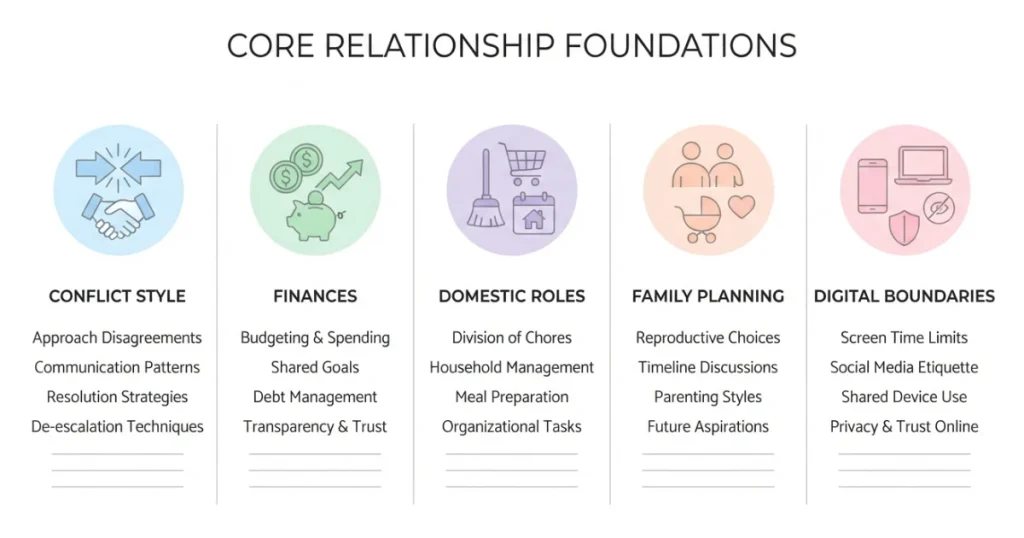
Quick Answer: The best questions to ask your partner before marriage cover five areas: conflict style, money, domestic workload, family planning, and digital boundaries. These conversations show how a couple actually functions under stress, not just how they feel about each other, and that distinction predicts long term marital stability far better than compatibility quizzes do.
Contents
Table of Contents
Chemistry Got You Here. It Won’t Get You Through Year Ten.
We spend months picking the font for wedding invitations. We debate seating charts, cake flavors, and the exact shade of blush for bridesmaid dresses.
Meanwhile, we rarely spend even one evening discussing how we’ll handle a surprise medical bill, a depressed spouse, or a mother-in-law who shows up unannounced.
If you’re deep in wedding planning right now, pause for a second. The wedding is one day. The marriage is every day after it.
Psychologists call this the difference between “surface compatibility” and “operational compatibility.” You can adore the same movies and still fall apart over who manages the grocery budget.
This article gives you the real conversations, the ones that quietly determine whether a marriage holds up when life gets hard. Read through all 20, and you’ll walk into marriage with far fewer blind spots than most couples ever bother to remove.
Deep Questions to Ask Your Partner Before Marriage: The Emotional and Conflict Framework
Why conflict style predicts the marriage, not the fight itself
John Gottman’s decades of marital research found something counterintuitive. Most couples never resolve their biggest disagreements. Gottman calls these “perpetual problems,” and roughly 69 percent of marital conflict falls into this category (Gottman & Silver, 1999).
The marriages that survive aren’t the ones without conflict. They’re the ones where both partners understand each other’s stress response well enough to stop making things worse.
Here are the five questions that surface that pattern before the wedding, not three years into it.
- When we enter a high-stress conflict, what does your emotional cycle look like? Do you flood and withdraw, or become anxious and demand immediate resolution?
- What are your personal decompression needs after work or social events, and how do we keep that need for solitude from feeling like rejection?
- What’s our agreed protocol if one of us feels emotionally disconnected or sexually unsatisfied for longer than a month?
- What past trauma or family wound are you still actively processing that I need to handle with extra care?
- At what specific point do we commit to seeing a licensed marriage counselor instead of letting resentment quietly build?
The 48-Hour Rule
One practical tool worth testing before the wedding is a time-out protocol. Either partner can call for a pause during an escalating fight, as long as they name a return time within 48 hours.
This prevents the classic Gottman pattern of flooding, where a partner’s heart rate spikes past 100 beats per minute and rational conversation becomes physically difficult. It also prevents the withdrawal from feeling like abandonment, because there’s a promised return.
Financial Questions to Ask a Partner Before Marriage: Building Real Transparency
Why money fights aren’t really about money
Research compiled by the American Psychological Association consistently links financial disagreement to one of the strongest predictors of divorce, often outranking fights about in-laws, sex, or household chores. The reason isn’t the dollar amount. It’s what money represents: security, control, and whose values get prioritized.
Couples who disclose their full financial picture before marriage remove the single most common source of betrayal that surfaces later: the debt or liability nobody mentioned.
- What is your complete, unvarnished financial picture: debts, credit score, savings, and anything undisclosed?
- Will we combine finances fully, keep separate accounts, or split shared expenses proportionally to income?
- What’s our specific dollar threshold for individual purchases that need zero spousal consultation?
- How do we view a prenuptial agreement, as an estate-protection tool rather than a prediction of failure?
- How do we balance aggressive long-term saving with enjoying life now, and what lifestyle items are non-negotiable for each of us?
The Discretionary Spending Ceiling
Pick a number together, anywhere from $100 to $500 depending on your combined income. Below that number, no check-ins required.
Above it, a two-minute heads-up conversation happens first. This single rule eliminates most of the secret purchases that quietly erode trust, while still protecting each partner’s independence.
Important Questions to Ask Your Partner Before Marriage on Domestic Equity and Family Life
The invisible workload nobody puts on a registry
Pew Research Center data on modern households shows that even in dual-income couples, women still disproportionately carry what researchers call the “mental load,” the ongoing cognitive task of remembering, scheduling, and anticipating household needs. This imbalance, more than any single argument, is what erodes long-term domestic harmony.
The fix isn’t a chore chart. It’s clarity on who owns which outcome entirely.
- How will we divide domestic management so neither of us becomes the unpaid home manager by default?
- What are our non-negotiables on having children, how many, and what we’re willing to pursue if we hit fertility roadblocks?
- If we raise children, what discipline style, education approach, and spiritual framework will we actually commit to?
- What boundaries will we set with in-laws around unannounced visits, financial involvement, and holiday schedules?
- When our parents reach advanced age, what’s our actual plan: home care, assisted living, or moving them in?
The Closed-Loop Ownership Model
Assign full ownership of specific domains, not just tasks. One partner owns “laundry,” start to finish, including noticing it needs doing.
This single shift eliminates what researchers often describe as weaponized incompetence, where one partner technically helps but never initiates, keeping the mental load lopsided.
Questions to Ask Your Partner Before Marriage About Digital Boundaries and Life Crises

Modern fidelity looks different than it did twenty years ago
Attachment theory, first developed by psychologist John Bowlby, explains why emotional security matters as much as physical fidelity. A partner who feels emotionally abandoned through secretive texting or hidden online relationships experiences a very real threat response, even without physical contact involved.
Pair that with the unavoidable crises every marriage eventually faces: job loss, illness, burnout. These questions prepare you for both.
- What specific behaviors count as micro-cheating or emotional infidelity in our relationship?
- What are our expectations around privacy and device access? Is an open-phone policy transparency or a boundary violation?
- How would we handle sudden job loss or long-term disability, and how long could our emergency fund actually sustain us?
- If one of us faces chronic illness or severe burnout, what does compassionate caregiving look like without burning out the relationship too?
- Under what specific circumstances would either of us consider this marriage broken beyond repair?
What to Do With These 20 Questions Starting This Week
Reading the list is step one. Actually using it requires a little structure, so here are four ways to begin.
The Coffee and Alignment Date. One place to begin is scheduling a recurring weekly date, just four questions per session, over five weeks. Keep phones away and treat it like a working meeting, not a casual chat.
The Non-Defensive Opener. Consider starting hard questions with, “I’m asking this because I want us to be ready, not because I’m worried about us.” This single sentence lowers defensiveness before the conversation even starts.
The 48-Hour Time-Out Script. When a conversation gets heated, try saying, “I need a pause, and I promise we’ll pick this back up by tomorrow evening.” Naming the return time is what makes this work.
The Discretionary Spending Ceiling Setup. Sit down with both your last three months of bank statements and agree on one shared number together, in writing if it helps.
None of these require a certification or a therapist’s office, though a licensed counselor can absolutely help if a specific topic keeps stalling out. The goal isn’t a perfect score. It’s walking into marriage with far fewer unknowns than the couple sitting next to you at the reception.
Frequently Asked Questions
What if my partner refuses to answer these questions seriously?
A pattern of avoidance on serious topics is itself useful information. It often signals conflict avoidance that will resurface later, and a premarital counselor can help open that conversation safely.
When should we actually have these conversations, before or after getting engaged?
Earlier is better. Financial and family-planning questions in particular are worth addressing before a ring enters the picture, since they can genuinely change the decision to marry.
Can we really cover all 20 questions in just a few sessions?
Yes, if you treat it as an ongoing practice rather than a single marathon talk. Four questions a week across five weeks, as outlined above, keeps each conversation focused and manageable.
You Now Have the Map Most Couples Never Get
Remember the wedding planning comparison from the start of this piece? The flowers, the fonts, the seating chart debates?
None of that determines whether a marriage lasts. These twenty conversations do.
A good marriage isn’t built on finding someone with zero flaws. It’s built on two people who already know exactly how to handle each other’s hardest moments, because they talked about them first.
My Closing Remarks
I’ve sat with enough couples to know that avoiding hard questions doesn’t protect a relationship, it just delays the conversation to a worse moment. The couples who do this work early aren’t less in love. They’re just more honest about what love actually requires long term. Take it slow, be kind in how you ask, and trust that real intimacy grows from these talks, not in spite of them.
More Related Stories for You
If you’re ready to go deeper, this comprehensive guide to preparing for marriage emotionally and financially walks through the full framework beyond just these 20 questions.
About The Author