Sara Carmen

Intensity is easy to fake. Steadiness is harder. Here are six signals that show which one is sitting across from you.
Key Takeaways
- The clearest split between love bombing vs genuine interest appears after a small no, in the 48 hours that follow.
- Hot-and-cold attention runs on the same reward schedule as a slot machine, so feeling hooked proves nothing about their intent.
- Grand declarations cost nothing. Kept small plans cost effort. Judge the calendar, not the compliments.
Quick answer: Love bombing is flood-level affection that pressures you to commit fast and turns cold when you set limits. Genuine interest is steady, specific attention that respects your pace, survives small friction, and builds through kept promises. The difference shows in patterns over weeks, never in intensity on day one.
Contents
Table of Contents
Three weeks in, your phone hums before your alarm. Good-morning paragraphs, a surprise delivery at your office, dinner booked at a restaurant you mentioned once. It feels like being chosen. So why does a small, stubborn part of you keep bracing?
That bracing deserves a hearing. Early romance lights up the brain’s reward circuitry in everyone, so intensity alone can’t tell you who is safe. The quieter signal is friction: what happens after a declined invite, a slow reply, a stated limit. Control tightens; care adjusts.
Here you’ll find six observable signs, the mechanism that makes confusion feel like chemistry, and four low-drama tests that turn guesswork into evidence within a month.
Why Love Bombing Feels Like Chemistry: The Slot-Machine Effect
The term love bombing started with cult recruiters in the 1970s, who showered newcomers with instant belonging. The goal was compliance, and affection was the bait.
Modern dating inherited the pattern, and your reward system can’t tell the difference. Psychologists call it intermittent reinforcement: rewards arrive unpredictably, on what Ferster and Skinner (1957) named a variable-ratio schedule, the pattern that produces the steadiest, hardest-to-extinguish behavior of any reward arrangement. Slot machines run on it. So does a partner who sends twelve hearts on Monday and goes silent on Tuesday.
Your body reads that uncertainty as arousal. Racing thoughts, phone-checking, relief when they resurface: all of it feels like passion, and much of it is a reward system stuck in overdrive.
So “it feels intense” belongs nowhere on your evidence list. Intensity is the cheapest thing to manufacture. Ask a sharper question: what does their warmth do when it doesn’t get paid?
Love Bombing vs Genuine Interest: 6 Signs That Hold Up in Real Life

Speed gets all the headlines, yet plenty of healthy couples moved fast, and plenty of slow burns turned controlling. When weighing love bombing vs genuine interest, track function over pace: what the behavior does, week after week.
| Signal | Love bombing | Genuine interest |
|---|---|---|
| A small no | Guilt, coldness, scorekeeping | Adjusts without penalty |
| Attention | Scripted grand gestures | Recalls your actual specifics |
| Plans | Vague grand futures, flaky days | Small plans, kept |
| Audience | Warmest in public or on cue | Identical in private |
| Your off days | Treated as inconvenience | Turns toward you anyway |
| Conflict | Resets with gifts | Repairs the specific rupture |
Sign 1: A Small No Changes Their Temperature
Decline one low-stakes thing: a night out, a daily call, an early weekend plan. Then watch the next two days. Genuine interest renegotiates and stays warm.
Love bombing treats the no as an injury to punish or overwhelm: sulking, guilt (“after everything I’ve done”), or a gift flood that makes declining feel rude. The mechanism is compliance testing. Every boundary you withdraw teaches them how much access they can take next.
Sign 2: Their Attention Follows a Script, Not Your Specifics
Love bombing tends to be generic and cinematic: dozens of roses, a public declaration, a pet name assigned in week one. Genuine interest is oddly specific.
They remember your sister’s exam date, skip the cilantro you hate, ask a follow-up about the story you told twice. Researchers call this perceived partner responsiveness, and it’s the engine of real intimacy. Run a quiet audit: name three things they know about you that they could only know by listening.
Sign 3: Big Futures, Flaky Thursdays (Future Faking)
Future faking is the tell: marriage talk at week three, dream vacations named before your first disagreement, yet dinner plans evaporate on the day. The grand future buys your commitment now at zero cost to them.
Genuine interest plans in verifiable increments: a specific Thursday, honored, then another. Track kept small plans for a month. Three cancellations with vague reschedules outweigh any soulmate speech.
Sign 4: The Warmth Needs an Audience
Notice where the affection happens. Love bombing peaks where it earns something: in front of your friends, on social media, right after you pull away. Ordinary private moments get the leftovers.
Genuine interest looks the same with no witnesses, because connection is the point. Simple comparison: how do they treat you on a quiet Tuesday versus at your friend’s party? Same person, or two?
Sign 5: Your Bad Days Read as Inconvenience
Anyone can be delightful during the honeymoon phase. The diagnostic moment is your flat mood, your family drama, your boring story told twice. Gottman’s lab calls these small offers of attention “bids,” and turning toward them in everyday life tracks with how warmly couples handle conflict later (Driver & Gottman, 2004).
Love bombing skips bids that pay nothing. Genuine interest turns toward you even when you’re temporarily unimpressive.
Sign 6: Conflict Resets Instead of Repairs
After a rupture, study the shape of the apology. A reset sounds like “let’s forget it happened” plus a grand gesture, and the same wound reopens in two weeks.
A repair names the specific thing: “I mocked your job at dinner; that was dismissive, and I won’t repeat it.” Then behavior changes. Resets erase the receipt. Repairs pay it.
When Fast Intensity Is Innocent: Attachment, Distance, and Culture
Mislabeling enthusiasm costs people good relationships, so hold your verdict loosely. A few situations muddy the water.
Anxious attachment. Bowlby’s attachment research describes how some people protest distance loudly: double texts, reassurance loops, panic when you go quiet. It can look like pressure, yet it responds to calm consistency. Offer a predictable rhythm (“I’ll call every night after work”) and watch it settle across two weeks.
Hyperfocus. Some people, including many with ADHD, lock onto new partners with blazing attention. That intensity reflects an attention style rather than a strategy, and it still has to pass the small-no test.
Long distance. Text compresses intimacy. Six weeks of daily messages can manufacture a closeness that in-person pacing would spread over months. Weigh the video-call version of them, plus how they handle your delayed replies.
Culture and faith. Some communities court quickly toward marriage with families involved. Speed with transparency and accountability reads differently from speed with isolation.
One test unifies all four: ask to slow down a notch. Innocent intensity flexes and stays kind. Control stiffens, argues, or punishes. Give patterns six to eight weeks before verdicts; novelty fades on roughly that clock, and routine starts telling the truth.
What to Do Next: Four Low-Drama Tests That Give You Real Data
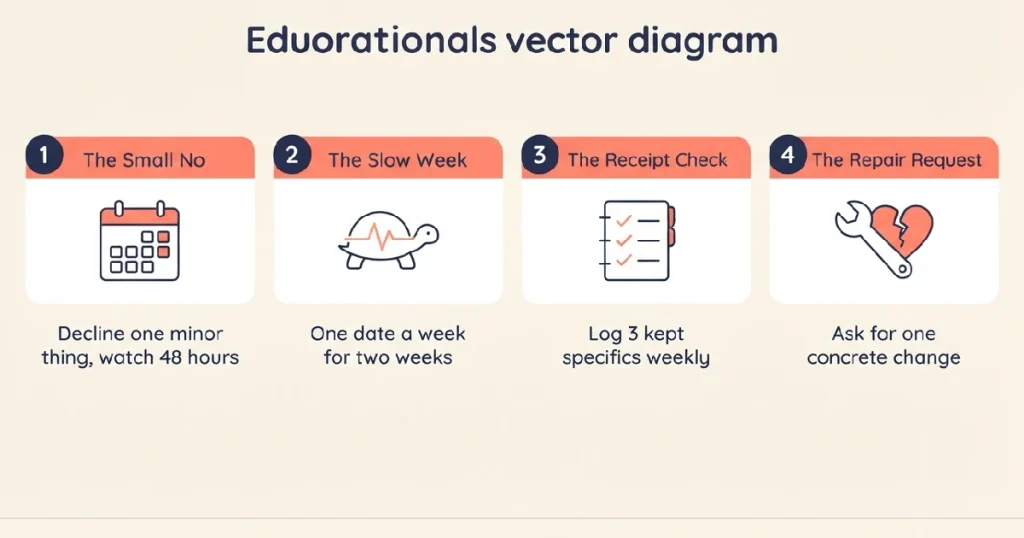
One place to begin is treating the next month as a quiet experiment. No confrontations, no ultimatums. Each test takes under a minute to run, and the observations do the rest.
1. The Small No
Decline one minor thing this week and change nothing else. Script: “I like seeing you. Sunday’s my recharge day, so let’s do Tuesday instead.”
Observe for 48 hours. Warmth that survives the no is data. Guilt, silence, or a sudden gift flood is data too.
2. The Slow Week
Propose one notch less intensity for two weeks. Script: “I’m enjoying this, and I want my weeknights back for now. Can we try one date a week and see how it feels?”
Notice what shifts. Someone interested in you will miss you and adapt. Someone invested in control will argue with your calendar like it owes them money.
3. The Receipt Check
Once a week, log three specifics: a detail they remembered unprompted, a small plan they kept, a moment they read your mood without being told. Three receipts a week for three weeks beats a hundred compliments. If the page stays empty while the grand gestures pile up, believe the page.
4. The Repair Request
Name one small hurt and request one concrete change. Script: “When you joked about my job at dinner, I felt small. Please keep that topic private.” Watch for a specific apology plus changed behavior within two weeks. “Sorry you feel that way” followed by roses is a reset, and resets recycle.
Reading your results:
- If warmth survives the no and repairs land specifically, proceed at a pace you choose.
- If two or more tests show punishment, scorekeeping, or vanishing warmth across a month, treat the pattern as your answer, and lean on friends or family before deepening commitment.
- If saying no triggers monitoring, threats, or sexual pressure, this leaves dating territory. The National Domestic Violence Hotline (1-800-799-7233) helps people plan safely, free and confidentially.
Frequently Asked Questions
Can love bombing be unintentional?
Yes. Anxious attachment and plain excitement can produce flood-level attention with zero intent to control. The dividing line is feedback: unintentional intensity softens when you ask, while control escalates.
How soon is too soon to say “I love you”?
There’s no universal clock. Watch what the words demand. Words that leave your pace alone share a feeling; words that require instant exclusivity, keys, or loyalty proofs propose a transaction.
Is every love bomber a narcissist?
No. The behavior overlaps with narcissistic patterns (our guide to characteristics of a narcissistic man maps the wider cluster), yet insecure attachment and learned habits produce it too. Judge the pattern; a diagnosis adds little to your decision.
Back to that phone humming at 6 a.m. You no longer need to decode every heart or stage a confrontation. You have six signals, four quiet tests, and permission to let evidence outrank adrenaline.
If the warmth is real, it will survive your Sunday no, your ordinary Tuesday, your specific repair request. If it isn’t, you’ll know in weeks instead of years.
You never have to trade your pace to keep someone’s warmth.
My Closing Remarks
Here’s what I want for you, honestly: fewer sleepless nights spent decoding texts at 2 a.m. The people worth your time make your nervous system quieter, not louder. If this piece handed you one usable sentence for a hard conversation, use it this week, while the moment is fresh. And if your gut has been bracing for a while, consider this permission to trust it, then verify.
Sara Carmen
More Related Stories for You
Ever wondered what the silence means after a breakup? Read why your ex suddenly deleted you everywhere for the psychology behind the vanishing act.
About The Author