Nicole Adkins

You already tried positive thinking. It didn’t stick. Here’s the real reason why, and the fix that actually works.
Key Takeaways
- Thinking negative isn’t a character flaw, it’s a habit loop with a reward, and you can map that reward in a week.
- Self compassion isn’t the soft option, its actually the thing that makes any reframe believable to your brain.
- You don’t need to delete the thought. You need to shrink the time it takes you to notice it and walk away from it.
Quick Answer: Thinking negative becomes a loop because the brain treats worry as useful, a false sense of control instead of a real solution. Breaking it isn’t about blocking the thought. It’s about naming it, softening your self talk, interrupting it through the body, and tracking how fast you recover, not whether it ever shows up again.
Contents
Table of Contents
You’ve Tried to Just “Think Positive.” It Didn’t Work. Here’s Why.
We’ve all sat there at 11pm running the same thought on repeat. Did that text mean something. Did I say the wrong thing in that meeting. Why do I always do this.
You tell yourself to just be positive. For about four minutes it works. Then the loop comes back, louder, heavier, more convincing then before.
Here’s the thing nobody tells you. This isn’t a willpower problem. It’s a mismatch. You’re using a tool built for isolated bad moods on something that’s actually a learned habit loop, running on autopilot, with its own reward system underneath it.
That reframe changes everything about how you fix it.
This article isn’t going to give you another list of cognitive distortions you already half know. It’s going to walk you through seven secrets that work on the mechanics, the actual wiring, not the surface content of the thought. If positive thinking worked on its own, you wouldnt still be reading this.
The first secret is the one almost every other article on this topic skips completely.
Secret 1 & 2: Stop Fighting the Thought, Change What You Do With It
The Mechanism
Most advice tells you to notice the thought, question it, replace it. Fine in theory. But it quietly frames the thought as an enemy, something to defeat.
If you’ve ever had a thought get louder the harder you tried to push it away, you already know why that backfires. Suppression creates a rebound effect. Your brain starts monitoring for the thought’s absence, which keeps it circling.
The better move, borrowed from Acceptance and Commitment Therapy, is decoupling. You separate the thought from the emotional reaction it triggers. A thought is just a mental event. It is not a command you have to obey.
The Scenario
Take Mark. Every time his boss sends a short, one line email, Mark’s brain runs the same loop. “I’m getting fired. I messed something up.” It doesn’t arrive as a sentence first, it arrives as a pit in his stomach before he even has language for it.
Mark used to argue with the thought, trying to prove it wrong with logic. That kept him stuck in it for hours. Then he tried something different. He labeled it. “This is my brain running the ‘I’m in trouble’ loop again.” Nothing more.
The Information Gain
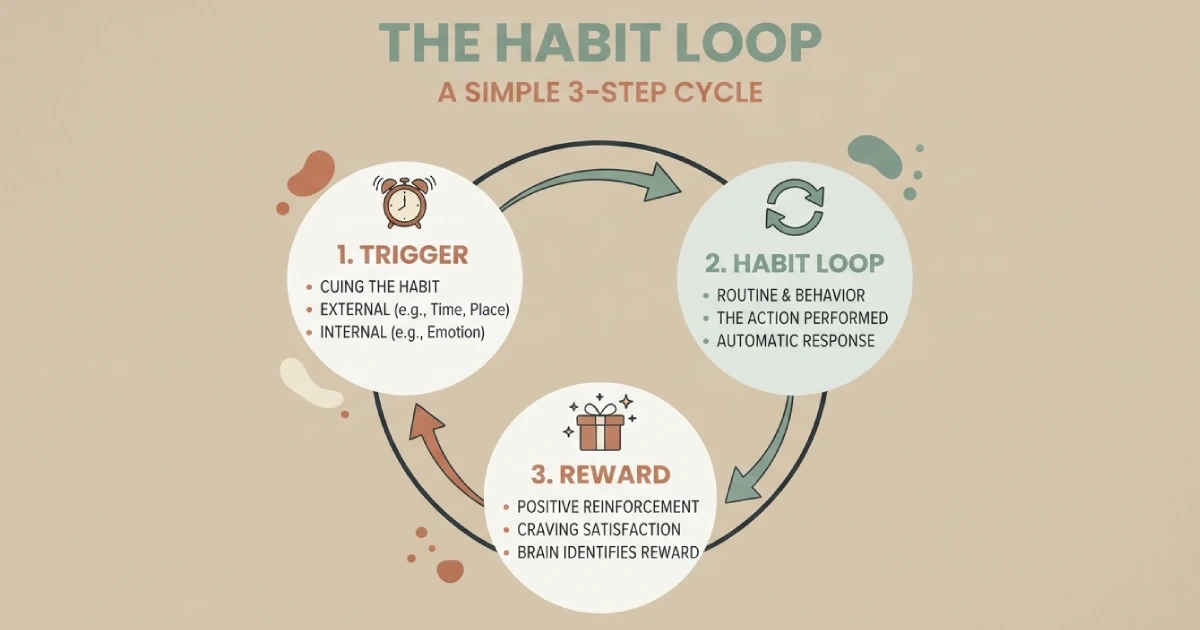
That label creates a fractional pause, just enough space to interrupt the automatic chain before it snowballs. Research on acceptance based interventions for intrusive thoughts shows this kind of non engagement, not analysis, is what actually lowers the emotional charge over time.
Underneath that labeling skill sits the real target: the habit loop itself. Trigger, loop, reward. The trigger is usually a small ambiguity, a flat tone, a delayed reply. The loop is the rumination. The reward is sneaky, it’s a false sense of control, a feeling that worrying equals doing something.
Keep a loop log for a week. Three columns. Trigger, thought loop, what it gave me. Most people are shocked to find the loop isn’t random. It’s serving a function every single time.
Secret 3: Self Compassion Is Not Softness, It’s the Switch
The Mechanism
Mayo Clinic and most health sites mention self talk like it’s a nice bonus. It’s not a bonus. It’s the hinge the whole door swings on.
When your underlying self relation is punitive, your brain rejects a forced positive statement outright. It contradicts what you already believe, so it reads as a lie. Self compassion lowers the threat response enough that a reframe can actually land instead of bouncing off.
The Scenario
Sarah kept telling herself “I am amazing” after messing up a presentation. It felt hollow every single time, because her brain didn’t believe it. So she tried something smaller. “This is hard. It makes sense my mind went there.” Then, only after that, “I’m struggling with this, and I’ve handled things like it before.”
The Information Gain
That second sentence is believable because it’s specific and honest instead of inflated. This is the actual bridge from negative thinking to positive thinking that most articles describe but never show you how to build. Studies connecting meditation practice to lower repetitive negative thinking point to self-compassion as the key mechanism, not a side effect.
Soften before you swap. That’s the whole rule.
Secret 4: Use Your Body Before Your Brain Catches Up
The Mechanism
The emotional surge behind thinking negative has a short half-life if you don’t keep feeding it with more thinking. The body is faster than cognition, which makes it a better entry point for interruption than trying to out-think your way free.
The Scenario
When the loop hits, don’t try to reason with it. Press your feet into the floor. Hold something textured. Feel the tightness in your jaw or chest without narrating it in words.
The Information Gain
Ninety seconds is usually enough for the wave to crest and fall if you don’t add new fuel. This matters even more for intrusive thought patterns, where the content of the thought is irrelevant. The reaction is the actual target, not the story.
Secret 5 & 6: Ask Better Questions, Build a Better Environment
The Mechanism
“Why do I always think like this” is rumination fuel. It’s abstract and evaluative, which keeps your brain stuck analyzing yourself instead of acting. “How can I respond in the next five minutes” shifts activity toward actual problem solving.
Rumination focused cognitive behavioral therapy research backs this up directly, showing that shifting from abstract to concrete questioning measurably reduces rumination and negative affect.
The Scenario
Write down your next three “why” questions. Rewrite each one as a “how.” The emotional tone shifts almost immediately, it’s a strange but reliable trick.
The Information Gain
Pair that with your environment. Negative thinking is cued externally too, by your phone, a certain chair, a time of night. Add friction to the old cues. Move your phone out of the bedroom. Keep a notebook on your desk for loop logging. Schedule a ten minute “worry window” so your brain learns the loop has a designated time and place, not every waking hour.
Secret 7: Track Recovery, Not Perfection
The Mechanism
Most advice sells a straight line, notice, question, replace, feel better forever. That’s not real life, and when the old pattern returns, which it will, people feel like they failed and quit the whole practice.
The Scenario
The goal was never to stop thinking negative completely. The goal is shortening the gap between noticing the loop and exiting it.
The Information Gain
Track it on your phone. “Loop noticed at ___, exited at ___.” If that gap shrinks from twenty minutes to twelve over a week, that’s success, even if the thought still showed up. This data becomes proof of progress, which motivates a lot more than chasing the impossible goal of never having a bad thought again.
What to Do Next: Five Places to Start

You don’t need all seven secrets running at once. Pick one and let it breathe.
1. The Naming Script. Next time the loop starts, say silently, “This is my brain running the [name] loop again.” Nothing else required.
2. The Loop Log. For seven days, jot down trigger, thought, and what it gave you. Patterns show up fast.
3. The Soften Sentence. Before any reframe, try “This is hard, it makes sense I went here.” Then add a realistic, specific follow up.
4. The 90 Second Anchor. Press your feet to the floor or hold something textured when the wave hits. Ride it out instead of arguing with it.
5. The Gap Tracker. One note on your phone. Noticed at ___, exited at ___. Watch the number shrink over weeks, not days.
Consider testing just one of these for seven days before adding a second.
Frequently Asked Questions
Why does telling myself to “just stop” make thinking negative worse?
Suppression creates a rebound effect, your brain monitors for the thought’s absence, which keeps it active. Acceptance, not force, actually lowers its emotional charge over time.
How long does it really take to break the habit of negative thinking and self talk?
There’s no universal clock, but most people notice meaningful shrinkage in recovery time within four to eight weeks of consistent, small daily practice.
What’s the difference between a negative thought and an intrusive thought?
A negative thought is an ordinary self critical appraisal and usually responds well to reframing. An intrusive thought is unbidden and feels alien to your values, and responds better to non engagement than analysis.
You Were Never Missing Willpower
Remember that loop from the beginning, the 11pm spiral that got louder the harder you pushed. You now have a different map for it.
Name it instead of fighting it. Find what the loop is actually giving you. Soften before you swap the thought. Use your body for ninety seconds. Ask how instead of why. Build friction into the old cues. Track the gap, not the perfection.
Thinking negative doesn’t disappear overnight, and anyone who promises that isn’t being honest with you. But it becomes visible. Interruptible. Smaller than it used to be.
The loop doesn’t have to win just because it shows up.
My Closing Remarks
I’ve sat in that 11pm spiral more times then I’d like to admit, and the thing that finally helped wasn’t trying harder to be positive. It was getting curious about the loop instead of ashamed of it. Pick one secret from this list. Just one. Give it seven honest days and see what shifts, even a little.
More Related Stories for You
If this resonated, you may also want to read our piece on how mindfulness changes your relationship with negative thoughts.
About The Author