
 Nicole Adkins

Why loving someone with NPD feels like holding sand, and what actually helps you breathe again
Key Takeaways
- NPD and relationships often run on a hidden supply economy, where your vulnerable moments get filed away and used against you later.
- A BPD and NPD relationship creates a chemical trauma bond that can feel like withdrawal from a substance when it finally ends.
- Surviving NPD and relationships means giving up the hope that love alone will change him, and replacing hope with boundaries you actually enforce.
Quick Answer: NPD and relationships are shaped by a repeating cycle of idealization, devaluation, cold withdrawal, and a basic lack of mutual empathy over time. Because a partner with NPD struggles with emotional reciprocity, intimacy often turns transactional, built around control and validation rather than genuine closeness or real accountability.
Contents
Table of Contents
The Paradox of Loving Someone with NPD
You remember the beginning. He saw you in a way nobody else ever had.
Then somewhere along the way the floor started moving under your feet and you stopped trusting your own memory of what happened five minutes ago, let alone five years ago. That disorientation is not a character flaw in you. It is a predictable response to a specific psychological pattern.
There is a real difference between a partner who is occasionally selfish and a partner whose entire relational operating system runs on Narcissistic Personality Disorder. Selfish people can feel bad. They can sit with your pain even when it is uncomfortable for them. A partner with clinical NPD struggles to do that consistently, because the architecture underneath is different.
This matters for your daily life because the fix everyone keeps suggesting, more patience, more love, more understanding, will not change the underlying wiring. Survival here starts with a hard admission. You cannot love someone out of a personality disorder.
The Psychological Core: Why NPD and Relationships Struggle With Genuine Intimacy
Lack of Whole Object Relations and Emotional Object Constancy
In healthy attachment, a person can hold two true things at once. Their partner is wonderful and their partner is also late for dinner again.
NPD often disrupts something called whole object relations, the capacity to see a person as good and flawed simultaneously. Without that capacity, a single frustrating moment can flip the entire internal file on you. You go from “beloved wife” to “the enemy” in the time it takes to say “you’re forty minutes late.”
Take Sarah and Mark. Sarah gets stuck in traffic and walks in late for the anniversary dinner Mark planned. Instead of mild annoyance, Mark goes cold for three days, speaking to her like a stranger he barely tolerates.
This is emotional object constancy failing in real time. The relationship history did not shrink in Mark’s mind, it briefly ceased to exist. That is a documented feature in clinical research on pathological narcissism and relationship functioning, not a personal insult invented to punish Sarah specifically.
The Narcissistic Supply Economy: Transaction Over Vulnerability
Intimacy in these dynamics often gets treated like a ledger instead of a gift. Warmth gets issued as payment for admiration received, and withheld as a penalty when supply runs low.
Here is the part most partners do not see coming. Anything you reveal while trusting him becomes data he can use later.
Jenna once told Derek, quietly, that she sometimes feared she wasn’t talented enough for her job. Eight months later, mid-argument about something unrelated, Derek said “maybe you’re just not cut out for success, you said so yourself.”
That is not a cruel accident. It is the supply economy functioning exactly as designed, converting vulnerability into leverage.
The Magnetic Collision: Inside a BPD and NPD Relationship
The Initial Magnetism: Why the BPD NPD Couple Attracts
A BPD and NPD relationship often ignites fast and burns intensely, and there is a reason it is not random chance.
The NPD partner’s grandiose confidence can feel like solid ground to someone with Borderline Personality Disorder, whose sense of self often shifts depending on who they are with. In return, the BPD partner’s intense, focused attention feeds the NPD partner’s need for admiration almost immediately.
Maya and Chris fell into this within weeks. Chris’s certainty about everything felt like safety to Maya, whose identity had always felt borrowed from whoever she loved. Chris, meanwhile, got something rare, a partner who found him endlessly fascinating.
Neither of them was villain or victim here. Two unhealed attachment wounds found each other and mistook intensity for intimacy.
The Volatile Conflict Loop: Engulfment vs Abandonment
Once the relationship stabilizes into routine, the collision point appears. Maya’s fear of abandonment makes her chase closeness. Chris experiences that chasing as pressure, which triggers his defense against shame and loss of control.
Maya reaches for reassurance, Chris reads it as criticism and pulls away. Maya escalates, Chris goes silent. This is where BPD hyper-reactivity meets NPD stonewalling, a dynamic the American Psychiatric Association has documented in research on the neurobiology of emotional dysregulation and personality disorders.
The loudness on one side and the silence on the other are not opposite problems. They are two different nervous systems protecting the exact same thing, a sense of self that feels fragile underneath.
Trauma Bonding and Mutual Splitting in a BPD and NPD Couple
Splitting means thinking in extremes, your partner is either perfect or worthless, with almost nothing in between. In a bpd npd couple, both partners can split at the same time, just from different directions.
This is part of how trauma bonds form in toxic relationships. The brain treats intermittent affection the way a slot machine treats an occasional payout, and the unpredictability is exactly what makes it addictive.
That is why these couples break up and reunite so many times. Walking away does not feel like a decision, it feels like withdrawal, because in a real sense, it is.
The Four Structural Phases of an NPD Relationship Cycle
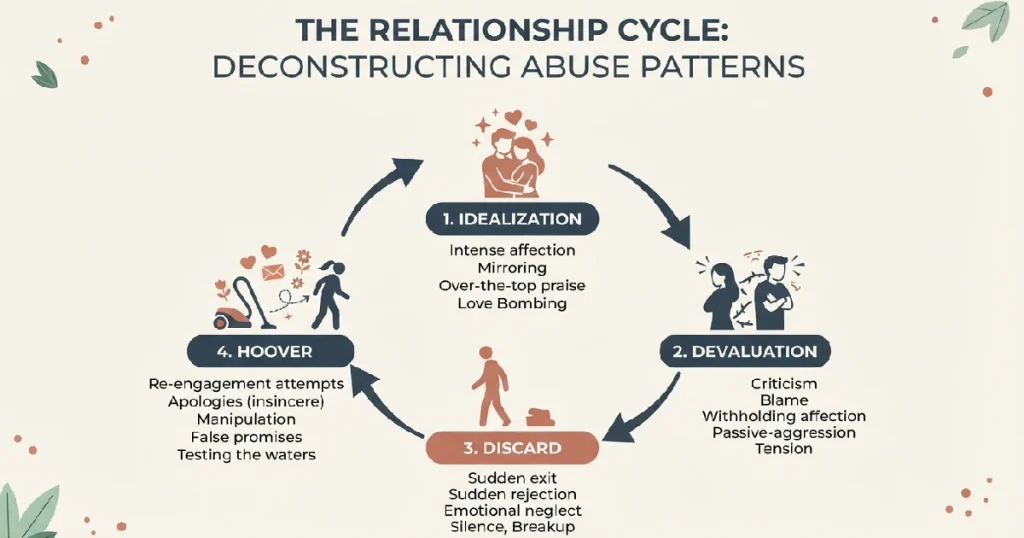
Idealization moves fast, with future talk and statements of soulmate perfection within days. You were not fully seen here, you were cast in a role.
Micro-devaluation creeps in quietly through backhanded jokes and small moving goalposts, until the phrase “you’re too sensitive, I was only joking” becomes familiar.
Discard can happen without anyone leaving the house, through cold detachment delivered right when you need support the most.
The hoover then arrives, dressed up as a crisis or a nostalgic apology. Its real purpose is not reconciliation, it is a test to see if the supply line still works.
Daily Survival Rules: Actionable Protocols
The Reality-Anchored Boundary Ledger
Boundaries here are not announcements you make to him, they are decisions you keep for yourself. One script that works well: “I will not continue this conversation while voices are raised. I’m taking a walk and I’ll be back in one hour.”
Write down what actually happened after arguments, in your own words, in a private note. This single habit protects your memory against chronic rewriting of events.
Low-Engagement Tactics: BIFF and Strategic Detachment
For texts or emails about logistics, try the BIFF method, Brief, Informative, Friendly, Firm. “Pickup is at 4pm Saturday. That works for me. Thanks.” Nothing more is owed.
Avoid the JADE trap, do not Justify, Argue, Defend, or Explain your reasonable requests. You can also build communication scripts for shutting down gaslighting so you are not improvising mid-conflict. Emotional neutrality here is armor, not surrender.
The Path Forward: Reality-Checking the Future
Can someone with NPD change. Rarely, and only through years of specialized psychodynamic or schema therapy with a provider trained for this, not through a few counseling sessions or your unconditional love.
Set your own non-negotiable exit triggers in advance, things like financial ruin, ongoing emotional decay, or any danger to a child’s wellbeing. Decide these while calm, not mid-crisis.
Your sanity is allowed to outrank the relationship.
What to Do Next

Start the Boundary Ledger tonight. Write one private paragraph describing today’s conflict exactly as it happened, before sleep edits your memory of it.
Practice one BIFF response this week. Pick a single logistical text and keep it brief, informative, friendly, and firm, nothing extra attached.
Try the Three-Minute Pause. When you feel pulled into a JADE spiral, say “I need three minutes,” then physically leave the room before responding to anything.
One place to begin is simply noticing which of the four cycle phases you are currently living inside. Naming it correctly is often the first moment your reality stops feeling negotiable.
Frequently Asked Questions
Can a narcissist truly love their partner?
Many people with NPD experience a real, if limited, form of attachment, but it often lacks the consistency and empathy that long-term reciprocal love requires. Love tends to feel conditional on supply, not unconditional on your presence.
Why do I keep going back after a breakup?
Intermittent reinforcement creates a trauma bond that mimics substance withdrawal in the brain. Going back is a chemical pull, not proof you are weak or confused.
Is the BPD and NPD relationship combination always doomed?
Not always, but it requires both partners committed to individual, specialized treatment, not couples work alone. Without that, the engulfment and abandonment loop tends to repeat indefinitely.
You Already Hold the Map
You came here holding the exact confusion we opened with, wondering if the person you fell for was ever real.
He may have been real for a moment, and the structure around him may never let that moment return consistently. Both things can be true.
You are allowed to stop auditioning for someone else’s approval and start trusting what you already witnessed with your own eyes.
My Closing Remarks
I have sat across from so many smart, kind people who were convinced they had simply failed at love. You did not fail. You met a pattern that was never built to meet you halfway.
Take what applies here, leave what doesn’t, and go slow with yourself tonight. You are not too sensitive. You are paying attention.
More Related Stories for You
If you are still untangling what you lived through, this breakdown of the narcissist meaning in a relationship is a solid next read.
About The Author