
 Sara Carmen
How subtle gestures of disgust quietly dismantle intimacy, why contempt predicts divorce, and the exact steps to rebuild mutual respect.
Key Points
- The signs of contempt in marriage often hide inside humor, “honesty,” or ordinary tiredness, until the pattern becomes impossible to ignore.
- Dr. John Gottman’s research found contempt predicts divorce with striking accuracy, making it the single most dangerous habit a couple can develop.
- You’ll learn the exact phrases, facial cues, and internal thought patterns that separate a rough patch from a marriage quietly dying.
Contents
Table of Contents
We all have days when our spouse gets on our last nerve. We snap. We sigh. We say something sharper than we meant to. That’s marriage. That’s being tired, stretched thin, and sharing a life with another imperfect person.
But you know the difference between that and something else. You’ve felt it in your body before your mind found the words for it. There’s ordinary friction, and then there’s the look. The eye-roll that lands like a slap. The sigh that says more than a full sentence could. The joke that leaves you sitting in a room full of people, smiling on the outside while something in you quietly closes a door.
Someone watching from the outside might think your husband is “just blunt.” What they don’t see is the way his mouth curls before he corrects your grammar in front of his mother, for the third time this month.
Someone might think she’s “just stressed from work.” What they miss is the eye-roll she gives every time you open your mouth at dinner, the one she thinks you haven’t caught.
Someone might call it typical dry humor when he mocks your accent or your cooking in front of friends. What no one notices is that you stopped laughing along two years ago.
You’ve tried to brush it off. You’ve told yourself you’re too sensitive, that every couple talks this way, that it’s just his humor or her stress. Here’s the uncomfortable truth: contempt is not a communication style. It’s the strongest predictor researchers have ever found for whether a marriage will end, and it almost never looks like shouting.
In short, contempt is any word, tone, or expression that positions you as superior and your partner as beneath you, whether through sarcasm, mockery, or cold detachment. It differs from anger because it attacks a person’s worth rather than their behavior, and it has been shown to predict divorce with remarkable consistency.
What Contempt Actually Is: Why Psychologists Call It Relationship Acid
Dr. John Gottman spent decades watching couples argue through a one-way mirror, wired with heart monitors, in what researchers now call “the Love Lab.” Out of everything he measured, one behavior stood out as the clearest warning sign of a marriage headed toward divorce court: contempt.
Gottman identified contempt as the most corrosive of what he named the Four Horsemen of relationship collapse, alongside criticism, defensiveness, and stonewalling. Criticism attacks a specific behavior. Contempt attacks the person. It comes from a place of assumed moral, intellectual, or practical superiority, the belief that you are simply better than your spouse. That belief is what makes it so dangerous. You cannot problem-solve with someone you secretly believe is beneath you .
Here’s what most people never realize about how contempt actually forms.
It rarely appears out of nowhere. Contempt is fed by what I call the Resentment Ledger, a private mental tally most people keep without ever saying it out loud. Every unspoken grievance, every “I’ll let that one go,” every night you bit your tongue instead of asking for help, gets quietly entered into that ledger. Nobody balances it. The account just grows. Eventually the ledger gets so heavy that disdain starts leaking out through your face, your tone, your silences, long before you consciously decide to show it.
This isn’t just emotional. It’s biological. Research on hostile marital interaction has found that chronic conflict marked by contempt raises stress hormones and actually slows physical wound healing, evidence that this kind of interaction doesn’t just hurt feelings, it affects the body at a cellular level (Kiecolt-Glaser et al., 2005).
That’s not a minor detail. That’s your nervous system paying the price for a pattern you may not have even named yet.
6 Subtle Signs of Contempt in Marriage Most Couples Miss

Contempt rarely announces itself. It hides inside moments that look, on the surface, like personality or humor. Here are six signs worth paying close attention to.
Weaponized Sarcasm and “Just Joking” Gaslighting
Sarcastic put-downs in marriage often get disguised as affection. “Oh, look who finally remembered how to load a dishwasher.” Said once, it’s a jab. Said for years, it’s a verdict.
The real tell isn’t the comment itself. It’s what happens when you push back. If your spouse responds with “you can’t take a joke” or “I’m just being honest,” that’s the invalidation playbook at work. Instead of owning the sting, they hand the blame back to you for feeling it.
Contempt Body Language: The Micro-Sneer and Eye-Rolling
Facial expression researcher Paul Ekman identified contempt as a universal emotion with one unmistakable signature: a unilateral lip corner pulled up and back, a sneer on only one side of the face. Unlike a smile, it appears asymmetrically, and it happens fast, often less than a second.
Psychologists who study eye rolling in relationship psychology describe it as one of the clearest nonverbal predictors of marital distress because it communicates disdain without a single word being spoken. Add in the scoff, the mocking exhale, or a spouse physically turning their back mid-sentence, and you have a body that has already decided the conversation, and the person having it, isn’t worth its full attention.
The Parental Dynamic and Public Humiliation
“Let me do it before you ruin it.” “Must you always chew like that?” “I married someone with a full brain, where did that person go?”
These lines share one thing in common: they talk to a spouse the way you’d talk to a child who keeps failing a simple task, or an employee you’re seconds from firing. When this shows up specifically in front of family, coworkers, or friends, it stops being a private irritation and becomes public humiliation, a particularly corrosive form of this pattern because it adds an audience to the wound.
Contempt vs. Emotional Abuse: Where Is the Line?
This is the question that keeps people up at night. Is my spouse contemptuous, or am I actually in an emotionally abusive marriage?
The distinction between emotional abuse vs contempt isn’t about how sharp a single comment feels. It’s about pattern, intention, and what happens afterward.
Contempt born from built-up resentment tends to come with cracks of remorse. A partner might snap, catch themselves, and later apologize, even imperfectly. Chronic emotional abuse looks different. It’s calculated, used to maintain control, and rarely followed by genuine accountability. The target is kept off-balance on purpose.
Here’s a simple, honest self-check. When your spouse is calm, not mid-argument, do they acknowledge the impact of their words and attempt to repair it? Or do they double down, reframe your hurt as weakness, and insist they were right to treat you that way?
The first pattern is a relationship with a serious problem that can often be treated. The second pattern deserves a conversation with a licensed therapist about safety, not just communication.
Mara and Dan: When the Sneer Became a Signal
Mara didn’t notice it until her sister pointed it out over Christmas dinner. Every time Mara spoke, her husband Dan’s mouth tightened on one side for just a second before he looked away. Mara had quietly stopped finishing her sentences months earlier without knowing why. In therapy, Dan admitted he’d been keeping score for two years, feeling unseen at home and overlooked at work, and the sneer was years of swallowed resentment finally leaking through his face. Naming it out loud, without blame, became the turning point. Dan started saying “I feel overwhelmed” instead of smirking. Mara started naming what she saw, calmly, instead of absorbing it. Six months later, she says she can finish a sentence again.
The Reversal Protocol: How to Fix Contempt in a Marriage
Here’s what no one tells you.
Contempt can be reversed, but only if both partners are willing to stop rehearsing disdain in private before it ever makes it to their face.
Gottman’s Antidote: Building a Culture of Appreciation
Gottman’s research found that stable couples maintain roughly a five-to-one ratio of positive to negative interactions, even during conflict (Gottman & Levenson, 1992). That ratio doesn’t happen by accident. It comes from a daily practice of actively noticing what your partner does right, instead of silently cataloging what they get wrong.
This also means rewriting contemptuous statements into vulnerable ones. “You’re useless” becomes “I feel overwhelmed and I need support.” That shift feels uncomfortable at first because vulnerability requires lowering your guard, while contempt lets you stay armored and superior. Only one of those options can actually repair a marriage.
The Physiological Reset: Calming the Body First
When your heart rate climbs past 100 beats per minute during an argument, a state researchers call diffuse physiologic arousal, your body shifts into a fight-or-flight state. Your prefrontal cortex, the part of your brain responsible for empathy and reasoning, essentially goes offline. Nothing productive happens in that state. Nothing.
The fix is a structured twenty-minute break before continuing any hard conversation, paired with a firm, shared rule that mockery and eye-rolling are simply off the table, in private and especially in public. The American Psychological Association’s guidelines on marital communication offer well-researched frameworks for exactly this kind of structured repair.
Where to Start Today: Four Ways to Interrupt Contempt
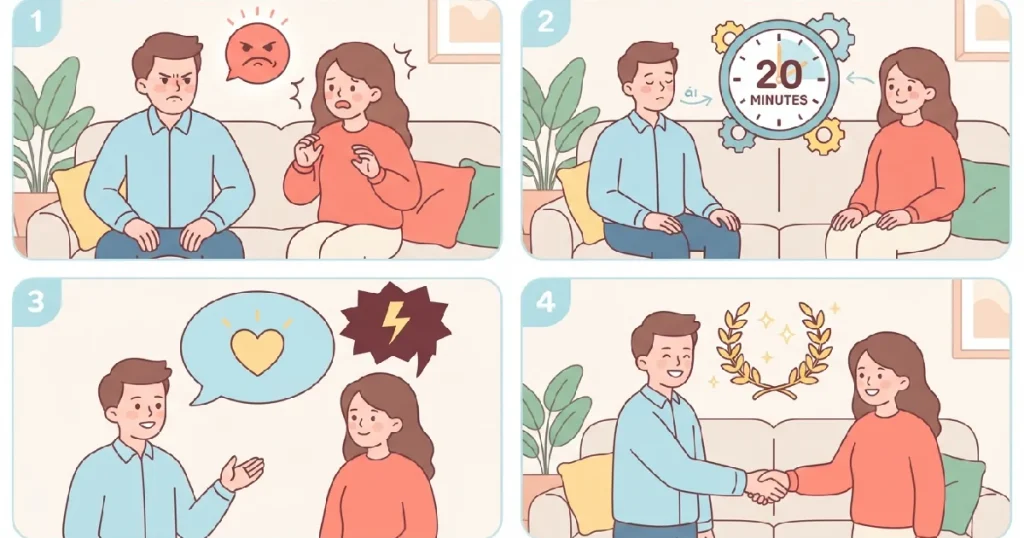
One place to start is the Appreciation Audit: each evening, name one specific thing your spouse did that day, out loud, before you mention anything that irritated you.
Consider trying the Physiological Timeout: the moment your pulse spikes mid-argument, say “I need twenty minutes,” and actually take them before continuing.
Another option is the Feeling Rewrite: the next time a sarcastic line forms in your mouth, pause and ask yourself what you actually feel underneath it, then say that instead.
And finally, hold the Public Dignity Rule: agree together that criticism, correction, or mockery in front of other people is never acceptable, no exceptions.
A useful question to ask yourself tonight: when was the last time I spoke to my spouse the way I’d speak to someone I deeply respected?
Choosing Dignity Over Disdain
A marriage cannot survive years of unchecked contempt. That’s the honest prognosis, and no amount of positive thinking changes it. But a couple who can name the pattern, together, while there’s still respect underneath the resentment, has a real chance of dismantling it.
If both of you recognize the Resentment Ledger and are willing to reconcile it, couples therapy grounded in Gottman’s research can rebuild what contempt wore away. If one partner refuses to acknowledge the harm, individual therapy can help you protect your own sense of self while you decide what comes next.
Respect isn’t a bonus feature in a marriage. It’s the foundation everything else sits on. Affection cannot grow in soil where dignity has been denied.
Contempt works like rust on a hinge. Invisible at first, then one eye-roll, one sneer, one dismissive sigh at a time, until the door won’t open and won’t close.
You now know what that rust looks like. You know the sneer, the sarcasm, the silent ledger building behind someone’s eyes. That knowledge is yours to keep, whether you use it to repair your marriage or to protect your own worth within it.
Pick one small, honest conversation to have this week, about one specific moment that hurt. Not every grievance. Just one.
Contempt thrives in silence. Dignity starts the moment you speak.
My Closing Remarks
I’ve sat across from couples who could barely look at each other, and I’ve watched that same couple, months later, laugh at something small over coffee. The difference was never grand gestures. It was one partner finally saying “that hurt” instead of swallowing it, and the other choosing to listen instead of defend. If you recognized your marriage in this piece, you’re not broken, and you’re not imagining it. You’re simply paying attention, which is the first real step toward something better.
More Related Stories for You
Respect and partnership start long before contempt ever enters the picture. If you want to understand what protects couples from reaching this point in the first place, read about why it matters to marry your best friend.
About The Author