
 Sara Carmen

Secret debts and hidden accounts quietly erode trust, yet the warning signs rarely look the way you expect.
Key Takeaways
- Modern financial infidelity in marriage rarely hides in a locked paper filing cabinet; it usually lives inside peer-to-peer payment apps, Buy Now, Pay Later installments, and routine grocery store cash-back withdrawals.
- Partners who lie about money are rarely driven by pure greed, as most secret spending grows out of conflict avoidance, deep financial shame, or a “Parent-Child” control dynamic at home.
- Rebuilding broken financial trust requires a structured 48-hour amnesty window and a small, autonomous spending fund for both spouses so privacy never has to turn into secrecy again.
What is financial infidelity in marriage? Financial infidelity happens when one spouse intentionally hides spending, debt, income, or accounts from the other in a relationship with shared financial expectations. You can spot it through sudden password changes, unexplained cash skimming, defensive reactions to basic budget questions, and fragmented payment trails across third-party apps.
Contents
Table of Contents
We often picture marriage crises arriving like a sudden thunderclap, yet most trust fractures start with a quiet thumb-swipe on a smartphone screen. Maybe you noticed your partner quickly angling their phone away when a banking notification popped up. Perhaps a casual question about a credit card balance triggered an outburst that left a cold knot in your stomach.
Sitting with that suspicion is exhausting. You find yourself caught between wanting to trust the person sleeping next to you and feeling foolish for ignoring numbers that simply refuse to add up.
In our work counseling couples through money conflicts, we see how quickly secret spending poisons daily intimacy. Behavioral researchers call this “anticipatory guilt,” a state where a partner hides a purchase to avoid a five-minute argument, only to build an invisible wall of anxiety that lasts for months.
Today, we are going to clear away the guesswork. You will learn how to distinguish healthy financial independence from active deception, recognize five subtle modern warning signs, understand the psychology driving the secrecy, and use word-for-word scripts to put the truth on the table without starting a war.
What Is Financial Infidelity in Marriage? Defining the Line Between Privacy and Secrecy
Many couples struggle to define what is financial infidelity in marriage because every household handles money differently. Some spouses pool every penny into one joint checking account, while others keep separate accounts and split the mortgage down the middle. Having separate bank accounts is completely fine when both partners know those accounts exist and agree on the ground rules.
So what is financial infidelity at its core? In a landmark study published in the Journal of Consumer Research, behavioral scientists Emily Garbinsky, Joe Gladstone, and Cassie Mogilner (2020) defined it as engaging in any financial behavior expected to be disapproved of by a romantic partner and intentionally failing to disclose it. The issue is never the account structure itself. The issue is the active deception surrounding it.
When evaluating healthy privacy against financial dishonesty in marriage, we ask couples to use a simple mental check we call the Over-the-Shoulder Test. Imagine your spouse is standing right behind you looking at your phone screen while you make a purchase, move money, or open a new credit line. Would you still tap the button?
If you would buy a birthday gift for them, you might ask them to look away for a week, which is a temporary surprise. If you wait until they leave the house to transfer funds or delete an emailed receipt so they never see it, you have crossed out of privacy and stepped straight into secrecy.
5 Subtle Tips to Spot Financial Cheating in Marriage

Most popular advice tells you to look for luxury shopping bags hidden in the trunk of the car or mystery credit card bills in the mailbox. In reality, digital banking has made those classic clichés nearly obsolete. When looking for financial cheating in marriage today, you have to pay attention to behavioral shifts and digital blind spots.
1. Look for the “Shadow Wallet” Effect in Peer-to-Peer Apps
Paper statements rarely tell the whole story anymore. A common pitfall we frequently see is one partner keeping a secondary financial life inside Venmo, CashApp, PayPal, Apple Cash, or Buy Now, Pay Later platforms like Klarna and Afterpay.
Because peer-to-peer apps can hold a standing balance without transferring money back to a joint bank account, money can come in and go out completely off the household radar. Similarly, installment apps break a $600 impulse buy into four smaller $150 charges spread across two months, making large spending sprees look like ordinary household errands on a shared bank feed.
2. Watch for “Defensive Generosity” After Quiet Guilt
Guilt is a heavy emotion to carry around the house every day. When someone is engaging in financial infidelity in a marriage, that unspoken guilt often leaks out as sudden, unprompted generosity.
A spouse who just racked up $3,000 on a hidden credit card might abruptly insist on treating the family to an expensive steakhouse dinner or surprise you with an uncharacteristic gift. On the surface, it looks thoughtful. Underneath, it operates as a subconscious peace offering and an emotional smoke screen: if they are spoiling you, you are far less likely to ask hard questions about the savings account.
3. Notice the “Hyper-Vigilant Accuser” Reversal
One of the strangest patterns in relationship psychology is behavioral projection. When a partner is hiding debt, a bad investment, or secret spending, their anxiety about getting caught runs high. Rather than waiting for you to ask about the budget, they go on the offensive first.
They might suddenly start policing your minor daily purchases, criticizing a $14 lunch or questioning why the grocery bill went up by thirty dollars. By turning you into the irresponsible spender who needs to defend every receipt, they keep the spotlight firmly pointed away from their own financial trail.
4. Track Micro-Skimming at the Checkout Line
Pulling $400 out of an ATM leaves an obvious footprint on a monthly checking statement. To avoid triggering an alert, secretive partners often rely on micro-skimming during routine household errands.
Every time they buy groceries, pick up prescriptions at the pharmacy, or stop at a big-box hardware store, they select the option for $20 or $40 cash back at the pin pad. Because the joint bank statement simply bundles the total into a single line item like “Supermarket $164.20,” hundreds of dollars a month can quietly vanish into a secret cash stash.
5. Pay Attention to “Lifestyle Math” That Stops Adding Up
Numbers leave echoes in daily life even when you never see the bank login. You might notice your spouse complaining that money is way too tight for a weekend getaway, even though both of your salaries have stayed steady and no major house repairs have come up.
The reverse happens just as often. New golf clubs, electronics, or designer clothes keep showing up in the closet, accompanied by elaborate stories about “unbelievable 80% clearance sales,” work raffles, or generous friends giving away brand-new gear. When a partner has an intricate discount story ready before you even ask what something cost, trust your gut.
The Psychology of Financial Betrayal in Marriage: Why Good Partners Hide Money
Discovering secret debt or hidden accounts stings deeply. Research by relationship psychologist Dr. John Gottman (2011) demonstrates that trust is built and broken in tiny daily interactions, and hiding financial truth erodes the very foundation of emotional safety in a partnership. Yet if you want to fix financial betrayal in marriage, it helps to understand what drives an otherwise loving spouse to lie.
In our experience sitting across from couples in crisis, financial secrecy rarely stems from malice. Nine times out of ten, it grows out of a toxic “Parent-Child” dynamic around the household budget.
When one spouse naturally steps into the role of the strict financial auditor and the other spouse feels judged, lectured, or micromanaged over every small purchase, resentment builds. Just like a teenager hiding a bad report card from a strict parent, the less controlling spouse starts hiding receipts to claim a sense of personal freedom and avoid a scolding.
Shame is the other major driver. We have worked with breadwinners who lost money on a risky stock trade or fell behind on credit card interest and felt terrified of looking like a failure in their partner’s eyes. They tell themselves a classic lie: I will fix this on my own before my spouse ever finds out, and nobody will get hurt. Unfortunately, compound interest moves faster than good intentions, and a small mistake balloons into a five-figure secret.
How to Address Financial Dishonesty and Rebuild Trust Together
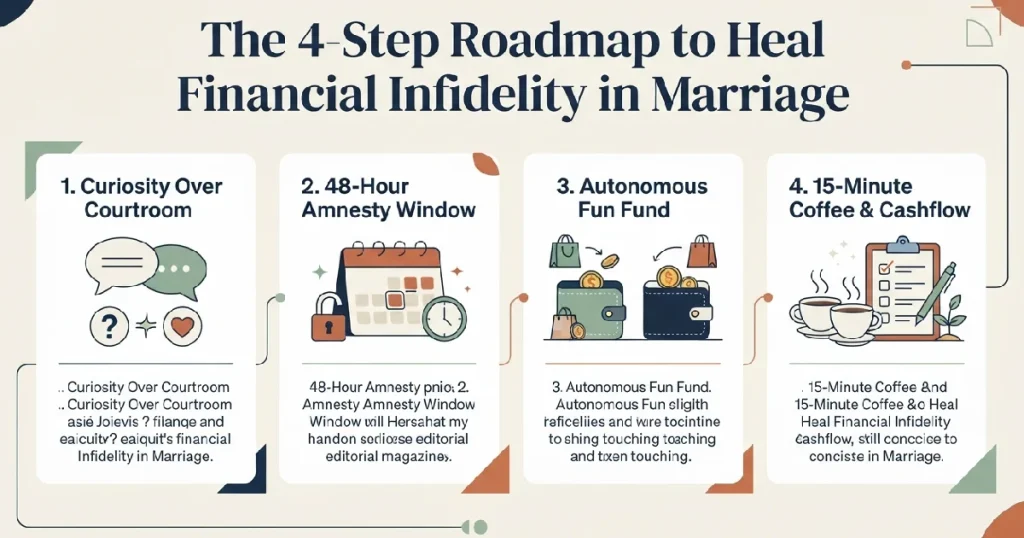
If you have spotted the signs or found proof of hidden money, taking a breath before confronting your partner will change the entire trajectory of your conversation. Cornering someone in the kitchen with a bank statement in your hand almost always triggers a fight-or-flight response, leading to more lies. Here are four practical strategies to bring the truth into the open and rebuild your financial team.
1. The “Curiosity Over Courtroom” Opener
When you first bring up a missing balance or an unfamiliar charge, step out of the prosecutor role. People tell the truth much faster when they feel safe enough to admit they are overwhelmed.
One place to begin is sitting down during a calm moment on a weekend morning (never right before bed or on the way out to work) and using this exact script:
“I noticed a few numbers on our account that I could not make sense of, and I have been feeling anxious and distant from you all week. I care way more about us being honest with each other than I do about the dollar amount. If something has gotten out of hand or feels scary to talk about, I promise not to yell. Can we look at everything together right now?”
2. The 48-Hour Financial Amnesty Window
In relationship recovery, “trickle-truth” destroys far more marriages than the original debt ever could. Trickle-truth happens when a spouse confesses to a hidden $2,000 credit card today, only for you to discover another $4,000 personal loan three weeks later, and an emptied savings account a month after that. Every new discovery resets the betrayal clock back to zero.
Consider testing a 48-Hour Financial Amnesty Window to stop the bleeding all at once. Use this collaborative boundary:
“Finding out about another hidden account next month will hurt our marriage much worse than seeing the full number this weekend. Let’s take the next 48 hours as a complete honesty window. We will both pull our full credit reports and put every balance, app, and account on the dining table on Sunday so we can deal with the real total once and for all.”
3. The Autonomous “No-Audit” Fun Fund
To prevent secrecy from coming back, you have to solve the autonomy problem that sparked it. Even in the closest marriages, adults hate feeling like they need permission from their spouse to buy a book, grab coffee with a friend, or spend money on a personal hobby.
Notice what shifts when you build a dedicated “No-Audit” Fun Fund into your monthly budget for both of you. Whether your budget allows for $40 a month per person or $400 a month, that money goes into separate individual debit accounts. Each spouse can spend or save their fun money with zero questions, zero tracking, and zero eye-rolls from the other partner.
4. The 15-Minute “Coffee and Cashflow” Check-In
Secrecy thrives in the dark gaps between yearly tax seasons. When couples only talk about money when a card gets declined or an overdraft fee hits, every money talk feels like an emergency root canal.
Replace high-stress budget fights with a brief, predictable weekly rhythm. Every Sunday morning over coffee, open your banking dashboard together for just fifteen minutes. Try starting the meeting with a quick self-reflection prompt: What is one expense coming up this week that we need to plan for, and where did either of us feel stressed about money over the last seven days? Keeping the check-in short and routine removes the fear that breeds dishonesty.
Frequently Asked Questions
Is hiding a small savings account from my spouse still considered financial infidelity?
If you agreed to combine finances with full transparency, keeping any secret account breaks that trust. The sole exception is when someone faces domestic control or abuse, where a private safety fund becomes a necessary survival step.
How do I find out if my spouse has secret debt without breaking the law?
Avoid guessing passwords or snooping through private mail. Instead, review your joint tax returns for unfamiliar interest forms and propose pulling free credit reports together at the kitchen table. A partner’s reaction to that simple request reveals a lot.
Can a marriage actually survive severe financial betrayal?
Yes, many couples recover and build stronger partnerships when both people commit to total honesty. Healing depends far less on the hidden dollar amount and much more on whether your spouse discloses everything at once.
Turning Secret Numbers Into Shared Strength
Think back to that quiet moment of suspicion when a phone screen tilted away or a casual question about a bill made the room go tense. You no longer have to sit in the dark wondering if you are imagining things or bracing for an explosive argument. You now hold a clear diagnostic lens to recognize modern financial infidelity in marriage, understand the fear or shame hiding behind the numbers, and open an honest dialogue with steadiness and self-respect.
A healthy marriage is measured not by a spotless bank statement, but by two people choosing to face the real numbers side by side.
My Closing Remarks
Sitting across from couples who have just uncovered years of secret receipts, I always see the same look of exhaustion on both faces. Keeping a secret takes enormous energy, and suspecting one takes even more. Please give yourself grace right now. You do not need to figure out the next ten years of your marriage tonight. Start with one honest conversation at the kitchen table, and let clarity guide your next step.
More Related Stories for You
- Rebuilding trust around money becomes much easier when you strengthen your everyday emotional bond: discover how to rebuild deep friendship in marriage when life pulls you apart.
About The Author