
 Sara Carmen
The miles are not what hollow you out. The days you stop sharing are.
Key Points
- A long distance marriage does not fail from missing each other. It fails when two nervous systems lose the habit of calming one another.
- Daily connection rituals rebuild what extra video calls cannot: trust, romance, and a shared story.
- The couples who stay close treat distance as a body problem, not a calendar problem.
Contents
Table of Contents
We were built to calm each other with a hand on a back and a body on the other side of the bed. A long distance marriage takes that away and hands you a screen. You do the calls. You send the texts. And you still hang up feeling strangely alone.
You have tried. You really have. And the hollow feeling keeps coming back. You start to wonder if something is wrong with you, or with the marriage. There is not.
You keep love strong in a long distance marriage by replacing accidental closeness with daily, named rituals. Three of them. One for your emotions. One for your calendars. One for your bodies. Do them on the days you feel nothing. Especially then.
Someone might think you are lucky because you talk every night. But what they do not see is the performance. You smile on camera while the dishes sit in the sink and loneliness sits in your chest.
Someone might think the hard part is missing each other. But what they do not see is the strange guilt of building a full life in a city your spouse has never walked through.
Someone might think a weekend visit will reset everything. But what they do not see is the crash that comes three days after the airport goodbye. Two people arriving with a fantasy. Two people leaving with a grief they do not know how to name.
Left alone, this pattern does not just strain a long distance marriage. It can quietly become the reason it ends.
Here is the map of the territory you have been walking without a name for it.
A long distance marriage is not a logistics problem. It is a nervous system problem. Your body learned to settle in the presence of one specific person. Distance removes that cue. What you feel is not drama. It is withdrawal from co-regulation, the quiet biological process of two people calming each other through proximity, tone, and touch.
Think of your marriage as two clocks in different rooms. Without a daily reset, they drift. Not all at once. Minute by minute. Until one of you is living in a completely different hour.
According to work by Janice Kiecolt-Glaser and colleagues on marriage and physical health, relational stress does not stay in the mind. It changes sleep, immune function, and the body’s ability to recover. Distance is a form of chronic relational stress. Your body keeps the score even when your calendar looks fine.
That is why more calling often fails. You can be connected all day and still be dysregulated. Dysregulated means your system is stuck on high alert or shut down. Neither state is good for patience, desire, or trust.
Understanding Your Long Distance Marriage: Why It Feels Harder Than It Should
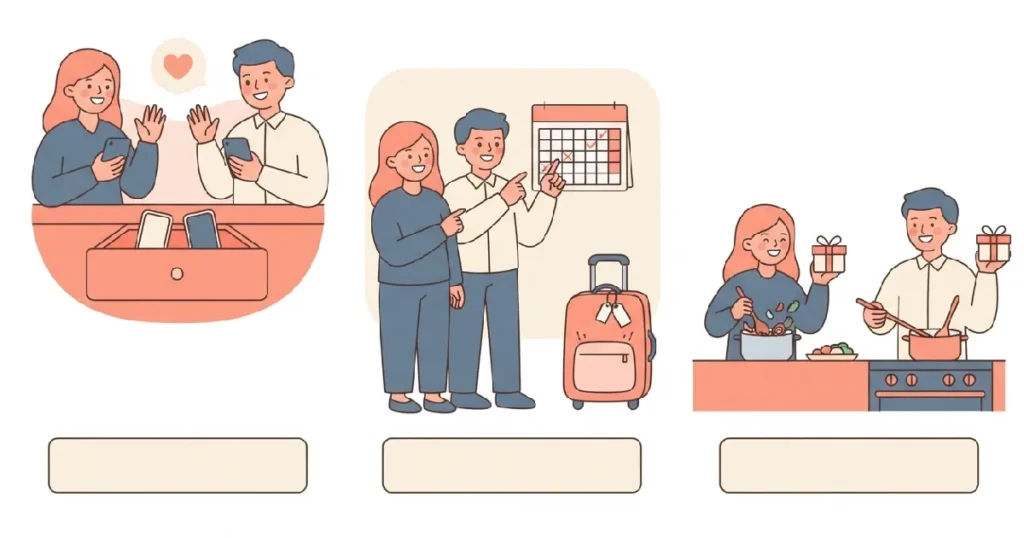
Most people in this situation do not realize that the strain has a shape. It is not random. Three forces do most of the damage.
The first is the co-regulation gap. You used to borrow calm from each other without thinking. A sigh in the kitchen. A knee against a knee on the couch. Now you have to manufacture that safety through pixels. Your body does not fully believe the pixel.
The second is narrative drift. While you live apart, you are not frozen. You are changing. Your days fill with new coworkers, new streets, new private jokes your partner has never heard. Your two life stories start to diverge. If you only swap task lists at night, you slowly become strangers with a shared last name.
The third is sensory hunger. That is the ache that has no polite language. You do not just miss their voice. You miss weight, smell, temperature, the fact of a body in the room. No app can fully feed that. Ignoring it only makes it louder.
Digital life makes all three worse. An unused phone on the table can already reduce closeness, as research on mobile devices and conversation has shown. On a video call, the same split attention becomes a quiet insult. You are looking at them. They are looking at a notification.
That’s not weakness. That’s wiring.
Priya learned this the hard way. She was 31, married eleven months, when she took a two-year research post in Boston. Marcus stayed in Dublin to finish a degree and wait on a spouse visa. They did everything they had been told. Scheduled calls. Shared a playlist. Counted down on a widget. By month six she was snapping at him for typing too slowly. He had stopped telling her about his days because they felt too small next to hers. They were not falling out of love. Their clocks had drifted. When they finally named it, they built one Sunday hour that was not a recap of chores. It was a telling of who they were becoming. The fights did not vanish. The loneliness got a place to land.
If your long distance marriage feels harder than the advice promised, you are not failing the advice. The advice was too thin for what your body is doing.
Ritual 1: Daily Emotional Connection That Rebuilds Trust From Afar
Emotional connection in a long distance marriage is not more talking. It is better regulation.
The claim is simple. You need a daily practice that tells both nervous systems, we are still in the same hour.
Start with a digital detox rhythm. Not a weekend off the grid. Twenty minutes. Phones face down, in another room, before the call even begins. Frame it as care, not punishment. You are protecting the one window you have.
Then practice bid-fishing. A bid is any small reach for contact. A meme. A voice note. A photo of the sky. The Gottman Institute’s work on turning toward bids shows that these tiny turns predict whether a bond holds. You do not need a perfect reply. You need a reply that says, I saw you.
Pair that with an appreciation flood. Once a day, send one specific notice. Not “love you.” Try “I keep thinking about how you handled your sister yesterday.” Specific praise is food. Vague praise is air.
Healthy couples tend to offer about five warm moments for every sharp one, a pattern the Gottman research has tracked for decades. Distance tilts that ratio toward irritation because you only hear the highlights and the complaints. The ordinary kindness in the middle goes missing. You have to put it back on purpose.
What this means for you: stop grading the call by how romantic it felt. Grade it by whether both of you hung up a little more settled than you started.
Ritual 2: Long Distance Marriage Communication and Shared Logistics

Chaos is not romantic. Unpredictability is a tax your patience cannot keep paying.
The claim here is that shared systems are an act of love. They cut the mental load that so often lands on one partner and then turns into resentment.
Master one shared calendar. Time Tree or Google Calendar is enough. Put work blocks, sleep windows, family dinners, and call times in the same place. You are not being rigid. You are making yourself findable.
If immigration is part of your story, stop treating the paperwork as one person’s private mountain. Make it a joint project with dates, documents, and money in one folder you both can see. Bookmark the official USCIS family immigration page so the process has a single source of truth. Fear loves missing files. Shared files starve that fear.
Then build a Reunion Blueprint before every visit. Three parts. A low-key first evening, not a performance. One honest check-in on day two about what feels different. A planned landing after the goodbye, so the crash has a cushion. The reunion pressure cycle is real. You arrive hoping to recapture an old version of yourselves. That version does not live here anymore. Plan for the people you are now.
What this means for you: the goal is not a perfect schedule. The goal is fewer surprises that your already tired nervous system has to absorb.
Ritual 3: Maintaining Intimacy in a Long Distance Marriage
Romance dies in a long distance marriage when every call becomes a meeting.
The claim is that you still need shared experience, not just shared updates. Memory is built from doing, not from reporting.
Structure virtual dates as activities. Cook the same cheap recipe. Play one game. Watch the same film with the sound synced. Talk after, not through the whole thing. You are collecting proof that you still know how to be together without solving a problem.
Address sensory hunger with something the hands can hold. A worn shirt. A small object that traveled in a pocket. A letter that arrived three days late and still smells like paper. These are not cute extras. They are stand-ins for touch, and the body takes them seriously.
Start one shared hobby you can both be bad at. A language. A song. A skill one of you already has. Teaching each other keeps you from becoming two parallel documentaries. You become classmates again.
What this means for you: desire rarely returns because you discussed it. It returns because you remembered how to play.
What to Do With Tonight

You do not need a new personality. You need a small reset you can repeat.
The Two-Clock Reset. Once a day, at a time you both protect, spend twelve minutes on one question only: what is one thing that changed in you since yesterday? Not your to-do list. You. This is how you fight narrative drift before it becomes distance inside the marriage.
The Attention Gate. Before any important call, both of you put the phone you are not using in another room. Say it out loud: “I am here.” It will feel awkward the first week. Awkward is the sound of a new habit landing.
The Reunion Blueprint Note. Open a shared doc tonight. Write three lines for the next visit: first night plan, one honest question, one aftercare plan for the goodbye. Future you will be too raw to invent this in the airport parking lot.
A useful question to sit with: “If we lived on the same street this month, what ordinary thing would we still be doing together?” Then do a thin version of that thing from where you are.
The next time a call feels flat, try this before you diagnose the marriage. Ask, “Are we dysregulated, or are we disconnected?” Often you are only tired, hungry, and under-touched. Repair the body first. Then talk.
Until the time comes when you will meet and live in a house alone, treat every ordinary Tuesday like it still belongs to both of you.
You hung up tonight and felt that hollow spot under your ribs. You know that feeling. It used to mean the marriage was thinning. Now you can read it as a signal. The clocks drifted. Reset them. Send the specific notice. Put the other phone in the other room. Tell them one true thing about who you are becoming.
You do not need more miles closed. You need more days shared.
Distance is only fatal when you stop living in the same hour.
My Closing Remarks
In my practice the couples who last are almost never the cinematic ones. They are the stubborn ones. The ones who send the voice note when they are angry and still choose accuracy over silence. I used to wait for the grand reunion to do the healing. I was wrong. The healing is boring. It happens on a Wednesday when you are both tired and you still tell the truth about your day. That is the whole secret, and it will offend anyone waiting to be swept. Stay anyway.
More Related Stories for You
- If the distance arrived before the wedding even felt real, you may also need the quieter question underneath the logistics: whether he wants to marry you but is scared.
About The Author