Sara Carmen

Why two people who deeply love each other still fight over invisible family rulebooks (and how to write your own).
Key Takeaways
- Unresolved cultural differences in marriage rarely explode over food or holidays, instead eroding trust through hidden assumptions about privacy, money, and conflict.
- Even couples born in the exact same town clash over family-of-origin micro-cultures when they mistake inherited upbringing habits for universal moral truths.
- Building a “Third Culture” household with explicit translation scripts replaces chronic resentment with shared habits that honor both partners.
Cultural differences in marriage are the unspoken expectations, values, and behavioral norms regarding family boundaries, communication styles, finances, and household roles that each spouse brings from their upbringing. When left unexamined, these invisible rulebooks cause couples to misinterpret ordinary cultural habits as personal disrespect, selfishness, or a lack of love.
Contents
Table of Contents
We often assume that love and good intentions are enough to carry a couple through any misunderstanding. Then an ordinary Tuesday evening turns icy because your mother-in-law booked a three-week visit without asking, or your spouse went completely silent in the middle of a serious budget disagreement.
You stare at the person across the kitchen counter and wonder how someone who claims to love you can act so carelessly. Neither of you is trying to cause harm. You are simply operating from two incompatible instruction manuals that were handed to you before you could talk.
Anthropologist Edward T. Hall (1976) demonstrated that roughly ninety percent of culture sits beneath conscious awareness, operating like the submerged base of an iceberg. In our relationship coaching practice, a common pitfall we frequently see is couples treating an inherited cultural script as a deliberate personal insult.
When you decode the twelve specific friction points below, you stop fighting your partner’s personality. You gain a practical map for building a unified household rulebook that protects your connection.
The Invisible Rulebook: Communication and Family Boundaries
Most newlyweds expect differences in marriage to show up around major religious holidays, wedding menus, or language barriers. In daily practice, the deepest relational wounds come from how you speak during tension and where the boundary of your front door begins.
1. Extended Family Authority vs. Nuclear Privacy
In collectivist traditions, marriage merges two extended clans. Parents, aunts, and older siblings retain an active voice in where you live, how you spend money, and how you raise children.
In individualist frameworks, marriage requires drawing a firm boundary around the couple and moving parents into an advisory background role. When these models collide, the individualist partner feels suffocated and betrayed by intrusive in-laws. Meanwhile, the collectivist partner feels pressured to abandon sacred family loyalty just to keep the peace at home.
2. High-Context Hints vs. Low-Context Directness
Growing up in a high-context environment teaches you to read tone, posture, and subtle hints to preserve group harmony without blunt words (Hall, 1976). Saying “That might be tricky this weekend” is understood by everyone in the room as a clear, polite “no.”
Low-context households prize direct, literal speech where stating a need plainly shows honesty and respect. Put both styles in one kitchen and friction sparks fast. The high-context spouse hears literal requests as cold, bossy hostility, while the low-context spouse feels exhausted from trying to read minds.
3. Spirited Debate vs. Quiet Harmony in Conflict
Some family micro-cultures treat animated volume, overlapping speech, and passionate pushback at the dinner table as proof of deep engagement and honesty. Silence in those homes signals icy withdrawal or hidden anger.
Other backgrounds view a raised voice as emotional danger. Children in harmony-oriented homes learn to lower their tone, choose words slowly, or pause the conversation to demonstrate care. Without translation, the expressive partner feels stonewalled and abandoned, while the quiet partner feels cornered and verbally attacked.
4. Filial Financial Duty vs. Household-First Budgeting
In many global and working-class cultures, sending monthly funds to aging parents or paying for a younger sibling’s tuition is an unquestioned badge of adult integrity. You do not debate it because parental sacrifice made your current life possible.
Partners raised in nuclear-first financial systems view undisclosed or ongoing transfers to extended relatives as a direct threat to marital security. The argument looks like a disagreement over math, yet it is actually a clash over how a good son or daughter behaves.
| Friction Area | Collectivist / High-Context Script | Individualist / Low-Context Script | How Partners Misread Each Other |
|---|---|---|---|
| In-Law Involvement | Parents remain elders within the core family unit; their input shows care. | The spouse comes first; parents visit by mutual invitation only. | “You are a mama’s boy/girl” vs. “You are cold and disrespectful to family.” |
| Saying “No” | Indirect hints and soft delays protect everyone’s dignity. | Clear, direct refusals prevent confusion and save time. | “You are being manipulative” vs. “You are being harsh and aggressive.” |
| Financial Support | Income is a shared safety net for parents and extended kin. | Income belongs strictly to the nuclear household and its future. | “You are robbing our kids’ future” vs. “You are selfish and ungrateful.” |
| Arguing Style | Stepping back and staying quiet prevents saying hurtful things. | Talking it out immediately and loudly shows you care about us. | “You don’t care enough to fight” vs. “You have zero self-control.” |
Daily Friction Points: Home Life, Time, and Money Habits

Once the honeymoon phase settles into utility bills and Tuesday chores, childhood programming takes over the living room. Taking a thorough marriage compatibility test often surprises couples by revealing just how differently they define a restful weekend or a fair domestic schedule.
5. Open-Door Hospitality vs. Home as a Private Sanctuary
For one spouse, love looks like an unlocked front door where cousins, neighbors, and childhood friends drop by unannounced for three hours of hot tea and loud laughter. Turning guests away or asking for advance notice feels humiliating.
For the other spouse, home is the only private sanctuary on earth to decompress after a demanding workweek. Resentment takes root when the hospitable spouse feels embarrassed by a partner hiding in the bedroom, and the private spouse feels ambushed in their own hallway.
6. Traditional Domestic Scripts vs. Egalitarian Task-Sharing
Even when both spouses work forty-hour weeks outside the home, childhood observation quietly dictates who notices an empty refrigerator or buys birthday cards for relatives. We repeat what we watched our parents do whenever we get tired.
If one partner watched their mother manage every social detail and kitchen chore while the other grew up splitting household labor evenly across genders, unspoken expectations quickly breed exhaustion. One partner waits to be asked for help, while the other quietly fumes over carrying the invisible mental load.
7. Scarcity Saving vs. Experiential Spending
Money habits carry generations of survival memory. A spouse raised by immigrant or working-class parents who endured economic instability often equates a large cash reserve with physical safety. Spending two hundred dollars on a concert ticket triggers genuine physical anxiety.
A partner raised with a predictable financial cushion may view spending on travel, hobbies, and restaurants as the entire reward for working hard. Without understanding the family history behind the bank account, the saver labels the spender reckless, and the spender calls the saver joyless.
8. Polychronic Relationship Time vs. Monochronic Clock Time
Monochronic cultures treat the clock as a sacred contract. Arriving at a 6:00 PM dinner at 5:58 PM signals reliability, self-discipline, and respect for everyone else’s evening.
Polychronic cultures prioritize human connection over rigid schedules. If an aunt starts a heartfelt conversation as you are walking out the door, staying an extra forty minutes is the moral choice. On the drive to every party, the clock-oriented partner feels perpetually humiliated by lateness, while the relationship-oriented partner feels rushed and policed.
Long-Term Fault Lines: Parenting, Faith, and Affection
Many couples smooth over early cultural differences in marriage while they are young, healthy, and solely responsible for themselves. Major life transitions like welcoming a baby, grieving a parent, or hitting career burnout pull dormant cultural loyalties straight to the surface.
9. Obedience-Focused Parenting vs. Autonomy-Focused Parenting
Wait until a three-year-old throws a tantrum at the dinner table to see childhood scripts emerge in seconds. One cultural tradition measures good parenting by respect for elders, polite compliance, and strong academic discipline.
Another tradition prizes emotional negotiation, independent self-expression, and letting children question house rules. When parents have not aligned these values ahead of time, they end up correcting and undermining each other in front of the child.
10. Dormant Faith and Milestone Rituals
Two secular adults may date happily for five years without a single religious disagreement. Neither attends weekly services, so both assume religion is a non-issue in their home.
The week a first baby arrives, one spouse suddenly feels a fierce ancestral pull toward baptism, naming ceremonies, circumcision, or holiday dietary laws. Those rituals carry identity, grief, and belonging that logic alone cannot explain away.
11. Verbal Romance vs. Practical Acts of Devotion
In our clinical observations, the way people express love is heavily shaped by cultural survival history. Western media celebrates poetic compliments, public hand-holding, eye contact, and daily verbal reassurance.
Many agrarian, immigrant, and stoic traditions treat heavy verbal praise with suspicion. In those homes, fierce devotion looks like peeling a fresh bowl of fruit for your spouse, checking their tire pressure in January, or working overtime without a word of complaint. Couples miss dozens of daily love letters simply because they are written in a different behavioral alphabet.
12. Saving Face in Public vs. Radical Emotional Transparency
Certain communities teach that marital struggles stay strictly inside the four walls of the house to protect dignity and family honor. Sharing relationship tension with friends or outsiders feels like public betrayal.
Other cultures encourage processing marital stress openly over coffee with close friends, siblings, or support groups. According to relationship researcher John Gottman (2015), lasting marriages depend on creating a “shared meaning system” where neither partner feels their background is mocked or erased. When couples fail to agree on privacy boundaries, one spouse feels isolated without a support network while the other feels publicly exposed.
4 Practical Strategies to Bridge Cultural Differences in Marriage
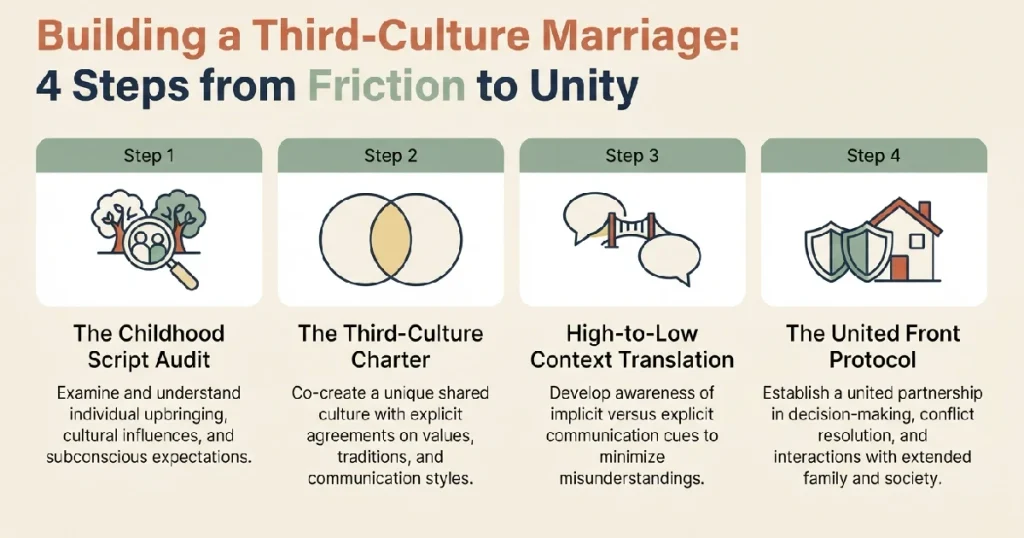
Recognizing that your partner is following an inherited script rather than trying to hurt you changes the emotional temperature in the room immediately. Here are four concrete tools to turn conflicting backgrounds into a shared household culture.
1. The “Where Did We Learn That?” Audit
When a recurring argument flares up over dishes, punctuality, or holiday travel, pause the debate over who is right and get curious about childhood origins. Sit down when neither of you is hungry or rushing out the door.
One place to begin is asking each other: “When you were ten years old, what happened in your house when guests came over, or when someone was upset?” Notice what shifts when you hear the childhood story behind your partner’s stubborn habit. Empathy comes much easier when you realize your spouse is trying to recreate safety or avoid an old childhood shame.
2. The Third-Culture Household Charter
Instead of competing over whose family culture wins, intentionally design “Culture C” for your marriage. Culture C keeps the best warmth from Partner A’s upbringing, blends it with the healthiest strengths of Partner B’s background, and retires the toxic habits from both.
Consider testing a simple Sunday evening check-in where you write down explicit household agreements for one friction zone at a time. You might agree: “We embrace your family’s generous hospitality on Saturdays, and we protect my need for a quiet, guest-free sanctuary every Sunday.”
3. The High-to-Low Context Translation Pause
If one of you speaks in hints and the other speaks in literal headlines, establish a neutral translation phrase that takes the sting out of miscommunication. Agree on the script before tension hits.
When a request sounds sharp or vague, try saying: “Let’s do a quick cultural translation. In my family, asking directly is how we show trust, and I want to make sure that didn’t land as bossy to you.” The indirect partner can use a matching bridge: “I am giving you a soft hint right now, which actually means I really need help with dinner tonight.”
4. The United Front Protocol for In-Laws
Extended family friction heals only when each spouse takes full responsibility for managing their own biological relatives. Never cast your partner as the villain to avoid an uncomfortable conversation with your own parents.
Consider testing this word-for-word boundary script with your parents: “Mom, Sara and I talked it over together, and we decided that weekend stays work best when we plan them a month ahead.” Using “we decided” prevents your in-laws from blaming your spouse and reassures your partner that your marriage sits on solid ground.
Frequently Asked Questions
Can a marriage survive huge cultural differences?
Yes, cross-cultural marriages thrive when couples stop treating their upbringing as objective truth and start treating it as one valid preference among many. Research consistently shows that how a couple repairs misunderstandings matters far more than how similar their backgrounds were on their wedding day.
Do couples from the same country still have cultural clashes?
Absolutely, because every family operates as its own powerful micro-culture. Differences between rural and urban roots, working-class and white-collar finances, or loud and quiet conflict styles create the exact same friction as marrying someone from across the ocean.
What should I do when my spouse always puts their parents first?
Start by shifting the conversation away from attacking your in-laws and toward protecting the safety of your marriage. Express appreciation for your partner’s loyalty as a son or daughter, then clearly request specific marital boundaries around finances, house keys, and joint decisions.
Building a Home That Belongs to Both of You
Think back to that tense Tuesday evening across the kitchen counter, staring at a three-week in-law visit or a silent partner after a money talk. With a clear map of the hidden cultural iceberg, you no longer have to wonder if your spouse has stopped caring about your feelings.
You can recognize a high-context hint, a collectivist duty, or a scarcity money reflex for what it truly is. Blending two histories takes patience, steady humor, and a willingness to explain what always felt obvious to you. Love grows strongest when two people stop defending the homes they came from and start designing the home they are building together.
My Closing Remarks
After sitting with hundreds of couples over the years, I can tell you that the happiest partners are rarely the ones who started out identical. They are the couples who stopped keeping score and became lifelong students of each other’s inner world. Give yourself permission to laugh when your family rulebooks collide this week. Curiosity will always take your marriage further than courtroom arguments ever could.
More Related Stories for You
- Want to build daily habits that keep both partners feeling heard and valued? Read our practical guide on how to have a healthy relationship for simple rituals that strengthen trust every day.
About The Author