
 Sara Carmen
Why your worst fights might be the doorway to your closest connection, if you know how to walk through them.
Key Points
- Conflict resolution techniques aren’t about winning the argument. They’re about building a relationship that can hold disagreement without breaking.
- Learn the exact scripts, not vague advice, that stop criticism, defensiveness, and stonewalling before they take over your next hard conversation.
- Discover the one ratio, backed by decades of research, that predicts whether a couple will grow closer or slowly drift apart.
Contents
Table of Contents
Most couples don’t actually fight about the dishes. Or the money. Or who forgot to text back on the drive home. We fight about whether we matter to the person sitting across from us. You already know this somewhere under the anger. The argument about the sink is rarely about the sink.
Here’s the short version, before we go further. Conflict resolution techniques work not because they make disagreement disappear, but because they change what your body does the moment disagreement shows up. That shift, more than any clever phrase, is what actually protects a relationship for the long haul.
Maybe you’ve had this thought after a bad blowup: “We’re just not compatible.” But what’s actually happening underneath is far more mechanical than that, and far more fixable than you’ve been led to believe.
According to the Gottman Institute, roughly 69 percent of relationship problems are perpetual. That means they stem from basic differences in personality, values, or needs that never fully resolve. You will not “fix” the fact that one of you is a saver and the other a spender. You will not eliminate the fact that one of you needs quiet and the other needs conversation after a long day.
That number should feel like relief, not defeat.
Once you stop trying to win a fight that was never designed to be won, you can start using relationship conflict management tools that do something more useful: they turn a battle into a shared project. Many of the strategies below come directly from the Gottman Method, built from more than four decades of research watching real couples argue, repair, and reconnect in controlled lab settings researchers nicknamed the “Love Lab.”
The Premise of Healthy Relationship Arguing: Understanding the Traps
Before you learn the tools, you need to understand why fights spiral in the first place. This is the foundation of relationship conflict management. Not eliminating disagreement, but changing how your body and brain respond to it.
The first three minutes decide almost everything. Gottman’s research found that the opening moments of a disagreement predict how it ends with startling accuracy, close to 96 percent of the time. If you launch into a conversation with an accusation, the entire exchange is already tilted toward defensiveness before your partner says a word.
Then there are the Four Horsemen. This is Gottman’s shorthand for the four communication habits most likely to predict a relationship’s decline: criticism (attacking character instead of behavior), contempt (mockery, eye-rolling, or superiority), defensiveness (playing the victim instead of hearing the complaint), and stonewalling (shutting down and withdrawing entirely).
Contempt is the most corrosive of the four. It’s the difference between “I’m frustrated you forgot” and “You’re so useless, you forget everything.”
Left unmanaged, these patterns don’t just create tension in the moment. They slowly erode the friendship the entire relationship rests on.
Then there’s flooding. When your heart rate climbs above 100 beats per minute during a conflict, something measurable happens in your brain. Your prefrontal cortex, the part responsible for reasoning, empathy, and impulse control, temporarily goes offline. Your body shifts into fight-or-flight mode, the same survival response you’d have facing a physical threat. This is why you say things in a heated argument that you’d never say calmly. You’re not being cruel. You’re biologically incapable of accessing your best self.
Most couples don’t realize their arguments are failing for physiological reasons long before they’re failing for relational ones.
7 Expert Conflict Resolution Techniques for Long-Term Couples
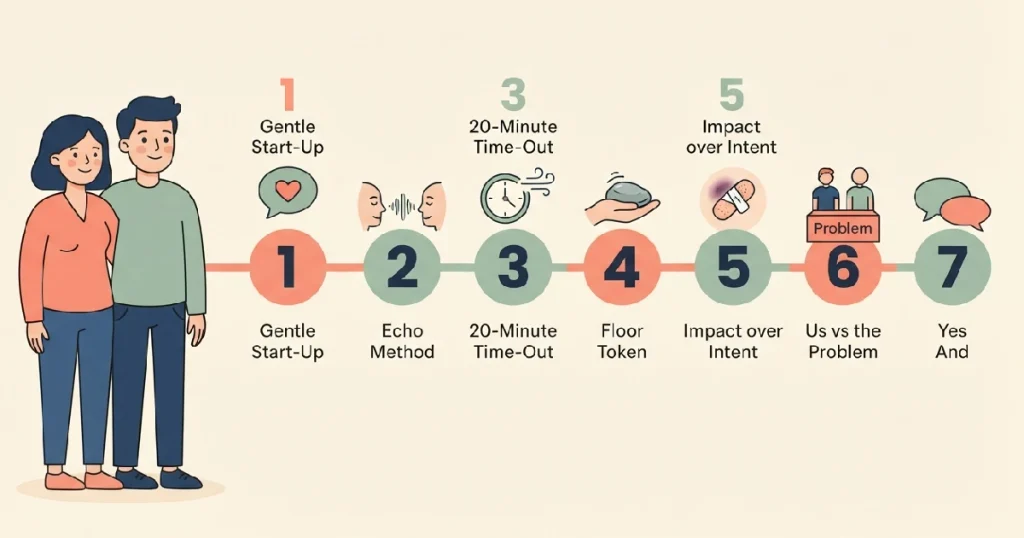
Here’s where theory becomes practice. These seven tools are the ones I return to most often with couples in session, because they interrupt the cycle at the exact moment it usually spirals.
1. The Gentle Start-Up (Replacing Criticism)
The core idea: How you open a hard conversation matters more than what you say next. The gentle start-up follows a simple script: “I feel [emotion] about [specific situation], and I need [positive action].”
In practice: Instead of “You never clean up after yourself,” try “I feel overwhelmed by the kitchen mess, and I need help clearing the counters tonight.” Same problem. Completely different nervous system response in the person hearing it.
Why it works: You’re naming a feeling and a need instead of a character flaw. Nobody has to defend their identity, so nobody has to fight back.
2. Active Paraphrasing via the Echo Method
The core idea: Before you respond, repeat back what you heard in your own words. This is one of the simplest couples communication exercises available, and one of the most underused.
In practice: “It sounds like you feel isolated when I work late. Is that right?” Notice this isn’t agreement. It’s confirmation that you actually heard them.
Why it works: Validation has to happen before problem-solving. Skip this step, and your partner will keep repeating themselves louder, hoping you’ll finally register what they said.
3. The 20-Minute Physiological Time-Out
The core idea: Once flooding hits, no amount of good communication technique will help. You need a structured pause, not a slammed door.
In practice: The partner requesting the break states a specific return time. “I need 20 minutes to calm down, and I’ll come back at 7:15.” Spend that time actually self-soothing, walking, breathing, listening to music, not replaying the argument in your head.
Why it works: A vague exit (“I need space”) can trigger real abandonment fear in an anxious partner. A time-bound exit signals commitment, not rejection.
4. Speaker-Listener Floor Tokens
The core idea: This is one of the most effective couples communication exercises for chronically interrupting or escalating couples. Use a small object, a stone, a coaster, anything physical, to mark who has the floor.
In practice: Only the person holding the token speaks. The other person listens without formulating a rebuttal, then hands it over when it’s their turn.
Why it works: It physically blocks the interruption cycle that turns a disagreement into a shouting match.
But here’s what no one tells you.
The Hidden Mechanism Behind Every Conflict Resolution Technique
Every script above works for a reason most articles never mention. You’re not just exchanging better words. You’re co-regulating each other’s nervous systems.
This idea comes from interpersonal neurobiology and from Dr. Sue Johnson’s work on Emotionally Focused Therapy. When you lower your volume, slow your speech, or hold eye contact through a hard moment, you’re sending your partner’s body a biological signal of safety, not just a verbal one. Their heart rate can actually respond to your tone before it responds to your content.
This is why the same sentence, delivered calm versus clipped, produces two completely different outcomes. The words were never the whole story.
Understanding this changes how you use every technique on this list. You’re not performing a script. You’re regulating a shared system.
5. Separating Impact from Intent
The core idea: One of the most common traps in arguments is defending your intentions while ignoring the pain your actions actually caused.
In practice: “I didn’t mean to forget our anniversary plans, but I recognize it hurt you deeply, and I take responsibility for that impact.” Notice the intent gets one clause. The impact gets acknowledged fully.
Why it works: Your partner isn’t arguing with your intentions. They’re reacting to the outcome. Meet them there first.
6. Establishing a Shared Relationship Goal Boundary
The core idea: Shift the framing from “me versus you” to “us versus the problem.” This single reframe is one of the fastest ways to practice healthy relationship arguing.
In practice: Before a hard money conversation, try: “We both want our home to feel secure, so let’s look at this budget discrepancy together.”
Why it works: You can’t feel attacked by someone standing next to you facing the same problem. Positioning matters, literally and psychologically.
7. The “Yes, And” Perspective Validation
The core idea: You can hold your partner’s reality and your own at the same time. The word “but” cancels out everything before it. The word “and” holds both truths.
In practice: “Yes, I agree your work schedule is exhausting, and I also need to feel supported with our chores on the weekends.”
Why it works: Nobody has to lose for the other person to win. This is what learning how to stop toxic relationship cycles actually looks like in real time, one sentence at a time.
5 Tension-Diffusing Tools to Stop Toxic Relationship Cycles

Sometimes you need something faster than a full script, an in-the-moment tool to bring your body back down before you can even attempt the techniques above.
Set a formal break protocol. Agree beforehand on a phrase like “I need 20 minutes, but I promise we’ll come back to this.” Saying it out loud, before you’re mid-fight, makes it far easier to use when things get heated.
Try the reflect-and-diminish move. When your partner raises their voice, deliberately lower yours and slow your pace. This subtle mirroring pulls their nervous system down to match your calm, almost like tuning two instruments to the same key.
Subtract the person from the problem. Sit side by side rather than face to face, looking at a shared notepad or budget spreadsheet instead of each other. Redirect the intensity toward the logistics, not the person.
Do a somatic ground-rule check. Sit with feet flat on the floor before a difficult talk. Grounding your body physically reduces the fight-or-flight response and makes aggressive posturing far less likely.
Use the five-second tactical breath. Before responding to a sharp comment, take one slow, silent breath. It’s a small pause, but it’s often the exact gap your prefrontal cortex needs to come back online.
Think of every one of these tools like a pressure valve on a pipe. Vent it correctly, and the system holds. Ignore it and weld it shut, and eventually the whole thing bursts. Conflict resolution techniques aren’t about avoiding pressure. They’re about giving it somewhere safe to go.
Conclusion: Making Conflict Resolution Techniques a Habit
None of this requires perfection. It requires practice, the same way any skill does, one small conversation at a time.
The Gottman Institute’s long-term research on stable couples found something worth remembering: they maintain a ratio of at least five positive interactions for every single negative one, even during conflict. That’s your benchmark. Not zero fights. Five to one.
Pick one tool from this list, maybe the gentle start-up, and try it during your next small disagreement. Not the big one. The small one, this week.
You now have a map for a territory that used to feel unpredictable. The next time an argument starts, you’ll recognize the fork in the road, and you’ll know which direction actually leads back to each other.
The couples who last aren’t the ones who stopped fighting. They’re the ones who learned how to fight for each other instead of against each other.
My Closing Remarks
In my practice, the couples who make the fastest progress aren’t the ones with the fewest problems. They’re the ones willing to try a new script even when it feels awkward the first few times. I’ve watched a single gentle start-up shift the entire tone of a marriage in one conversation. You don’t need to overhaul everything tonight. You just need one honest attempt.
If you’re struggling with recurring conflict in your relationship, consider speaking with a licensed therapist.
More Related Stories for You
- If calming your nervous system during hard conversations resonated with you, you may also want to look into a mindfulness practice to build that same regulation skill outside of arguments too.
About The Author