
 David Wall
It has nothing to do with your salary, your relationship status, or your next vacation, and everything to do with a skill almost no one ever taught you.
Key Points
- What is the key to happiness? Research says it isn’t wealth or achievement. It’s social fitness, the active, ongoing practice of tending your relationships like a muscle.
- The longest-running study on adult life ever conducted found that connection, not cholesterol, predicts how healthy and happy you’ll be decades from now.
- You can calm an overstimulated, anxious brain in minutes a day through something scientists call micro-awe, and it doesn’t require a vacation or a bank account.
Contents
Table of Contents
We have been sold a very specific dream of happiness. Land the promotion. Buy the place with good light. Hit the number in your savings account, and joy will follow like a reward for good behavior. You have followed the instructions. You have the job title, the apartment, maybe even the relationship that looks right in photos. And still, some nights, you lie awake feeling strangely alone.
Someone might look at your calendar and think you have it together. Full schedule, a phone that never stops buzzing, a group chat that never goes quiet. But what they don’t see is the quiet dread that shows up the moment the notifications stop.
Someone might assume your fifty daily texts count as real connection. But what they don’t see is that you can’t remember the last time someone held eye contact with you for longer than it takes to order coffee.
Someone might admire how you “protected your peace” by cutting off difficult family members and shrinking your circle down to a tight, safe few. But what they don’t see is that this same protective instinct, taken too far, can quietly deepen the very loneliness you were trying to escape.
Here’s what no one tells you.
The key to happiness is not a feeling you chase. It’s a practice you build. It comes down to consciously tending real relationships and training your attention toward wonder instead of worry. Decades of research place this one learnable skill above income, status, and career achievement.
What Social Fitness Actually Means for Your Daily Life
Psychologists have a name for this: social fitness. It describes the ongoing, hands-on maintenance of your relationships, the same way physical fitness requires you to actually show up to the gym instead of just owning a membership.
Dr. Robert Waldinger, current director of the Harvard Study of Adult Development, has tracked hundreds of participants and their families for 88 years. It remains the longest study of adult life ever conducted. His conclusion, repeated generation after generation, is almost disarmingly simple: good relationships keep people happier and healthier than money, fame, or career success ever could.
Here’s the why behind the why. Your nervous system did not evolve for the world you actually live in. For most of human history, safety meant being seen, known, and physically near a small group of people who would help you survive. Your body still runs on that old operating system.
A text message can inform you. It cannot regulate your nervous system the way a real conversation can. Regulation here means your body’s ability to calm itself after stress, largely through the vagus nerve, a long nerve connecting your brain to your heart and gut. Eye contact, tone of voice, and physical presence activate that calming system. A blue notification bubble does not.
Most people in this situation don’t realize their loneliness has nothing to do with how many contacts are saved in their phone. It has to do with how few of those contacts they’ve actually sat across from lately.
The Happiness Paradox: Why You Feel More Connected but Less Fulfilled
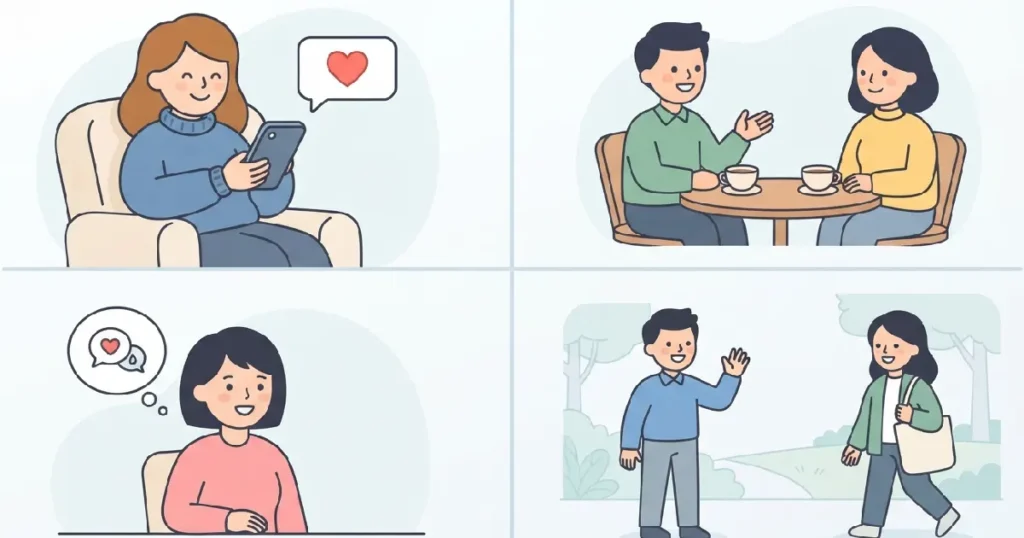
This year’s World Happiness Report took a hard look at how digital life interacts with well-being across dozens of countries. The finding was uncomfortable but consistent: heavy daily social media use correlates with higher loneliness, not lower, even among people who describe themselves as “very connected.”
The Biological Difference Between Digital Closeness and Real Safety
Think of it this way. Loneliness works like a phone battery that shows a full charge on the screen but won’t actually hold power once you unplug it. Scrolling through likes and comments lights up the display. It does not store real energy in the battery.
I call this gap relational metabolism, the rate at which your brain converts face-to-face eye contact and shared vulnerability into lasting emotional stability. A video call metabolizes some of this. A liked photo metabolizes almost none of it. Your brain simply needs more raw material than a screen can supply.
How Algorithmic Overstimulation Hijacks Your Peace of Mind
Every platform on your phone is engineered around variable rewards, the same unpredictable payout structure that keeps people pulling a slot machine lever. Your brain releases small dopamine hits waiting to see what the next scroll brings.
That unpredictability keeps you glued to the screen. It also keeps your stress hormones mildly elevated for hours at a time, which is one reason you can spend an evening “connecting” online and still feel wired, anxious, and empty by bedtime.
The 88-Year Lesson: What the World’s Longest Study on Joy Actually Reveals
Why Your Social Circle Predicts Health Better Than Cholesterol
Here’s a finding that tends to stop people mid-scroll. Longitudinal data from the Harvard Study shows that a person’s relationship satisfaction at age 50 predicted their physical health at age 80 more accurately than their cholesterol levels did at midlife.
Read that again. Your emotional world is not separate from your body. It shapes your cardiovascular system, your immune function, and how well your brain ages, according to findings summarized by the American Psychological Association on the physical toll of isolation. Treat your close relationships as a form of preventive medicine, not a nice extra once the “real” priorities are handled.
High-Conflict Success vs. Low-Stress Connection: Choosing Longevity
The study also found something that complicates the fairy tale version of relationships. Warm, securely attached connections, even ones with normal friction and disagreement, predicted better outcomes than isolated professional success ever did.
You do not need a conflict-free relationship to be happy. You need a felt sense that someone has your back when things go wrong. That security, not the absence of arguments, is what your nervous system is actually tracking.
The Overly Local Trust Trap: Why Shrinking Your Circle Can Backfire

Here is the part that challenges a lot of popular advice. A recent multi-country analysis found that overly strict, exclusive local bonding, meaning trusting only your immediate family or a very tight inner circle, was linked to higher prejudice and lower collective well-being across communities.
In plain terms: a social bubble that’s too small and too similar to you can start working against you. Psychologists distinguish between two kinds of social capital. Bonding capital is the tight trust you share with people just like you. Bridging capital is the mental health boost that comes from talking to strangers, coworkers outside your usual crowd, or people who see the world differently than you do.
Maya, a 32-year-old graphic designer I worked with, had done everything the internet told her to do after a painful breakup. She cut off mutual friends, muted extended family group chats, and kept her world down to two trusted people. She felt protected. She also started feeling flat, like color had been drained out of her days.
We didn’t undo her boundaries. We added bridging back in. Maya joined a weekly pottery class full of strangers, said yes to a coworker’s invitation she would normally decline, and started chatting with the regular at her coffee shop. Within two months, she described feeling “less braced,” like she could finally exhale.
Protecting your peace does not have to mean shrinking your world down to almost nothing. Sometimes it means widening it on your own terms.
Building Your Social Fitness: A Practical Guide to Emotional Strength
Moving Beyond the Micro-Bubble: Why You Need Diverse Social Networks
A tiny, insular circle feels safe in the short term. Over years, it can quietly limit how resilient and satisfied you actually become. Diverse, loosely connected relationships act like cross-training for your emotional system, stretching your capacity for empathy, patience, and perspective in ways a small, familiar group never will.
The Power of Micro-Awe: Simple Tools to Calm an Anxious Mind
Neuroscience research points to something remarkable about awe, that specific feeling of being in the presence of something vast, like a mountain range, live music, or a genuinely moving piece of art. Awe quiets a brain network called the default mode network, the circuitry active when you’re stuck in self-referential thought, replaying your inbox or rehearsing an argument in your head.
Researchers at institutions including the Greater Good Science Center at UC Berkeley have found that even brief awe experiences reduce self-focus and increase feelings of connection to others. You do not need to book a flight to access this. You need what I call micro-awe engineering: deliberately hunting for small, focus-shifting beauty inside an ordinary day.
That might mean noticing the exact pattern of light on your ceiling before you get out of bed. It might mean stopping for ninety seconds to actually watch a bird instead of glancing past it. Small doses, repeated often, retrain your attention away from anxious self-monitoring and back toward the world outside your own head.
Your Social Fitness Workout Plan: What to Do Starting This Week

Knowing the research is one thing. Building the muscle is another. Consider trying this simple weekly structure, borrowed loosely from how the Harvard Study describes ongoing relationship maintenance.
The 60-Second Check-In. Pick three people you care about and send one specific, personal text daily, not a generic “hey,” but something like “this song made me think of you.” It takes a minute and it keeps a relationship’s metabolism active between bigger visits.
The Monthly Face-Time Rule. Schedule one in-person, phone-down meetup a month with someone outside your household. Real presence, even for an hour, does more for your nervous system than weeks of texting.
One Vulnerable Sentence. Once a week, tell someone one true thing you’re actually feeling instead of your default “I’m fine.” Shared vulnerability is the raw fuel of relational metabolism. Without it, closeness stalls.
The Stranger Rule. Once a week, have one small, unplanned conversation with someone outside your usual circle, a neighbor, a barista, someone at a class. This is bridging capital in action, and it costs nothing but a moment of initiative.
A useful question to ask yourself tonight: when was the last time you gave someone your full, undistracted attention for ten straight minutes? If the answer surprises you, that’s information, not a failure.
The Real Answer to What Is the Key to Happiness
You started this piece the way you started tonight, maybe scrolling, maybe restless, maybe quietly wondering why a full life can still feel this hollow. That hollow feeling was never a personal defect. It was a battery that looked charged on the screen but was never actually storing power.
The key to happiness was never hidden in a bigger salary or a fuller inbox. It was in the muscle you didn’t know you were supposed to train: showing up, staying in contact, letting people see you, and letting small moments of wonder interrupt the noise in your head.
You now have language for what was missing, and a plan for building it back. That is not a small thing to walk away with.
Real connection isn’t something that happens to you. It’s something you build, one honest conversation at a time.
My Closing Remarks
Here’s my honest take after years of sitting across from people who “had it all” and still felt empty: happiness was never about arriving somewhere. It’s about who’s still standing next to you when you get there, and whether you actually let them see you. Stop waiting to feel ready for closeness. Reach out messily, today, before the ache convinces you that you’re the only one who feels it.
More Related Stories for You
Curious how well the people around you actually know you? Take a closer look at who really knows you best and what that says about the strength of your relationships.
About The Author