
 Sara Carmen
Your wedding is one day, but closing the legal paperwork loop is what turns that day into a marriage the government can prove.
Key Points
- How to Marry Someone becomes simple when you treat it as one closed loop: authorization, lawful consent, and official recording.
- A marriage license gives permission to marry, while a marriage certificate proves that the legal process was completed.
- Costs, waiting periods, witnesses, officiant rules, and online wedding laws depend on the place where the ceremony legally occurs.
Contents
Table of Contents
We tend to picture marriage as one glowing moment: two people, a promise, and a room that goes quiet for the vows. Yet the weeks around that moment can feel like an administrative fog. You are tracking guests, money, family feelings, and a document that may expire before the date arrives.
Someone might think a courthouse appointment automatically makes the marriage official. But what they do not see is the unsigned or unreturned record still sitting in a folder.
Someone might think a close friend can become an officiant with one online click. But what they do not see is a local registration rule that applies before the ceremony.
Quick answer: To marry someone legally in most U.S. jurisdictions, obtain valid legal authorization before the wedding, complete the form of ceremony or consent your state accepts, and make sure the completed record reaches the issuing office. Your certificate is proof that this loop closed. Local rules control every detail.
The U.S. Census Bureau reported that the estimated median age at first marriage reached 30.8 for men and 28.4 for women in 2025. You may be approaching marriage with more life experience and more practical questions than earlier generations had. That care is healthy, not unromantic.
Wedding planning also strains prospective memory, your ability to remember an action that needs to happen later. Under high cognitive load, meaning the amount of information held in your working memory, “return the license” can lose to a hundred louder tasks. The safest response is not more willpower. It is a clear sequence.
How to Marry Someone Legally: Think in a Closed Loop
A legal marriage is not merely a ceremony. It is a process that begins with state-approved authority and ends with an official record. Think of it as a paper bridge: the vows express your commitment, while each legal step carries that commitment into taxes, insurance, inheritance, and public records.
In most states, the practical sequence is license, ceremony, return, certificate. Yet this is not a universal three-step statute. Alabama uses a notarized marriage certificate form recorded by a probate court and does not require a ceremony. Colorado and a few other jurisdictions permit forms of self-solemnization, which means you marry without a separate officiant.
That distinction matters. The real formula is legal authority + legally accepted consent + official recording. The office, form, and ceremony rules change by jurisdiction, but the closed loop does not.
Marriage License vs. Marriage Certificate
A marriage license is authorization to marry before the ceremony. A marriage certificate is the government record showing that the marriage was completed and recorded. In some counties, the same sheet becomes the certificate after the officiant completes it and the clerk records it.
The federal guide to marriage records makes the distinction plain: the license allows the marriage, while the certificate proves it. You will often need a certified copy of that certificate for a name change, benefits, immigration, or insurance.
A wedding can feel real and still be legally unfinished.
1. Get a Marriage License Before the Wedding Date
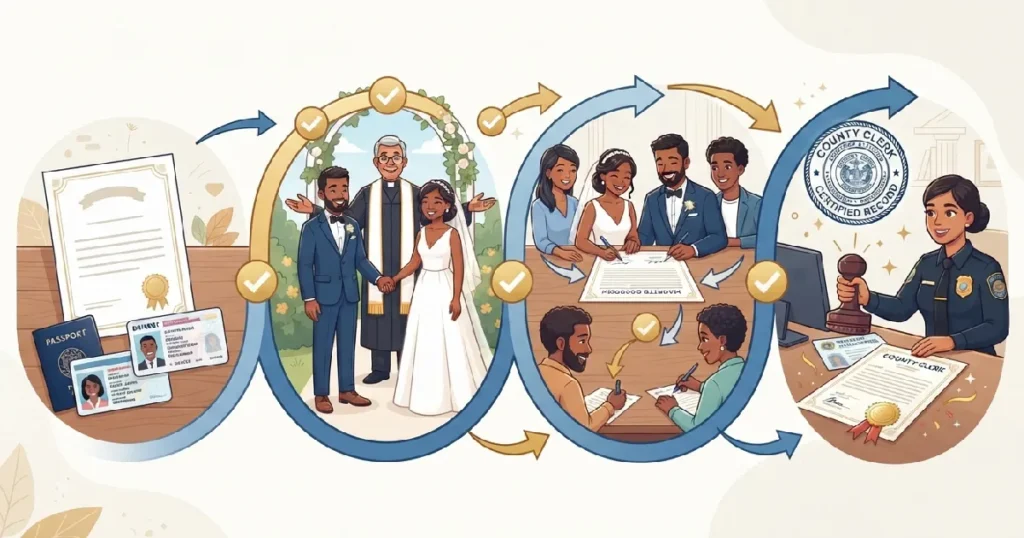
Start with the office that serves the place where the wedding will legally occur. It may be called the county clerk, recorder, probate court, vital records office, or city clerk. Many offices offer online applications, but an online form may only reserve an appointment rather than issue the license.
Expect some mix of these requirements:
- Government-issued photo identification or a passport
- Social Security numbers if you have them
- Birth information and parents’ legal names
- The date and legal end of any prior marriage
- A certified divorce decree or death certificate when requested
- A fee paid by an accepted method
Many jurisdictions ask both applicants to appear for identity verification. Others use remote identity checks. No U.S. state currently requires the old premarital blood test that still appears in outdated wedding advice.
Apply inside the license window. Too early and it may expire. Too late and a waiting period may push the ceremony past your planned date. The part most couples miss comes after they compare the fee.
State Marriage License Costs, Waiting Periods, and Expiration
This table is a planning snapshot as of August 12, 2026. County-set fees and waiver rules can change, so confirm the amount, payment method, ceremony location, and return deadline with the issuing office.
| State | Typical license fee | Wait before ceremony | License validity |
|---|---|---|---|
| Arizona | About $83 to $98 | None | 1 year |
| California | County-set, often $60 to $112 | None | 90 days |
| Colorado | $30 | None | 35 days |
| Florida | About $86 | 3 days for residents, often waivable | 60 days |
| Georgia | County-set, often $16 to $76 | None | Usually no expiration |
| Illinois | About $30 to $75 | Until the next day | 60 days |
| Massachusetts | About $20 to $50 | 3 days | 60 days |
| Minnesota | $115, reduced with approved education | None | 6 months |
| Nevada | About $77 to $102 | None | 1 year |
| New York | $35 in NYC, $40 elsewhere | 24 hours | 60 days |
| Ohio | County-set, often $40 to $75 | None | 60 days |
| Pennsylvania | County-set, often $45 to $100 | 3 days | 60 days |
| Tennessee | County-set, often $40 to $100 | None | 30 days |
| Texas | Often about $81, with local additions | 72 hours, exceptions apply | 90 days |
| Washington | County-set, often $70 to $170 | 3 days | 60 days |
If you are remarrying, do not rely on a photocopy or an online docket screenshot. Ask whether the clerk wants a certified final decree and whether your state imposes a post-divorce waiting period. If a foreign document is involved, ask about a certified translation or apostille rather than ordering either one blindly.
2. Choose a Legal Wedding Officiant, Not Just a Meaningful One
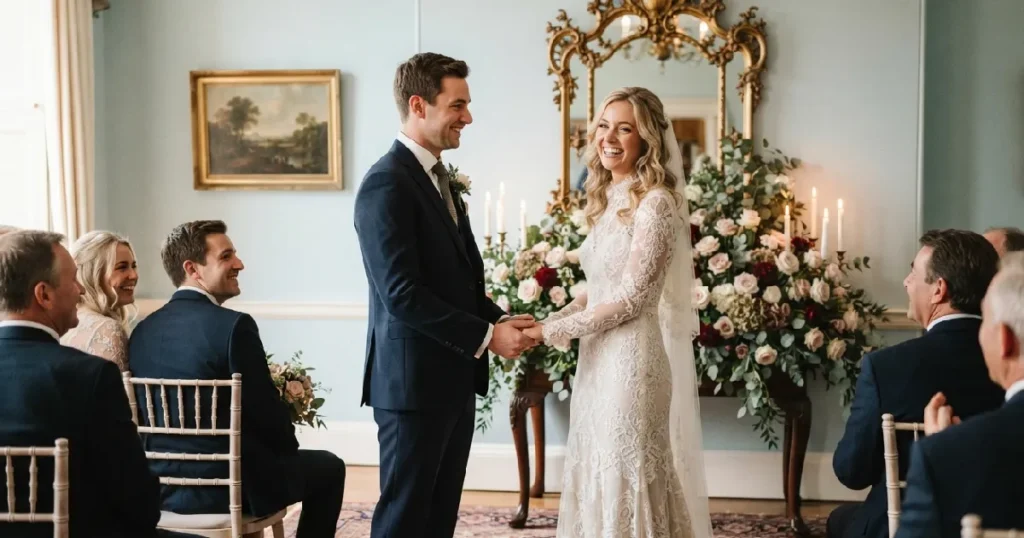
Judges, magistrates, authorized civil celebrants, and recognized clergy can often perform a legal wedding. A friend or relative may also qualify through ordination or a one-day civil authorization. The exact category depends on the ceremony state.
Online ordination is widely used, but it is not a national permission slip. New York City requires officiant registration. Nevada and Minnesota have credential or registration procedures. Virginia courts may reject ordination obtained only online. Tennessee excludes people whose authority rests on online ordination alone.
Before the wedding, ask the issuing clerk one precise question: “Is this named officiant authorized for this ceremony at this location, and is advance registration required?” Record the staff member’s name and the date. This five-minute check is stronger than a provider’s general claim that its credentials work everywhere.
Your officiant also needs the correct license, witness details, ceremony date, and return instructions. Then comes the signature step where small errors become expensive delays.
3. Complete the Legal Wedding Ceremony and Required Consent
A ceremony can be brief. What matters is that it contains the elements your jurisdiction requires, usually your voluntary consent, an authorized solemnizer when required, and the required witnesses. Solemnization is the legal act that turns your expressed consent into a marriage under state law.
Witness rules vary from none to two. Do not recruit witnesses based on another state’s rule. Check age limits, whether they need identification, and whether they sign the license.
Consider Maya and Luis, a composite couple planning a small lakeside wedding. Maya’s cousin became ordained online and wrote a personal ceremony. Three weeks before the date, Luis called the county and learned that the cousin needed local registration first. The cousin filed the credentials, and the couple moved their license appointment into the valid window.
Two adult witnesses signed after the vows. Their officiant returned the form by tracked mail the next morning. The romance did not shrink because they checked the law. Their nervous system settled because uncertainty had become a plan.
Can You Get Married Online Through Utah County?
Yes, a remote marriage can be valid when it follows the law of the issuing jurisdiction. Under Utah County’s official remote ceremony rules, you obtain a Utah County license, appear by live video with an authorized officiant and two adult witnesses, and complete the digital filing. The officiant hosts the ceremony from Utah, while the couple and witnesses may join from different locations.
A properly completed Utah marriage is generally recognized across the United States under the place-of-celebration principle. International acceptance is a separate matter. If immigration is involved and you were not physically together during the ceremony, USCIS policy on virtual marriages may require proof that you met and consummated the marriage afterward. Get case-specific legal advice before using a remote wedding for a visa or foreign registration.
Legal Marriage Age Requirements Are Still Changing
Marriage age is controlled by state law, not one federal rule. As of the publication date, 16 states and Washington, D.C. set 18 as the floor with no exceptions. Oklahoma has enacted the same rule, effective November 1, 2026. Other states allow narrow paths for an emancipated minor or require parental and judicial approval. The current state marriage-age summary shows why an old list is unsafe.
If either partner is under 18, pause the plan and speak directly with the clerk or a family-law attorney. Consent must be free of coercion, meaning pressure or threats that overpower a person’s voluntary choice.
4. Return the Signed Marriage License and Verify Recording
After the ceremony, the officiant commonly returns the completed license, though some jurisdictions allow or require the couple to do it. Deadlines can be short. Use the exact method on the form, make a copy, and choose tracking if you mail it.
A late return does not automatically void every otherwise lawful marriage. State “saving statutes” may protect couples who believed the officiant had authority or completed the filing. Still, a missing record can block certified copies and create a proof problem when you apply for insurance, immigration, or survivor rights.
Use a simple verification sequence:
- Photograph or scan the completed document before it leaves your hands.
- Confirm delivery to the issuing office.
- Ask when the record will be indexed.
- Order at least two certified copies if you expect name, benefit, or immigration filings.
Common errors include an expired license, a ceremony during the waiting period, the wrong ceremony county, missing witness information, an unregistered officiant, and an unsigned field. A religious or symbolic ceremony alone does not create a civil marriage unless the local legal requirements are also met.
5. Finish the Post-Marriage Legal Checklist
Once the certificate is available, treat the next month as a short administrative season. A name change is optional. If you choose one, begin with Social Security, then update your driver’s license or state ID, passport, employer payroll, banks, and other accounts according to each agency’s process.
Marriage is a qualifying life event. Federal Special Enrollment Period guidance says Marketplace plans generally allow 60 days after marriage, while job-based plans provide at least 30 days. Put the deadline on both calendars even if you think one partner’s current coverage will remain unchanged.
Review taxes rather than assuming marriage always creates a bonus. If you are married on December 31, the IRS generally treats you as married for that full tax year. The IRS tax update sets the 2026 standard deduction at $32,200 for married couples filing jointly and $16,100 for single filers or married people filing separately. Run both permitted married filing options or ask a tax professional.
Also review beneficiaries on life insurance and retirement accounts, wills, medical authorizations, emergency contacts, leases, and any existing prenuptial agreement. These records do not all update simply because a clerk recorded your marriage.
Your 24-Hour Marriage License Action Plan

The Clerk Call. One place to start is the government office for the ceremony location. Ask about identification, fee, waiting period, expiration, witnesses, officiant status, return deadline, and certified copies. For example: “We plan to marry in Travis County on October 10. What needs to be completed before that date?”
The Paperwork Buddy. Assign one person to own the legal timeline and another to verify it. You might complete the application while your partner checks the officiant’s registration and adds the filing deadline to both calendars. Shared responsibility lowers the chance that prospective memory fails under wedding stress.
The 48-Hour Audit. Two days after the ceremony, check that every signature is present and the record is on its way to the clerk. A useful question to ask each other is, “What proof do we have that the loop is closing?” This is not distrust. It is care made visible.
Marriage Paperwork Is Not the Opposite of Romance
Return to that glowing moment you pictured at the start. The vows can remain intimate, joyful, and entirely yours. The forms simply carry those vows across the paper bridge into the legal life you are building together.
You do not need to memorize fifty sets of marriage laws. You only need to identify the jurisdiction, confirm its current rules, and close the record. That is how uncertainty becomes a shared plan.
My Closing Remarks
I have seen loving couples treat paperwork as if checking it might cheapen the promise. I believe the opposite. Romance without follow-through can leave one partner carrying every invisible task, and that imbalance starts long before a marriage certificate goes missing. Make this your first act of marital teamwork: name the task, divide it fairly, and verify it together. The bold truth is that care is not only what you feel at the altar. Care is what you finish afterward. Make the love official.
More Related Stories for You
- If wedding planning is revealing control, blame, or emotional pressure, learn how narcissistic personality traits can appear in close relationships.
About The Author